Published on: 2026-08-05
Updated on: 2026-08-05
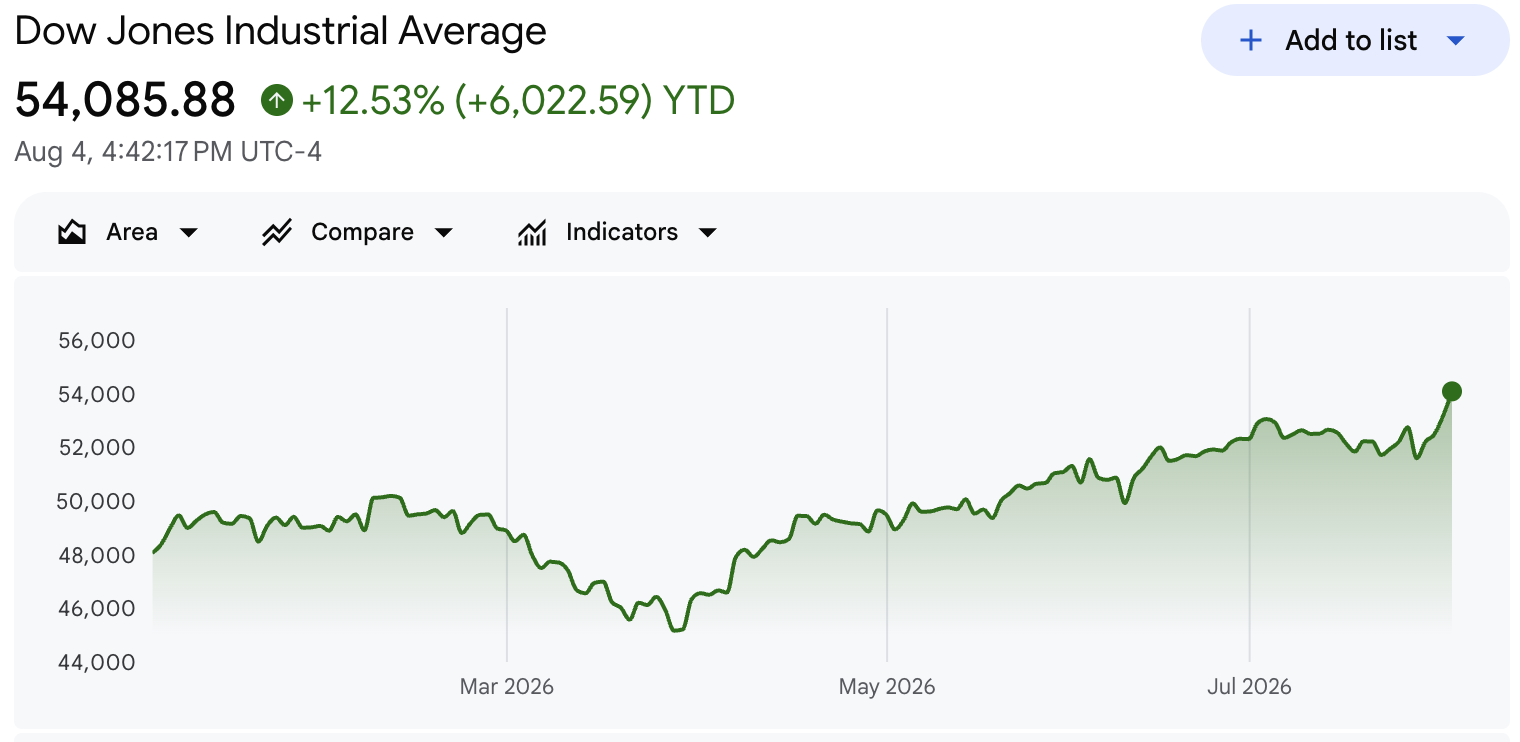
The Dow Jones Industrial Average closed above 54,000 for the first time on 4 August, rising 907.47 points to a record 54,085.88. Caterpillar contributed about 276 points after its shares gained $46.51, while Goldman Sachs, IBM and Cisco lifted the four-stock contribution above half the advance.
Falling oil and lower Treasury yields could not be assigned discrete point contributions, but they supported the wider rally by easing concerns about inflation, financing costs and corporate margins.

The Dow closed at a record 54,085.88 on 4 August, gaining 907.47 points or 1.71% for its first finish above 54,000.
Caterpillar contributed approximately 276 points after gaining $46.51, showing how price weighting amplified its earnings reaction.
Caterpillar, Goldman Sachs, IBM and Cisco produced an estimated 518 points, or about 57% of the advance.
Palantir added no Dow points, while Nvidia contributed approximately 31 points as both a semiconductor stock and a Dow component.
Falling oil and lower Treasury yields supported the wider advance, alongside strong earnings and a sharp rebound in technology shares.
| Market measure | 4 August result |
|---|---|
| Dow close | 54,085.88 |
| Dow daily change | +907.47 points, or +1.71% |
| S&P 500 close | 7,736.52 (+1.79%) |
| Nasdaq Composite close | 26,584.99 (+2.59%) |
| Brent crude | About $79.36, down more than 5% |
| US 10-year Treasury yield | About 4.62%, down from about 4.68% |
The Dow and the S&P 500 both set closing records. The Nasdaq gained most in percentage terms but finished roughly 1.9% below its 2 June peak.
Because the Dow is price weighted, index points follow dollar moves rather than company size. A $1 change in any component shifted the index by about 5.94 points, and that figure explains most of the day’s arithmetic.
| Dow component | Share-price move | Estimated contribution | Main explanation |
|---|---|---|---|
| Caterpillar | +$46.51 | About +276 points | Earnings beat and stronger outlook |
| Goldman Sachs | +$25.92 | About +154 points | Financial-sector and broader market advance |
| IBM | +$8.84 | About +53 points | Technology and enterprise-stock rebound |
| Cisco | +$5.88 | About +35 points | Technology and networking-stock rebound |
| Nvidia | About +$5.30 | About +31 points | Semiconductor and AI-sector rebound |
| Remaining 25 components | Net residual | About +359 points | Wider advance, partly offset by decliners |
Of the four largest contributors, Caterpillar had the clearest company-specific catalyst that morning. Goldman Sachs, IBM and Cisco largely participated in broader sector and market gains.
IBM rose by a larger percentage than Goldman Sachs yet delivered roughly a third of the points, because Goldman Sachs trades at a far higher share price. Reading the Dow as a gauge of market performance is largely reading dollar movement.
Caterpillar closed at $876.54, up 5.60%, after reporting revenue of $20.54 billion, a rise of 24% and its first quarter above $20 billion. Adjusted earnings of $8.17 per share exceeded the $6.22 consensus estimate reported by FactSet.
Growth was broad rather than tied to one theme. Construction Industries revenue rose 35%, the largest absolute increase of the three principal segments, while Power and Energy rose 17% and Resource Industries 20%. Power generation sales climbed 29%, so data centre investment supported the quarter without driving it.
What is more important for the index is the gap between the company result and the point effect. A 5.60% gain is strong, but hundreds of stocks moved more. Caterpillar was decisive because that gain sat on a share price near $877, close to a tenth of the combined share price of all 30 members.
Palantir surged 29.5% after reporting revenue growth of 93% and raising its outlook. Its earnings strengthened sentiment toward AI and technology stocks, but it contributed nothing to the Dow, because it is not in the index.
The semiconductor index rose 6.6% and drove the Nasdaq sharply higher. Most of that sector rally came from outside the Dow, although Nvidia’s gain contributed approximately 31 points to the 30-stock average.
The session split in two: companies that generated Dow points, and companies that generated the mood in which investors were willing to buy.
Brent crude fell more than 5% to about $79.36 as traders priced in a possible arrangement reopening the Strait of Hormuz, and the 10-year Treasury yield eased to roughly 4.62% from about 4.68%.
| Transmission channel | Potential market effect |
|---|---|
| Inflation expectations | Lower energy prices can reduce near-term inflation pressure |
| Treasury yields | Reduced inflation concern can support bonds, although yields respond to several factors |
| Corporate costs | Lower fuel and transport costs can support margins in energy-intensive sectors |
These channels are directional rather than automatic. Yields also move on growth expectations, central bank pricing and demand for safe assets, so cheaper crude and lower yields arriving together is not proof of a causal chain.
What can be said is that the oil decline eased one source of inflation and margin pressure while lower yields supported valuations, a tailwind broader than Caterpillar’s earnings.
Caterpillar, Goldman Sachs, IBM and Cisco contributed an estimated 518 points, about 57% of the 907.47 point advance. The remaining 26 components added a net 390 points, a figure that already absorbs the decliners, which is a meaningful concentration, and it deserves stating plainly rather than burying under the phrase “broad based”.
The rally still reached well beyond those names. Both the equal-weight S&P 500 and the S&P 500 excluding technology finished higher, though neither matched the market capitalisation weighted index, and the Russell 2000 rose around 1.85%. Energy lagged as crude fell, while utilities also trailed the wider advance.
The two indices began the session from different starting points. The Nasdaq was still recovering from a steep semiconductor correction, while the Dow had set a record the previous day and then received a dollar gain that counted for far more in a price-weighted index than it would in a market capitalisation weighted one.
The oil decline reflected optimism about a possible agreement rather than a completed reopening of the Strait of Hormuz. If talks stall, crude could recover part of its decline, renewing inflation concerns and potentially reversing some of the relief in Treasury yields.
Strong results early in the reporting season may also have raised the market’s expectations for companies still due to report. Price weighting also cuts both ways: the components that delivered hundreds of points can remove them just as fast if sentiment toward industrial or financial earnings turns.
Caterpillar supplied the largest single block of Dow points, and price weighting amplified its earnings reaction. The wider advance in technology, the equal-weight S&P 500, and non-technology stocks shows this was not a one-company event, though four high-priced members still produced more than half the headline gain. Participation was broad; the point total was not.
The Dow closed at 54,085.88 on 4 August 2026, its first close above 54,000 and its second consecutive record.
Caterpillar, with an estimated 276 points on a share price gain of $46.51.
No. Palantir rose 29.5% and lifted technology sentiment, but it is not a Dow component and added no points to the index.
The Dow is price weighted, so the highest-priced components carry the most influence. Caterpillar closed at $876.54, close to a tenth of the combined share price of all 30 members.
Methodology: Contribution estimates apply the session multiplier of approximately 5.94 index points for every $1 of share price movement to close-to-close price changes. Goldman Sachs, for example, rose $25.92, or 2.52%, from $1,027.06 to $1,052.98, giving an estimated contribution of about 154 points. Because the conversion factor is rounded, individual estimates and their total are approximate, and the rows above may not sum exactly to 907.47.