Published on: 2026-04-09
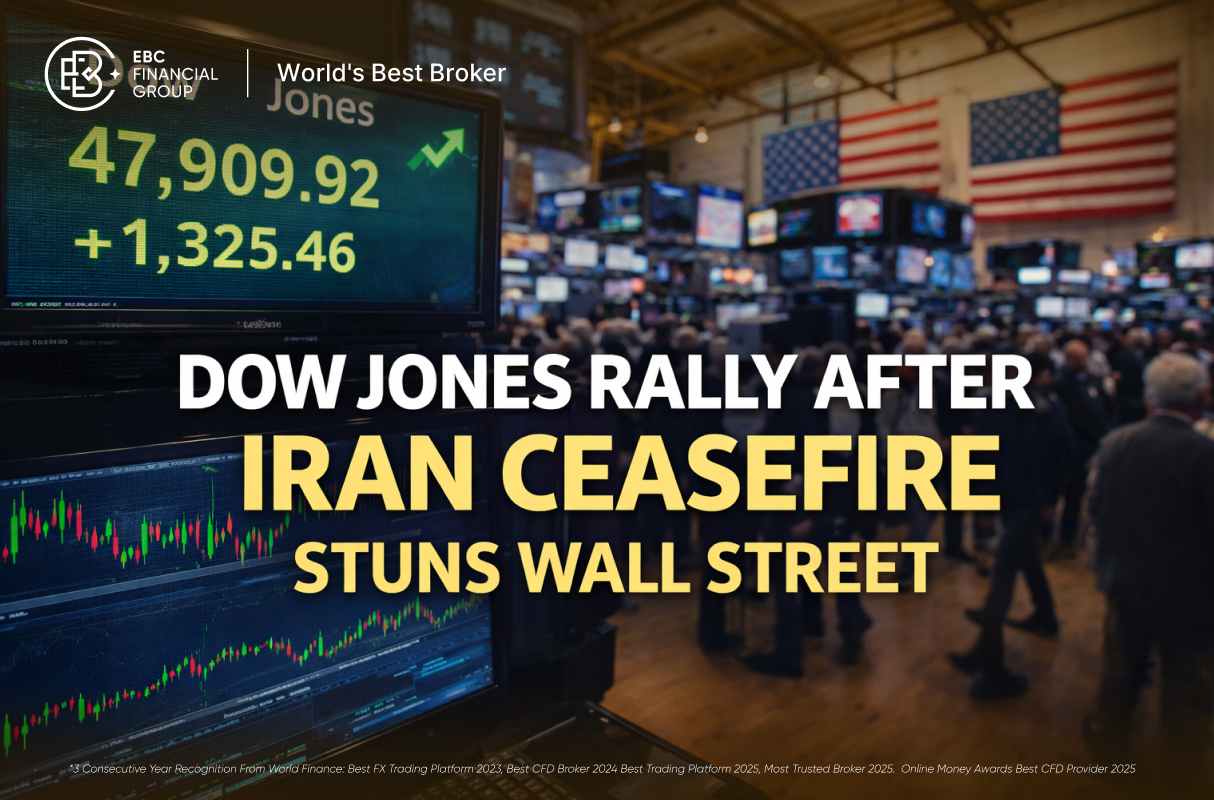
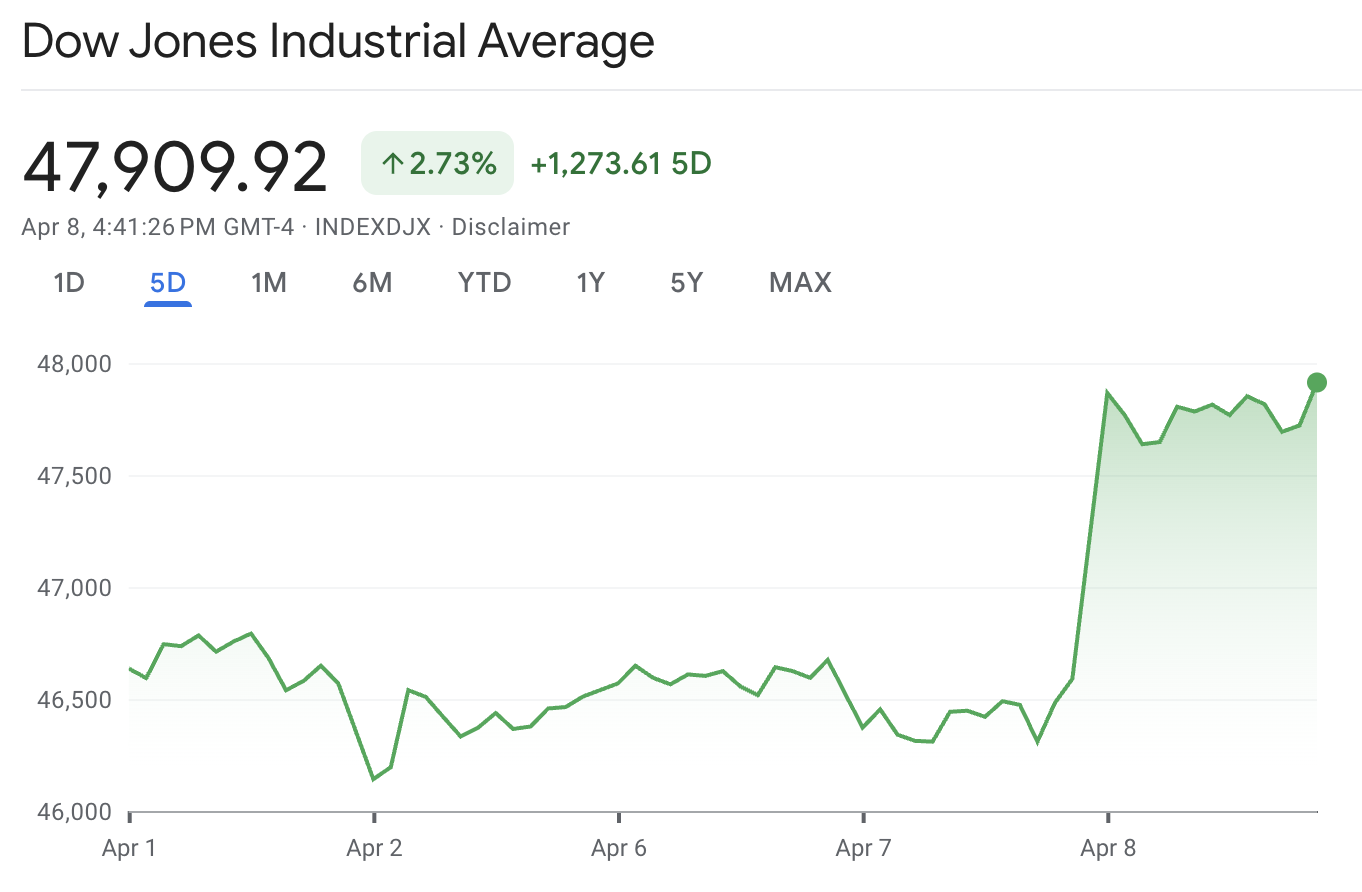
The Dow Jones Industrial Average ceasefire rally sent the index up 1,325.46 points, or 2.8%, to 47,909.92 on April 8, after a two-week US-Iran ceasefire eased fears of a prolonged oil shock.
The S&P 500 rose 2.5%, the Nasdaq gained 2.8%, and the Russell 2000 climbed 3.0%, showing investors moved beyond a narrow mega-cap bounce.
WTI fell 16.4% to $94.41, and Brent dropped 13.3% to $94.75, sharply lowering near-term inflation pressure and lifting travel, consumer, and industrial shares.
Fed minutes released the same day said upside risks to inflation remained elevated, and many officials warned that persistently high oil prices could still justify rate increases.
The market is now trading on one question: whether the Iran ceasefire becomes durable enough to keep oil falling and turn this relief move into a more durable stock market rally.
The Dow Jones ceasefire rally tore through Wall Street on April 8, pushing the blue-chip index up 1,325.46 points to 47,909.92 as traders rushed to reprice energy risk, inflation pressure, and the odds of a wider Middle East shock. The move was fast, broad, and far stronger than a routine rebound in the Dow Jones today.
The White House said Iran agreed to a ceasefire and to reopen the Strait of Hormuz while broader talks continue. Markets responded immediately, but the truce remains fragile, with later reporting pointing to unresolved shipping and regional security risks.
That tension matters because Wednesday’s rally was driven as much by falling oil as by any durable peace dividend.
President Donald Trump announced a two-week ceasefire with Iran about 90 minutes before his deadline for Tehran to reopen the Strait of Hormuz. The White House said Iran had agreed to reopen the waterway as broader talks continue.
But by Wednesday, the truce already looked fragile, with conflicting accounts over shipping access, continued fighting tied to Lebanon, and no independent confirmation of a sustained recovery in tanker traffic.
This was a textbook relief rally. For weeks, investors had been forced to price in the risk that fighting in the Middle East would keep oil elevated, tighten financial conditions, and prolong inflation. Once the ceasefire headline hit, that risk premium began to unwind in a single session.
The result was a full reset across major benchmarks:
Dow Jones Industrial Average: +1,325.46
S&P 500: +165.96
Nasdaq Composite: +617.15
Russell 2000: +75.51
WTI crude: -16.4%
Brent crude: -13.3%
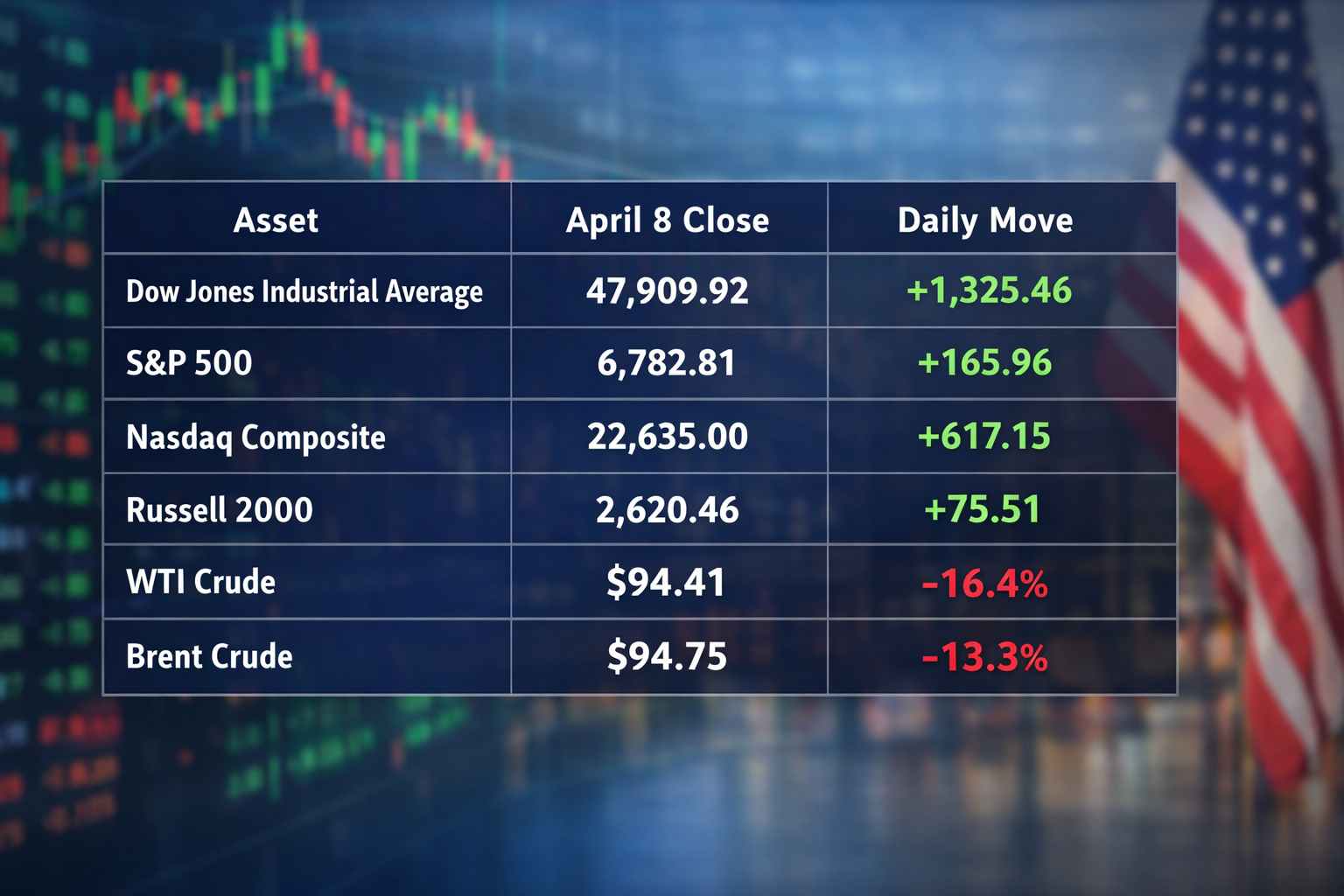
That mix tells the story clearly. Smaller companies rose even more than the Dow and S&P 500, which suggests investors were not only buying quality defensives.
They were also rotating back into cyclical and domestic names that had been hit by higher fuel costs, tighter financing conditions, and weaker confidence.
The gains were not just a Wall Street story, as Asian equities also posted strong overnight gains. South Korea’s Kospi surged 6.9%, Japan’s Nikkei 225 jumped 5.4%, Germany’s DAX rose 5.1%, and France’s CAC 40 gained 4.5% as investors priced in a lower risk of prolonged energy disruption.
A simple sector view shows the rotation:
| Sector move on April 8 | Direction | What it signaled |
|---|---|---|
| Industrials | Up about 3.5% | Growth confidence returned |
| Consumer discretionary | Up about 3.2% | Lower fuel costs support demand |
| Technology | Up about 2.9% | Yields and risk sentiment helped |
| Energy | Down about 5% | Oil risk premium unwound |
Before the ceasefire, traders had sharply reduced expectations for Fed easing as war-driven oil prices raised the risk of renewed inflation. After the ceasefire announcement, that changed quickly.
Market-implied odds of at least one Fed rate cut by December 2026 jumped to roughly 43% to 44% from about 14%, while the probability of no cut fell from 77.4% to 53.6%.
Treasury yields also dropped, with the 2-year near 3.75% and the 10-year near 4.25%.
The Cboe Volatility Index (VIX) fell back to around 20, near its historic average. This looks like a de-risking unwind consistent with a relief rally, but it does not mean risk is gone.
Seasoned traders know that relief rallies can be sharp and short. This one has specific caveats worth watching out for.
Iran’s state media signaled the ceasefire was limited, and independent shipping analysts said they had not yet seen a meaningful pickup in traffic through the Strait of Hormuz. Windward said ships still had to coordinate passage with Iranian authorities, underscoring the fragility of the recovery in oil flows.
Stock prices are still below pre-war levels, and oil prices remain higher because the threat of renewed conflict persists.
Though stocks soared on the two-week ceasefire, there is no guarantee oil will stay lower. Shipping and supply chains are taking time to recover, and the question is whether improved headlines translate into durable, real-world normalisation of supply flows.
The prices-paid components for both the ISM Manufacturing and Services PMIs in March reached their highest levels since 2022. Service prices posted their largest one-month increase in more than 13 years.
The Dow Jones ceasefire rally is a meaningful data point, but it is one chapter, not the full story. Here are the near-term triggers to monitor:
Strait of Hormuz tanker flow: Watch whether tanker movement through the Strait of Hormuz improves in measurable terms.
March CPI data: Whether the March CPI report on Friday, April 10, 2026 (Eastern Time) shows that the oil shock is feeding into headline inflation.
Federal Reserve language: The Fed’s language will matter too, because the March minutes made clear officials still see both inflation and growth risks from the Middle East conflict.
Ceasefire durability: The ceasefire represents a temporary pause rather than a lasting resolution. Ongoing tensions, including continued military activity in Lebanon and unresolved disagreements over trade routes and nuclear policy, continue to weigh on the outlook.
Oil price floor: Crude settling sustainably below $90 would be a strong reinforcement of the rate-cut narrative.
A two-week US-Iran ceasefire sharply reduced near-term fears of an energy shock. Oil plunged, investors unwound defensive positioning, and money rotated back into stocks, especially travel, tech, industrials, and small caps.
Oil had become the main channel for higher inflation and tighter financial conditions. When crude fell below $95, investors quickly repriced corporate cost pressure and the broader economic outlook.
Not directly. Fed minutes showed concern that persistently high energy prices could keep inflation elevated and even justify rate increases. The rally came because the ceasefire reduced that oil risk, not because the Fed turned dovish.
Yes, but only if the ceasefire holds and oil stays contained. If crude rebounds or regional tensions intensify again, Wednesday’s relief move could fade just as quickly.
The Dow Jones ceasefire rally was real, broad, and justified by a sharp unwind in energy risk. A 1,325-point jump in the Dow, a 16.4% drop in WTI, and strong gains across the S&P 500, Nasdaq, and Russell 2000 showed how aggressively investors had been positioned for a worse geopolitical outcome.
Still, this is a relief rally, not a final verdict. The ceasefire is temporary, the Fed remains wary of inflation, and oil is still well above pre-conflict levels.
For Wall Street, the next move depends less on the size of Wednesday’s bounce and more on whether de-escalation turns into something durable.
Disclaimer: This material is for general information purposes only and is not intended as (and should not be considered to be) financial, investment or other advice on which reliance should be placed. No opinion given in the material constitutes a recommendation by EBC or the author that any particular investment, security, transaction or investment strategy is suitable for any specific person.