Published on: 2025-12-09
Updated on: 2025-12-09
Black Tuesday didn't come out of nowhere. For most of the 1920s, Wall Street looked unstoppable: the Dow climbed roughly sixfold from 63 in 1921 to 381 by early September 1929, fuelled by easy credit, margin trading and a belief that a "new era" of permanent prosperity had arrived.
Seven weeks later, that dream was over. On Tuesday, 29 October 1929, panic selling drove trading to record volume, wiped out billions of dollars in paper wealth, and marked the day that would be remembered as Black Tuesday, the symbol of the Wall Street Crash that helped usher in the Great Depression.
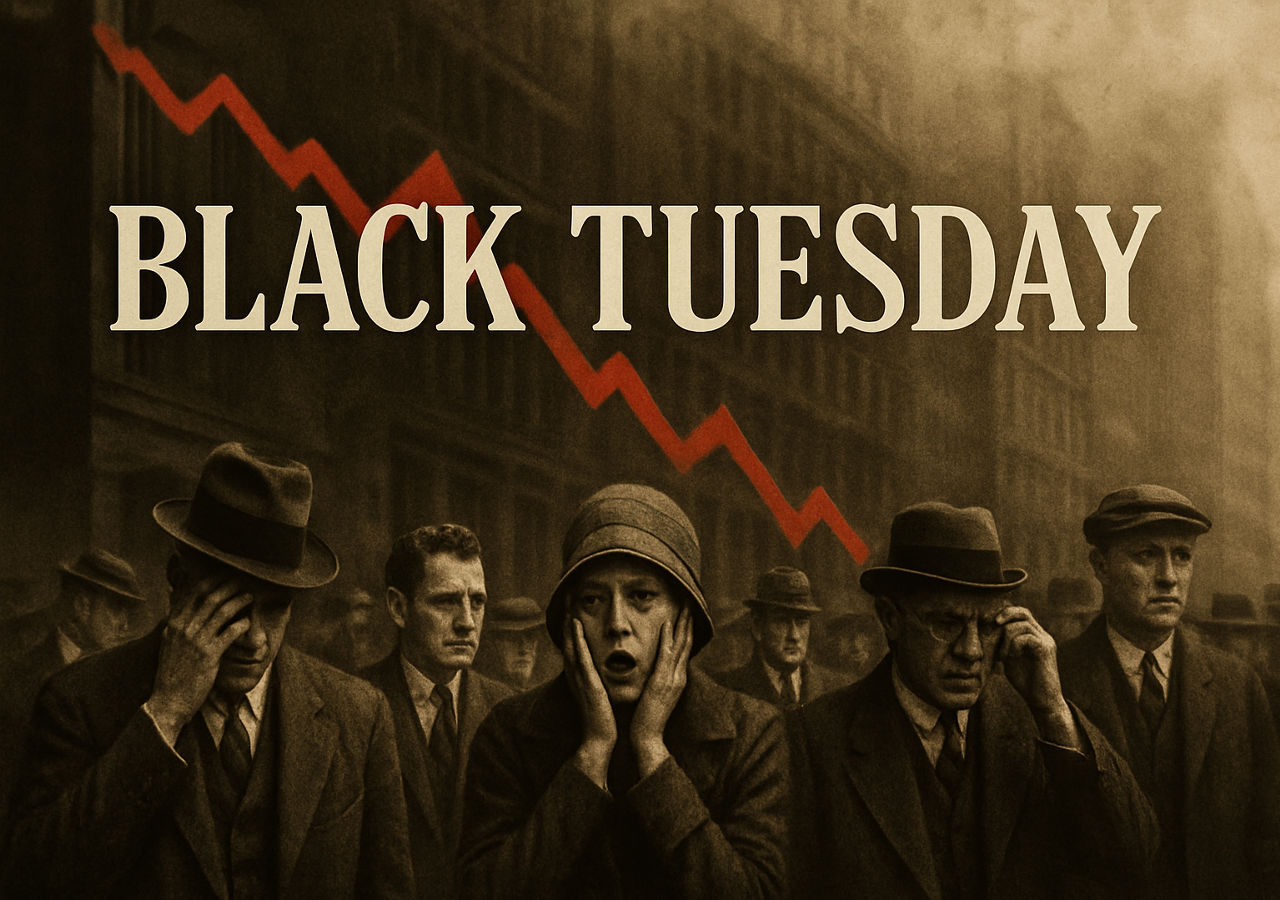
Black Tuesday is the name given to 29 October 1929, the worst day of the 1929 Wall Street Crash. On that day, investors traded about 16.4 million shares on the New York Stock Exchange, more than five times busier at the time.
The Dow Jones Industrial Average fell almost 12% (about 30.6 points), following a 12.8% plunge the previous day. Over two days, the Dow dropped about 23%.
Contemporary estimates put wealth losses at over $14 billion in a single day, an enormous sum in 1929.
To clarify, it wasn't the only bad day of the stock market crash of 1929. But it was the day when panic hit full force, and it quickly became the shorthand for the whole collapse.

Before the crash, the 1920s looked like an endless party:
Between August 1921 and September 1929, the Dow Jones rose from about 63 to 381, roughly a sixfold increase.
Real GNP increased approximately 4.2% annually throughout the decade, with production and corporate profits achieving consistent record highs.
Many Americans invested their savings in stocks, seeking returns that appeared much more attractive than bank deposits.
By early fall 1929, alerts were present, yet economist Irving Fisher captured the prevailing sentiment with his notorious statement: stock prices had attained "what appears to be a permanently elevated plateau."
| Date | Nickname | Dow close | Point change | % change (approx.) | NYSE volume (shares) |
|---|---|---|---|---|---|
| 24 Oct 1929 | Black Thursday | ~299* | Intraday −11%; closed −2% | ~−2% close | 12.9 million |
| 28 Oct 1929 | Black Monday | 260.64 | −38.33 | −12.8% | ~9.2 million |
| 29 Oct 1929 | Black Tuesday | 230.07 | −30.57 | −11.7–12% | 16.4 million |
*The exact Thursday close varies by source; the key point is the huge intraday swing and record volume
The first jolt came on Black Thursday, 24 October:
The market opened with panic selling and quickly lost about 11%, before big banks stepped in to buy blue-chip stocks and stem the rout.
Trading volume hit a record 12.9 million shares, overwhelming ticker machines and leaving investors in the dark about real-time prices.
Thanks to the bankers' support, the Dow closed only about 2% down on the day, but the sense of safety was already broken.
Selling pressure returned and intensified:
On Black Monday, 28 October, the Dow plunged 38.33 points, a loss of 12.8%, then the worst one-day fall on record.
On Black Tuesday, 29 October, the Dow dropped another 30.57 points (about 11.7–12%), closing at 230.07. Trading reached about 16.4 million shares.
Newspapers ran headlines like "Stocks Collapse in 16,410,030 Share Day," capturing the scale of the panic.
Even well-known financiers, including William C. Durant and members of the Rockefeller family, tried to buy stocks to show confidence. It didn't work. There were too many forced sellers and not enough buyers.
After a brief rebound on 30 October, the market continued sliding. By 13 November 1929, the Dow had dropped to 198.60, and by July 1932, it would bottom at 41.22, an 89% fall from the September 1929 peak.
| Metric | Figure / Date |
|---|---|
| Dow peak before crash | 381.17 on 3 Sept 1929 |
| Black Monday drop | −38.33 pts (−12.82%) on 28 Oct 1929 |
| Black Tuesday drop | −30.57 pts (−11.73%, often reported as ~−12%) on 29 Oct 1929 |
| Two-day loss (Mon + Tue) | Total −23.05% for the Dow |
| Shares traded on Black Tuesday | ~16.4 million |
| Estimated wealth lost on Black Tuesday | Over $14 billion in one day |
| Interim low after crash (1929) | 198.60 on 13 Nov 1929 |
| Ultimate Depression low | 41.22 on 8 July 1932 (about −89% from peak) |
| Time to regain 1929 peak | Dow finally regained its Sept 1929 high in Nov 1954 |
For a modern trader, the key takeaway is that the real damage wasn't just a single day. It was the multi-year slide and the 25-year wait to make new highs that made 1929 unique.
There wasn't a single trigger. Black Tuesday was the breaking point of a bubble built over the years.
The 1920s economy looked strong on the surface:
Industrial output and real GNP rose quickly, with growth averaging about 4.2% per year.
Corporate earnings surged, and top tax rates were cut from 73% to 25%, helping fuel investment booms.
But under that:
Wealth and income inequality reached record levels. Many households still had low wages and heavy debts, which limited real demand for the goods companies were producing.
Key sectors like agriculture were already in trouble, with falling prices and large farm debts.
So while stock prices soared, the real economy was not as strong as the market suggested.
The crash was also a story of leverage:
By the late 1920s, investors could buy stocks on margin with as little as 10% down, effectively borrowing 90% of the purchase price.
By August 1929, brokers had lent over $8.5 billion to margin buyers, more than the total US currency in circulation at the time.
It meant:
A small price drop triggered margin calls.
Investors forced to meet those calls by selling pushed prices down further.
That spiral turned an ordinary correction into a full-blown panic.
The 1929 market also operated under rules that would look shocking today:
There was no Securities and Exchange Commission (SEC) yet; insider trading and market manipulation were widespread.
Many banks invested depositors' money in stocks or lent heavily to brokers. When prices crashed, both investors and banks took big hits.
The Federal Reserve was divided and slow to act. Later analysis from Fed historians notes how policy mistakes and tight money in the late 1920s helped weaken the system before the crash.
Put together, you had a highly leveraged market, weak oversight and a fragile banking system, all sitting above a slowing economy. The crash was the match that lit that pile.

No. Most historians and economists treat Black Tuesday as a trigger, not the sole cause, of the Great Depression:
Britannica notes the crash "shattered confidence in the American economy", leading to sharp cuts in spending and investment.
Federal Reserve and St. Louis Fed studies show that from 1929 to 1933, US real GDP fell about 29%, unemployment hit about 25%, prices dropped by roughly 25%, and thousands of banks failed.
So the crash mattered because it:
Wiped out household and corporate wealth.
Sparked banking panics in the early 1930s, which reduced lending and deepened the downturn.
Undermined public confidence just as the global economy was already under strain.
But other forces, such as global debt problems, trade policy mistakes like the Smoot–Hawley tariff, and rigid adherence to the gold standard, also played massive roles in turning a severe recession into a decade-long depression.
Leverage amplifies everything
Bubbles often grow when the real economy is already slowing
Regulation matters, but can't remove cycles
Confidence is fragile
On Tuesday, 29 October 1929, a wave of panic selling hit Wall Street. Approximately 16.4 million shares were traded on the NYSE, the Dow dropped nearly 12%, and billions in paper wealth disappeared.
From its peak on 3 September 1929 to its low on 8 July 1932, the Dow dropped from 381.17 to 41.22, a fall of about 89%. The index didn't return to its 1929 peak until November 1954, even before inflation adjustment.
A one-day drop of 10–20% is still possible. We observed a comparable situation in 1987 and steep declines in 2008 and 2020, but circuit breakers, central bank interventions, and stricter regulations reduce the likelihood of a 1929-like multi-year 89% drop in one significant market.
In conclusion, Black Tuesday has become shorthand for far more than a single bad day on Wall Street. It was the moment a long, debt-fuelled boom finally cracked, revealing how much of the 1920s prosperity rested on leverage, speculation and fragile finance.
The crash didn't create all of the Great Depression's problems, but it exposed them in one brutal instant.
For today's investors and traders, the real lesson is not that "1929 will repeat exactly," but that bubbles built on borrowed money, weak regulation and overconfidence tend to end the same way.
Disclaimer: This material is for general information purposes only and is not intended as (and should not be considered to be) financial, investment or other advice on which reliance should be placed. No opinion given in the material constitutes a recommendation by EBC or the author that any particular investment, security, transaction or investment strategy is suitable for any specific person.