Published on: 2026-03-16
Updated on: 2026-03-16
Yes, a market rotation is underway in 2026, but it is not a clean handoff from growth to safety. Early-2026 data showed clear leadership from energy, materials, industrials, utilities, and consumer staples, while technology and financials lagged.
As the year progressed, however, volatility in March made market trends less clear. During this period, energy and utilities remained strong, while some software and megacap tech stocks also rebounded during brief periods of risk-on sentiment.
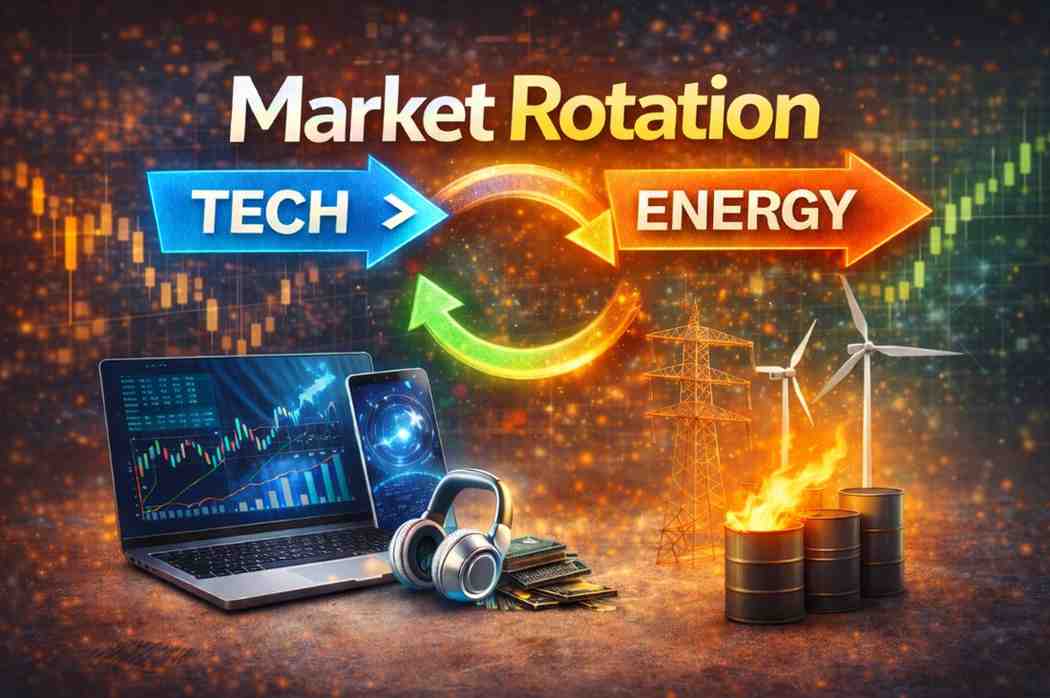
To clarify these developments, it is helpful to divide the year into two distinct windows. Through February 27, S&P Dow Jones Indices showed energy up 25.0% YTD, materials up 17.9%, consumer staples up 15.9%, industrials up 14.3%, and utilities up 11.9%, with technology down 3.6% and Financials down 6.0%.
Entering March, the situation became more mixed: utilities continued to act like defensive winners, while technology and software also found support during parts of the recent geopolitical shock.
The best outlook is provided by S&P Dow Jones Indices' U.S. Sector Dashboard, utilizing data up to February 27, 2026. It is not today's tick-by-tick tape, but it is the best broad scoreboard for how the year started.
| S&P 500 Sector | 2026 YTD return through Feb. 27 | What it tells you |
|---|---|---|
| Energy | 25.0% | Hard-asset leadership and commodity sensitivity led early 2026 |
| Materials | 17.9% | Broadening into cyclical and real-economy exposure |
| Consumer Staples | 15.9% | Strong early performance, though not a reliable March safe haven |
| Industrials | 14.3% | Capital spending and infrastructure themes gained traction |
| Utilities | 11.9% | Defensive cash flow plus power-demand and AI-grid tailwinds |
| Real Estate | 8.7% | Helped early by lower-rate hopes, then overshadowed by later macro shifts |
| Health Care | 3.5% | More of a stabiliser than a leader |
| Communication Services | 0.3% | Flat on the scoreboard, but telecom later improved |
| Consumer Discretionary | -2.1% | Weak consumer beta and crowded growth exposure |
| Technology | -3.6% | Valuation reset, not a proven earnings collapse |
| Financials | -6.0% | Clear early laggard, hurt by macro and credit concerns |
Source: S&P Dow Jones Indices U.S. Sector Dashboard, data as of February 27, 2026.
Energy has been the market's blunt instrument this year. Through February 27, it was up 25.0% in the S&P 500 sector table, making it the clearest early-2026 leader.
There is still a wrinkle traders should respect. FactSet predicts a 5.4% year-over-year decline in the Energy sector's Q1 earnings and a 0.6% drop in revenue, primarily due to average oil prices in the first quarter remaining below last year's levels.
That means energy's leadership is a price-action story first and an earnings-confirmation story second.
Materials rose 17.9% year to date through February 27, and Industrials gained 14.3%. That is classic broadening behavior. It tells you money was rotating into tangible-economy exposure, not just hiding in defensives.
There is also a real earnings story underneath Materials. FactSet expects the sector to post 24.6% year-over-year earnings growth in Q1, with Metals and Mining doing most of the heavy lifting.
Utilities are not supposed to be exciting. In 2026, they are.
S&P's dashboard showed Utilities up 11.9% through February 27, and Barron's reported that the Utilities Select Sector SPDR ETF had returned 10.2% through March 13, including dividends, against a 2.6% decline for the S&P 500.
The appeal is clear: stable cash flows, decent dividends, defensive characteristics during volatility, and a structural demand story tied to electricity needs from AI data centers.
Consumer Staples did lead the early-2026 scoreboard, rising 15.9% through February 27. However, March price action showed that this has not been a textbook defensive rotation, as staples and healthcare did not consistently behave like safe havens during the latest geopolitical shock.
Telecom has been a clearer winner inside the broader defensive-value trade. MarketWatch reported that Verizon was up 25.5% in early 2026, AT&T was up 15.3%, and T-Mobile was up 9.1%, helped by value appeal and improved sentiment around subscriber trends.

The Street spent three years treating AI spending as if every large capex cycle would quickly translate into margin upside. That assumption is being tested.
Morgan Stanley's perspective in February was clear: data that beats forecasts is no longer sufficient, and markets are seeking more proof that significant AI capital expenditures will yield tangible results.
In simple terms, the market is no longer offering free leadership in technology. FactSet still expects Information Technology to deliver the strongest Q1 2026 earnings growth in the S&P 500 at 41.7%. Still, investors are demanding clearer proof that revenue growth, margins, and AI spending can justify the sector's premium.
That is why the rotation looks more like multiple compression than an earnings collapse.
Here is something the consensus keeps getting backwards: sticky inflation is not uniformly bad for equities. Long-duration growth stocks are adversely affected, while cash-generative, real-asset-heavy businesses benefit.
Energy and Utilities have been among the strongest-performing sectors year to date, as volatility and geopolitical uncertainty have reinforced the market's preference for resilient, cash-flow-oriented businesses.
Higher crude prices and sustained capital discipline have supported the durability of free cash flow across the energy sector. At the same time, regulated utilities have excelled due to their contracted revenue models and robust balance sheets.
That is the playbook. Cash flows you can count. Contracts that do not expire when sentiment shifts.
The concentration problem has not vanished, but it is clearly being challenged. Earlier in 2026, Morningstar and Morgan Stanley both pointed to a broader trend as small caps, cyclicals, commodities, and equal-weight exposure began to outperform the narrow mega-cap trade.
That signal has become noisier during March volatility, so it is better not to describe it as a one-way handoff. A fairer conclusion is that the market is less dependent on a handful of giant tech names than it was in 2025, even if the broadening process is still uneven.
Technology is the most misunderstood part of this rotation.
The sector was down 3.6% YTD through February 27, but that did not mean the growth story died. FactSet still expects technology to deliver the strongest Q1 earnings growth and the strongest Q1 revenue growth in the S&P 500.
That is the key distinction for traders: this has looked more like a valuation reset than a broad earnings deterioration.
In March, the tape further complicated the bearish story, with MarketWatch reporting that megacap tech and software regained momentum amid the Iran-driven risk event as investors moved back toward liquid, familiar names.
If you want the one sector that says this rotation still has teeth, look at Financials.
S&P's dashboard had Financials down 6.0% through February 27, making it the weakest major sector in the early-2026 scoreboard. Recent market commentary has maintained a cautious tone, with MarketWatch noting that XLF has declined by 13.3% from its January high and is nearing a death cross.
That weakness is striking because FactSet still expects Financials to post 14.4% year-over-year earnings growth in Q1.
In simple terms, the market is adjusting for macro and credit risk more quickly than analysts are revising their forecasts. When there's a sharp divergence between the price and forward estimates, traders typically prioritize the price.
Equal-weight versus cap-weight. If equal-weighted exposure continues to outperform after March volatility cools, market breadth is still improving.
Financials. If banks and brokers cannot stabilize, it will be harder to call this a healthy cyclical handoff.
Oil and the 10-year yield. If crude remains strong and long-term yields stay high, sectors focused on hard assets and defensive cash flow should maintain an advantage.
Tech earnings versus tech price. If technology continues to demonstrate strong revenue and profit growth, even in the face of positive news, the sector may be entering a more mature phase.
The energy, utilities, and industrial sectors are now leading the market, shifting away from the previously dominant, tech-heavy trade. However, some areas of software and large-cap tech continue to find support.
The clearest leaders have been energy, utilities, and industrials. Energy has benefited from oil and geopolitics, utilities from defense and power-demand themes, and industrials from AI infrastructure and capital spending.
No. Technology has lost easy leadership, but it still has the strongest earnings growth profile in the market and has shown rebound strength during short risk-on phases.
In conclusion, a market rotation is underway in 2026, but it is not a clean break from growth into defense. The market is expanding, with leadership shifting to energy, materials, industrials, utilities, and certain defensive-value sectors, away from a focus on narrow mega-cap stocks.
The most important insight is that price leadership and earnings leadership are no longer the same. Technology continues to lead in expected earnings growth; however, energy, utilities, materials, and industrials topped the early-2026 performance table. March trading demonstrated that leadership can shift again when the macroeconomic backdrop changes.
That is what a real rotation usually looks like in practice: real, uneven, and highly sensitive to regime shifts.
Disclaimer: This material is for general information purposes only and is not intended as (and should not be considered to be) financial, investment or other advice on which reliance should be placed. No opinion given in the material constitutes a recommendation by EBC or the author that any particular investment, security, transaction or investment strategy is suitable for any specific person.