Published on: 2026-07-30
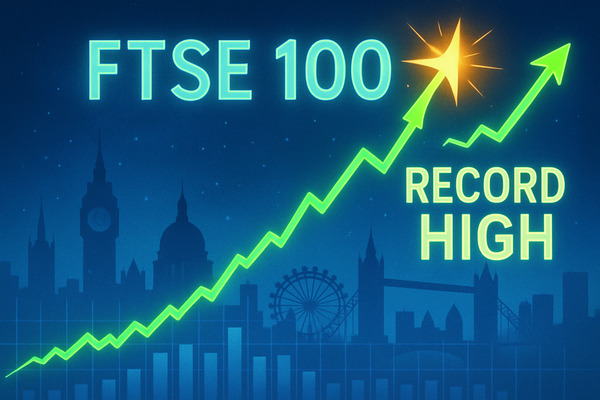
The FTSE 100 set an all-time intraday high on Wednesday 29 July 2026, reaching 10,951.06 points before closing at 10,908.41, up 37.39 points or 0.34%. Oil and mining shares drove the gain, not any fresh improvement in the UK economy.

London’s benchmark has become an unlikely winner from the global sell-off in artificial intelligence and semiconductor stocks. With limited direct exposure to major chipmakers and megacap technology, and heavy weightings in energy, banks and miners, the FTSE 100 rose while chip-linked indices fell.
The FTSE 100 hit an all-time intraday high of 10,951.06 and closed at 10,908.41, up 0.34%, finishing 2.14 points below February’s record close.
Energy led the advance, rising 2.9% as Brent crude settled 7.9% higher at $90.74 on renewed Middle East fighting.
Standard Chartered, Rio Tinto and Glencore reported stronger figures, while Reckitt Benckiser beat reduced expectations even as profit fell.
The domestically weighted FTSE 250 slipped 0.03%, which analysts read as global rotation rather than UK economic strength.
Energy was the biggest single driver. The FTSE 100 energy sector climbed 2.9% as crude prices rose almost 7% during the London session.
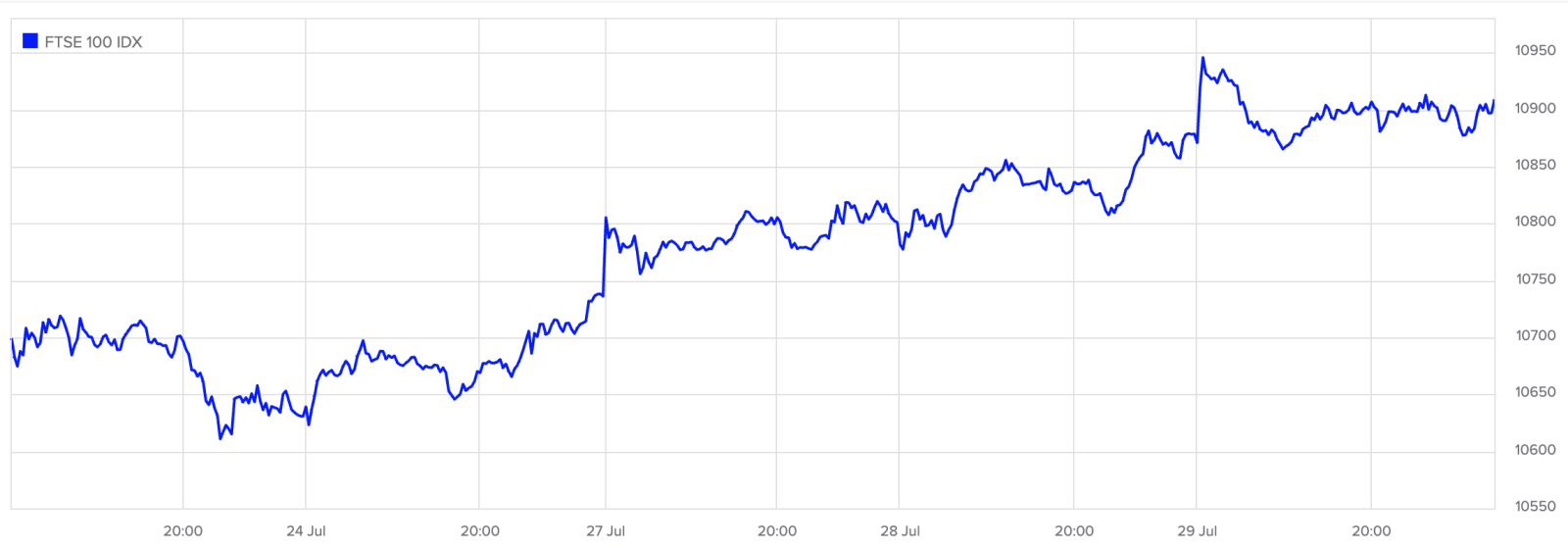
Wednesday’s peak cleared the previous intraday record of 10,934.94, set on 27 February. The close came 2.14 points below that day’s record finish of 10,910.55, so the milestone was intraday only.
| Date | Close | Change | Session driver |
|---|---|---|---|
| Fri 24 Jul | 10,736.23 | +97.06 (+0.91%) | Second straight weekly gain; Brent ended the week near $96.78 |
| Mon 27 Jul | 10,781.75 | +45.52 (+0.42%) | US and Iran paused strikes, while oil retreated sharply |
| Tue 28 Jul | 10,871.02 | +89.27 (+0.83%) | Asian chip sell-off deepened; Kospi fell more than 10% |
| Wed 29 Jul | 10,908.41 | +37.39 (+0.34%) | Record intraday high of 10,951.06; energy sector rose 2.9% |
| Thu 30 Jul | Session not open at publication | n/a | Bank of England decision at midday; Shell and Lloyds report |
Crude rose on renewed fighting rather than any shift in supply and demand. Major airstrikes resumed across the Middle East, and US Central Command said it intercepted an Iranian missile attack on American forces in Jordan. President Donald Trump told Fox News that Washington would respond forcefully, removing the market’s assumption of an imminent de-escalation.
Brent crude futures settled 7.9% higher at $90.74 a barrel and West Texas Intermediate up 6.6% at $84.46. Shell and BP both gained, since their earnings move with the crude price. London carries one of the highest energy weightings in the developed world, so an oil spike that hurts airlines elsewhere lifts its headline number.
Standard Chartered reported $11.6 billion of first-half operating income and a 17% rise in earnings per share, raised its dividend by 66% and announced a buyback of up to $1 billion. Reuters reported the profit came in ahead of analyst forecasts. The shares gained 2.8%.
Rio Tinto reported a 43% rise in half-year underlying earnings, underlying EBITDA up 28% and free cash flow up 75%, alongside a 43% increase in its first-half shareholder distribution. The stock added 1.6%.
Glencore’s production report put own-sourced copper output up 15% at 397,000 tonnes and estimated first-half Marketing adjusted EBIT at about $3.3 billion, against a through-cycle annual guidance range of $2.3 billion to $3.5 billion. Full financial results follow separately. The shares rose 2.8%.
Reckitt Benckiser was the exception on profit. IFRS operating profit fell 22.2% and adjusted diluted earnings per share fell 9.7% to 152.1p, both mainly reflecting the Essential Home disposal, although the adjusted figures beat consensus. The company lifted its interim dividend 5% to 88.6p and announced a £500 million buyback.
Aberdeen Group fell 4.5%, the worst in the index, after first-half net outflows of £3 billion. In the FTSE 250, Greggs jumped 18% after pretax profit rose 20% to £76.0 million.
AJ Bell’s June Dividend Dashboard forecast £88.8 billion of FTSE 100 dividends this year and put declared 2026 buybacks at £36 billion. Investment director Russ Mould said Wednesday’s announcements lifted the running buyback total towards £40 billion. Both are estimates and running tallies rather than confirmed outcomes.
The contrast was stark. In the previous US session the Nasdaq Composite slipped 0.2% to 24,877 as chip stocks stayed under pressure, while the Dow Jones Industrial Average climbed 1% to 52,747 and the S&P 500 closed at a record 7,429.
The FTSE 100 holds no large semiconductor manufacturer and no megacap software platform. Its biggest constituents are oil majors, pharmaceutical groups, banks, miners and consumer staples. When investors cut AI-linked exposure, London offers cash-generative alternatives at a discount to Wall Street.
The domestically focused FTSE 250 edged down 0.03% to 23,996.81, underperforming the blue chips for a second session. Analysts generally read that divergence as global rotation rather than a verdict on Britain.
The gap is structural. Most FTSE 100 revenue is earned outside the United Kingdom and reported in foreign currency, so the index tracks global commodity prices, worldwide demand and the value of sterling more closely than British growth.
Domestic conditions remain uncomfortable. UK consumer price inflation eased to 2.6% in June from 2.8% in May, still above the 2% target, with services inflation at 3.6%. Ten-year gilt yields have traded near 5%, raising costs for the government and for households refinancing mortgages.
The Federal Reserve held its target range at 3.50% to 3.75% on Wednesday in a 9-3 vote. Cleveland’s Beth Hammack, Minneapolis’s Neel Kashkari and Dallas’s Lorie Logan preferred an immediate quarter-point rise. Chair Kevin Warsh has said he is scaling back forward guidance, which markets read as reduced visibility on September.
The Bank of England announces its decision at midday on Thursday 30 July with a quarterly Monetary Policy Report. Bank Rate stands at 3.75%, unchanged since the December 2025 cut from 4%, and June produced a 7-2 vote to hold.
All 70 economists in a Reuters poll expected another hold, while the forward curve had moved towards rises rather than cuts. Those are forecasts and market pricing, not commitments.
The vote split and revised inflation path will say more than the headline rate, since both feed into sterling, gilt yields and bank margins.
The index’s leadership is narrow and tied to the oil price. Brent has traded through a range of almost $32 since the start of July and fell 16% over three sessions this week before Wednesday’s rebound, its steepest such drop since 2020. A durable pause in hostilities would reverse much of that contribution.
The steadier support is the cash London-listed companies are returning. This week’s dividend increases and buybacks are confirmed decisions, and they underpin the case for UK equities whatever the index level on a given day.