Published on: 2026-07-27
Updated on: 2026-07-27
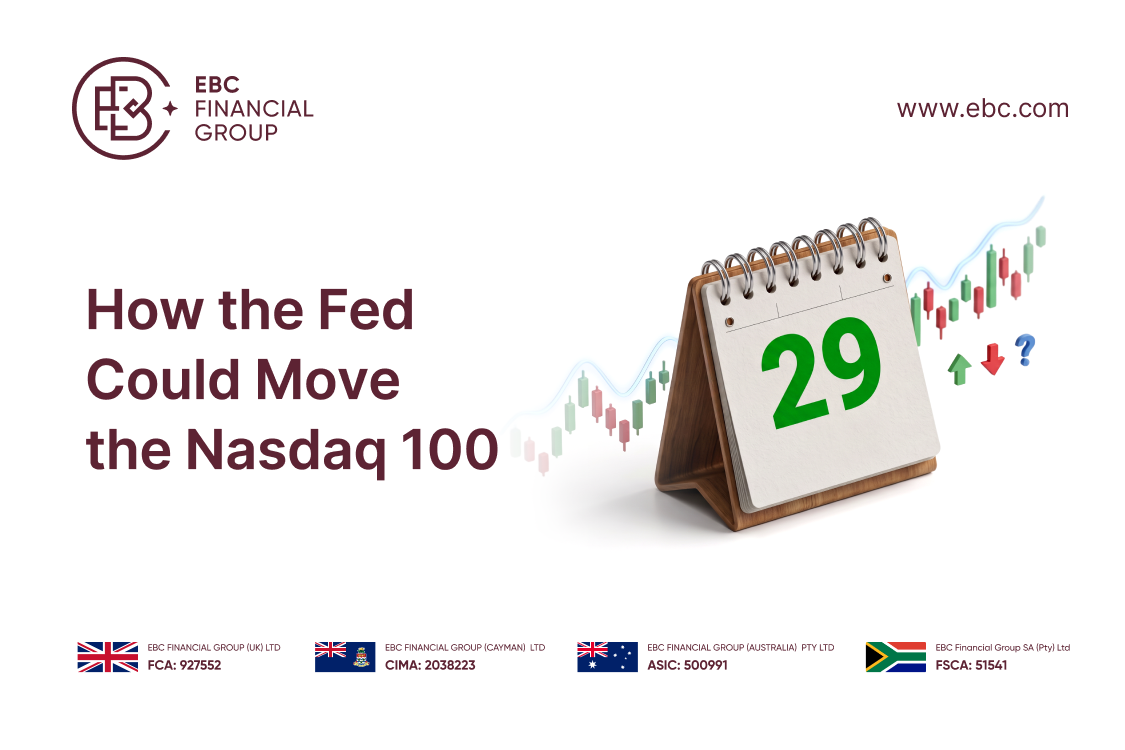
The Federal Reserve (Fed), the central bank of the United States (US), will announce its next interest-rate decision on 29 July 2026. The decision follows a two-day meeting of the Federal Open Market Committee (FOMC), the group that sets up US monetary policy.
The policy statement is due at 2:00 p.m. Eastern Time (ET), followed by the Fed Chair’s press conference at 2:30 p.m. ET.
As of Friday, 24 July, CME FedWatch data indicated that traders placed about a 62% probability on the Fed keeping its interest-rate target at 3.50% to 3.75%, and about a 38% probability on an increase. These figures are based on prices in 30-day federal funds futures and reflect market expectations rather than a guarantee of what the Fed will do.
The Nasdaq 100 closed at 28,128.34 on 24 July, down 1.15% for the day and about 1.6% over the week. The US 10-year Treasury yield stood at 4.69% on the same date.
Even though markets currently favour a rate hold, the Nasdaq 100 may still move sharply if the Fed’s statement or press conference changes expectations for where interest rates go next.
The Nasdaq 100 tracks 100 of the largest non-financial companies listed on the Nasdaq Stock Market. Larger companies carry more weight in the index, though Nasdaq caps individual holdings to stop one company or a small group from dominating its movement.
Many of these companies are valued partly on the profits investors expect them to earn in future years. Changes in interest rates and government bond yields may therefore affect the Nasdaq 100 more strongly than parts of the market dominated by companies valued more heavily on current or near-term earnings.
At its June meeting, the Fed held its main interest-rate target in a range of 3.50% to 3.75%, a decision backed by all 12 voting members.
The Fed also expected its preferred inflation measure to remain above its 2% target in 2026. Its interest-rate projections suggested that the typical meeting participants did not expect rates to fall substantially before the end of the year.
These projections reflect the individual views of Fed participants. They do not commit the FOMC to any particular decision at a future meeting.
Investors do not treat profits expected several years from now as being worth the same as profits earned today.
When interest rates rise, investors generally assign a lower value today to profits expected further in the future. This calculation is known as discounting.
Take a company expected to earn far more five years from now, if interest rates rise, those future profits are usually considered less valuable in today’s terms. Companies whose share prices depend heavily on long-term growth expectations may therefore face more pressure when rates or bond yields increase.
Higher interest rates may also increase the cost of borrowing. This may affect how much companies spend on expansion, data centres, equipment, research, or refinancing existing debt.
Treasury yields matter too. A Treasury yield is the return investors earn from lending money to the US government through a Treasury security.
When Treasury yields rise, some investors may find government bonds more attractive compared with shares carrying greater risk. This may place pressure on highly valued growth companies.
Falling rates or yields can ease that pressure, though the reason for the decline shouldn‘t be ignored. Rates falling because inflation is improving may support growth shares. Rates falling because the economy is weakening often come with lower expectations for company sales and profits, limiting the benefit.
The Nasdaq 100 is also affected by company earnings, artificial intelligence (AI) spending, product demand, and forecasts from its largest members. Interest rates influence how investors value the index, but they do not determine its direction on their own.
Traders considering exposure to the Nasdaq 100 can access its price movements through a contract for difference (CFD). EBC is offering zero-commission trading on QQQ and TQQQ until 11 September.
The July meeting will not include a new Summary of Economic Projections.
This report contains economic and interest-rate forecasts submitted by individual Fed participants. It also includes the chart commonly known as the dot plot, which shows where each participant believes the main interest rate should be at the end of future years.
The last projections came in June, and the next are due with the September meeting. With no fresh forecasts in July, traders will have fewer figures to work with, so attention shifts to changes in the policy statement and the Fed Chair’s answers during the press conference.
Traders will be comparing the July statement with June’s.
Changes in how the Fed describes inflation, employment, growth, and risks can shift expectations for September and the months after. Stronger concern about inflation points to rates staying high or rising further. Greater confidence that price pressures are easing can bring forward expectations for cuts.
Traders will also check whether the decision is unanimous.
A dissent, when a voting FOMC member does not back the decision, carries different weight depending on whether the member wanted higher or lower rates.
The press conference begins 30 minutes after the statement.
The Chair may explain how officials read recent inflation, employment, and economic data, and what could lead the Fed to raise, lower, or hold rates at later meetings.
The Nasdaq 100’s first reaction can change once the press conference is under way. A statement first read as favourable for growth shares can lose that lift if the Chair sounds more worried about inflation. One that looks cautious at first can seem less restrictive after the Chair fills in the detail.
The response will depend on how the Fed’s message compares with what traders expected before the announcement.
A decision to hold rates has no fixed effect on the Nasdaq 100.
In December 2023, the Fed kept its interest-rate target unchanged at 5.25% to 5.50%, as markets had expected. However, its new projections pointed to lower interest rates during 2024.
The technology-heavy Nasdaq Composite rose 1.4% that day as Treasury yields fell sharply. The Composite holds far more companies than the Nasdaq 100, but the reaction still makes the point: the rate had not changed, but expectations for future rates had.
Conditions in July 2026 are different, so this is not a prediction. It shows why even an expected hold can move technology shares when the message shifts expectations.
The Fed could hold rates while sounding more confident that inflation is easing, or signal that weaker growth or employment has reduced the need to keep rates high.
That kind of message can lead traders to expect cuts sooner. Treasury yields may fall, easing pressure on growth-company valuations and supporting the Nasdaq 100.
If the Fed leans toward lower rates because it sees a sharp slowdown, worries about company sales and profits can offset part of the benefit from lower yields.
The Fed could hold rates and change little in its message. When the decision and statement match expectations, the first move may be small or quickly reverse, and traders may wait for the press conference before judging whether the Fed’s position has shifted.
The Nasdaq 100 could then take its lead from Treasury yields, the US dollar, company earnings, or its largest members. An expected decision does not guarantee a quiet session.
The Fed could voice greater concern about inflation or signal that rates may need to stay high or rise further. Treasury yields may climb as traders reassess where rates are heading, and higher yields can lower the value investors place on future profits, pressuring the Nasdaq 100.
A hold can still produce this reaction. Keeping rates steady while warning that inflation risks have risen can land much like signalling that another increase is possible.
The initial move will follow the rate decision and policy statement, but it may change once the Fed Chair begins answering questions.
Prices may shift again as stock, bond, and currency traders reassess what the meeting means for future interest rates.
The US 10-year Treasury yield deserves close attention during this process.
It shows the return investors demand for lending money to the US government for ten years. It is also widely used as a reference point for borrowing costs and company valuations.
A falling yield may ease pressure on the Nasdaq 100, while a rising yield may weigh on it.
A falling yield can ease pressure on the Nasdaq 100, while a rising yield can weigh on it. The reason behind the move counts too: yields falling because inflation is improving read differently from yields falling because investors fear a slowdown."
Positioning before the announcement can shape the response as well. If the Fed's message differs from what traders expected, many may close trades at once, adding to sharp moves or reversals.
The Fed will not be the Nasdaq 100’s only major event that week.
Microsoft and Meta are scheduled to report financial results after the regular US market closes on 29 July 2026. Apple follows on 30 July 2026.
These companies are among the largest members of the Nasdaq 100, so large movements in their share prices may noticeably affect the index. Their results, investment plans, and financial forecasts may extend, weaken, or reverse the Nasdaq 100’s initial response to the Fed.
A Nasdaq 100 CFD allows a trader to take a position based on changes in the index’s price without buying shares in every company included in it.
CFDs use leverage: a trader puts up only part of a position's full value while gaining exposure to a larger amount. Leverage magnifies price movements, so a small move can produce a larger gain or loss compared with the amount deposited.
Trading around the Fed may carry added risk because prices may move quickly, while spreads and trading costs may also change.
The spread is the difference between the price available for buying and the price available for selling. A wider spread increases the cost of opening and closing a position.
Slippage occurs when an order is completed at a different price from the one requested because the market moved before it could be filled.
A standard stop-loss instructs the platform to close a trade after the market reaches a chosen level. It may help manage risk, but the final execution price may differ from that level when prices move quickly.
Traders should check their position size, available margin, and maximum acceptable loss before the announcement.
Margin is the money required to open and maintain a leveraged trade. If an account does not have enough available funds when the market moves against the position, the trade may be closed automatically.
Zero commission does not mean the trade has no costs. Spreads, overnight financing fees, and other applicable charges may still apply.
Overnight financing is a charge that may apply when a leveraged CFD position remains open beyond the trading day.
The 29 July decision will test whether the Fed’s message matches what markets have already priced in. For the Nasdaq 100, changes in Treasury yields and the Chair’s comments may matter as much as the rate decision itself.
Microsoft and Meta’s results later that day, then Apple on 30 July, give investors another reason to reassess the index. The Nasdaq 100’s first response to the Fed may therefore look different from where it settles once the week’s major announcements are in.
Trade the Nasdaq 100 commission-free until 11 September 2026. Terms and conditions apply.