Published on: 2026-07-28
Updated on: 2026-07-28
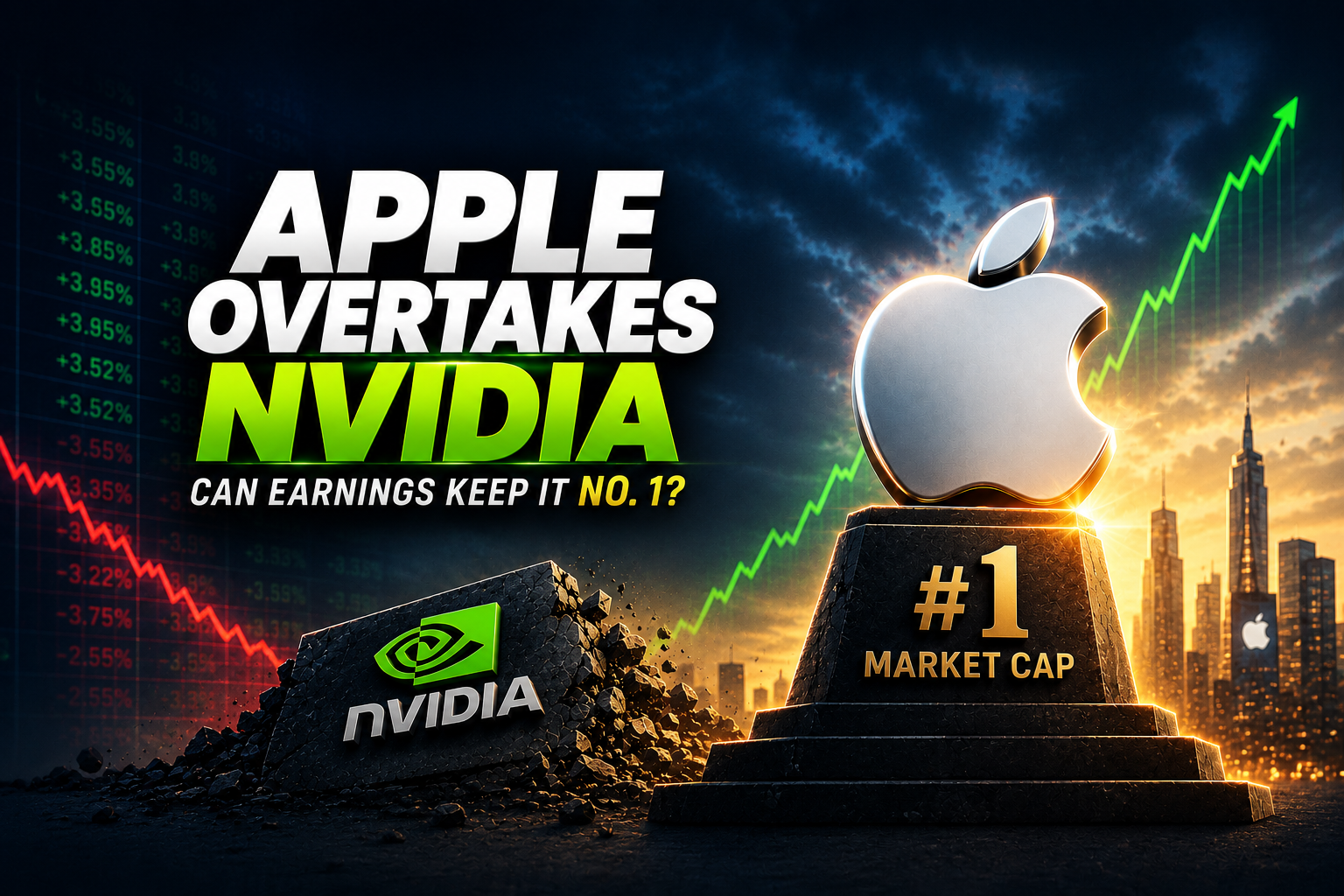
Apple's market cap passed Nvidia's again on July 27, and Nvidia did nearly all the work: its shares fell about 5% while Apple rose only about 1%. Apple had already spent 2026 closing the gap, so Nvidia's slide completed a shift that was already underway rather than starting one from nothing.
Whether Apple actually deserves to hold the title now falls to July 30, when its fiscal third-quarter earnings will show whether the lead rests on Apple's own numbers or was simply borrowed from Nvidia's bad day.
Apple closed July 27 at a record $336.91 a share, with a market value of about $4.93 trillion, ahead of Nvidia at approximately $4.8 trillion.
Apple's most recently reported quarter posted 17% revenue growth, 22% iPhone revenue growth and a 76.7% Services gross margin.
Apple spent $36 billion repurchasing 135 million shares in the first half of fiscal 2026, and the smaller share count added roughly 2.5 percentage points to quarterly EPS growth.
Apple discloses no standalone AI budget: first-half property and equipment spending fell 28%, while R&D rose 33%, ahead of the July 30 earnings test.
The closing figures show why the corporate ranking changed without a dramatic jump in Apple stock.
Measure |
Apple |
Nvidia |
July 27 move |
About +1% |
About −5% |
Closing price |
$336.91 |
$196.51 |
Market value |
About $4.93tn |
About $4.8tn |
Nvidia’s July 27 closing price is confirmed at $196.51. Its market value is presented as approximately $4.8 trillion because reported estimates vary depending on the outstanding-share figure used.
Apple had already been closing the gap. Its shares had gained more than 22% in 2026 through July 27 and had sharply outperformed the Nasdaq-100 during July. Nvidia’s selloff completed the crossover. It did not create Apple’s entire rally.
Apple’s most recently reported quarter supplied genuine earnings support before Nvidia’s July 27 selloff. Revenue increased 17% to $111.18 billion, net income rose 19% to $29.58 billion, and diluted EPS advanced 22% to $2.01.
The iPhone did the heaviest lifting. Apple's iPhone revenue rose 22% to $56.99 billion, showing that Apple's core hardware business was accelerating well before the market cap reversal. Apple's fiscal second-quarter preview had flagged iPhone demand as the figure to watch, and the results delivered on it.
Services added a more profitable layer on top. Apple's Services revenue increased 16% to $30.98 billion, and the segment's gross margin reached 76.7%, against 38.7% for products. Services revenue, led by the App Store, advertising and cloud services, carries much lower cost of sales than hardware. Its 76.7% gross margin was nearly twice the 38.7% product margin, helping lift Apple’s total gross margin to 49.3%.
Apple does not disclose a separate figure for AI investment, so the available figures show how its spending is structured rather than the full size of its AI budget.
Property and equipment spending fell 28% to $4.34 billion during the first six months of fiscal 2026.
R&D increased 33% to $22.31 billion over the same period, including a 34% rise during the March quarter.
Apple appears to rely less on owned AI data centres and more on research, software, staffing and external infrastructure.
Apple does not disclose the total cost or revenue generated by its AI strategy.
Apple appears less infrastructure-heavy than companies building large AI data-centre networks. These figures are consistent with a less infrastructure-heavy AI model, but Apple does not disclose enough detail to determine how much AI spending sits in R&D, cloud agreements or owned infrastructure.
Apple repurchased 135 million shares for $36 billion during the first six months of fiscal 2026. Its weighted-average diluted share count fell 2.2% year over year in the March quarter.
The lower share count helped diluted EPS rise faster than net income. Net income grew 19.4%, while diluted EPS grew 21.8%. Using Apple’s reported net income and diluted share figures, the share-count reduction added approximately 2.5 percentage points to EPS growth.
Buybacks boosted EPS growth, but Apple still needed a higher share price and stronger earnings to reach a $4.93 trillion valuation. The program provided support but it did not manufacture a $4.93 trillion company on its own.
Apple will discuss its fiscal third-quarter results on Thursday, July 30, at 5:00 p.m. ET. The market-cap leader will face four immediate tests.
iPhone revenue will show whether the previous quarter’s 22% growth reflected durable demand or temporary product timing.
Services revenue and margin will test the most profitable part of Apple’s mix. Slower growth or weaker margins would remove a major source of valuation support.
AI execution needs measurable progress. Evidence of product usage, upgrade demand, or clearer AI costs would matter more than broad promises about future opportunity.
September-quarter guidance will determine whether current expectations extend beyond the reported period. A strong past quarter offers limited protection if the outlook weakens.
A routine earnings beat may not be enough near $5 trillion. Apple needs figures and guidance strong enough to show that the market-cap lead can survive without another Nvidia selloff doing the work.
Apple rose about 1% on July 27 while Nvidia fell 5%. Apple’s earlier rally had already narrowed the gap, and Nvidia’s decline completed the crossover.
No. Apple ended July 27 at about $4.93 trillion. It would need roughly a 1.4% gain, assuming the share count remains unchanged.
Apple spent less on property and equipment, but R&D rose 33%. Its AI model appears less infrastructure-heavy, though total AI spending remains undisclosed.
Apple will report fiscal third-quarter results on July 30, followed by its conference call at 5:00 p.m. ET the same day.
Yes. Apple’s lead was only about 3% of its market value. A weak earnings reaction, Nvidia rebound or both could quickly reverse the ranking.
Apple's rally reflects two forces working together: a genuine earnings recovery built on iPhone and Services growth, and a market that currently favours established cash flow over capital-intensive AI spending. Nvidia's 5% slide on July 27 completed that shift; it did not create it. If iPhone demand, Services margins and guidance hold up on July 30, Apple's lead as the world's most valuable company rests on a stronger financial base; if they slip, Nvidia will not need another historic rally to take the title back.