Published on: 2026-05-28
Wolfspeed posted Q3 FY2026 revenue of $150.2 million, a negative 21% non-GAAP gross margin and a $46 million underutilization charge. The stock is being treated as a margin-recovery option that the income statement has not yet confirmed.
The core issue is factory loading. About 90% of Wolfspeed’s Power Products revenue now runs through the Mohawk Valley 200mm fab, and that fab is not yet running at the level needed to absorb fixed costs cleanly. Until AI data centers, industrial programs, aerospace demand and the EV supply chain collectively push enough volume through the facility, gross margin remains under pressure. Revenue growth alone does not solve that problem.
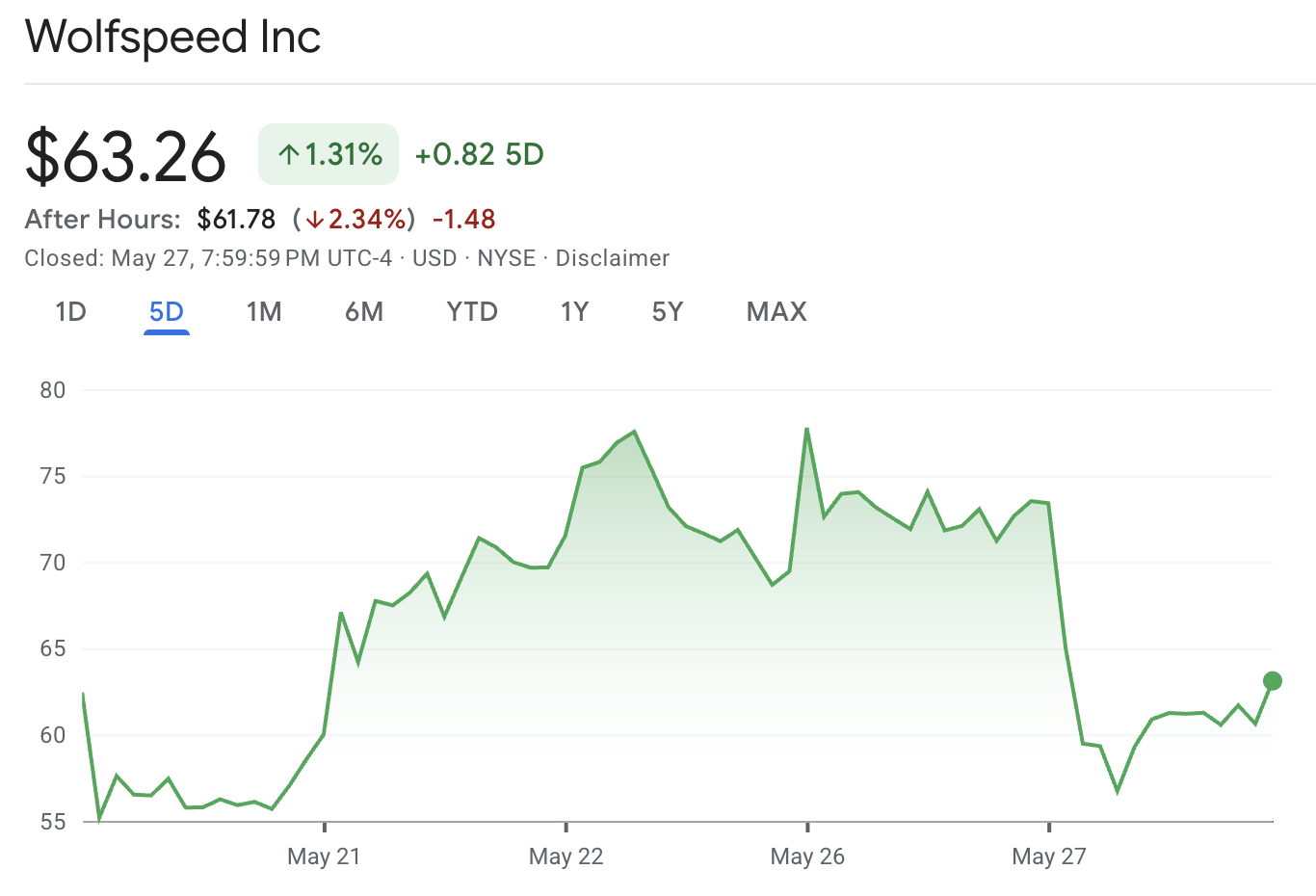
Latest available market data showed WOLF at $63.26, with an intraday range of $56.55 to $78.00 and volume above 16.5 million shares. That price action reflects a market testing operating leverage before Wolfspeed has delivered a confirmed margin turn.
Q3 revenue of $150.2 million remains below the level needed to absorb Wolfspeed’s manufacturing footprint cleanly.
The $46 million underutilization impact is the most direct link between demand, gross margin and cash burn.
Negative 21% non-GAAP gross margin shows product progress has not yet translated into factory-level profitability.
AI data-center applications grew about 30% sequentially, but management described them as a moderate part of the business.
Q4 guidance of $140 million to $160 million signals gradual, not immediate, margin repair.
Wolfspeed’s investment case has tightened to a single, pressing question: can the 200mm silicon-carbide fab’s loading rise fast enough to transform gross margin before time runs out?
Mohawk Valley gives Wolfspeed a more advanced manufacturing platform. It also raises the penalty for weak utilization. Semiconductor fabs incur high fixed costs, so low utilization can keep margins negative even as customer engagement improves.
The $46 million underutilization charge shows the gap between installed capacity and revenue-producing output. Wolfspeed can win more design activity but still face margin pressure if orders do not translate into enough wafer starts.
Wolfspeed’s cost structure is now under the microscope, with the current stock price urgently testing whether management can act before further value erodes.
| Q3 FY2026 Metric | Result | Operating Signal |
|---|---|---|
| Total revenue | $150.2 million | Demand base remains limited |
| Power Products revenue | $100.1 million | Main Mohawk Valley exposure |
| Materials Products revenue | $50.1 million | Smaller stabilizing stream |
| GAAP gross margin | -27% | Fixed-cost pressure remains high |
| Non-GAAP gross margin | -21% | Core margin remains below breakeven |
| Underutilization impact | About $46 million | Key earnings drag |
| Operating cash flow | -$84 million | Cash burn remains linked to scale |
| Q4 revenue guidance | $140 million to $160 million | No near-term revenue step-change |
AI is a real growth channel. Wolfspeed reported approximately 30% sequential growth in AI data-center applications during Q3, following 50% growth the quarter before. The company also launched a 10 kV silicon-carbide power MOSFET for grid modernization and AI data-center infrastructure and introduced its next-generation TOLT portfolio for AI direct-power requirements.
Those disclosures support the silicon-carbide case. Data-center operators are seeking higher efficiency, higher voltage and smaller power-conversion footprints. Wolfspeed has technology that fits those requirements.
The limitation is current scale relative to the fab’s cost base. Wolfspeed’s description of AI as a “moderate but expanding” part of the business sets the right expectation: AI is building as a growth driver, but it has not yet changed the margin picture.
For gross margin to move, AI demand must show up as factory loading, not only as sequential growth from a smaller base.
Automotive remains central to Wolfspeed’s silicon-carbide strategy, but the EV cycle is not providing a clean near-term lift. Management has acknowledged that silicon-carbide revenue does not scale in lockstep with vehicle sales because design-in and qualification timelines are long. New automotive wins are expected to contribute revenue over time rather than immediately.
That pushes more of the near-term loading task onto industrial, aerospace and AI data-center programs.
This is where the bull and bear cases separate. The bull argument is operating leverage. If AI, industrial electrification and selected aerospace programs lift Mohawk Valley output while fixed costs stay relatively stable, gross margin could improve faster than revenue growth implies.
Bears focus on timing: If AI grows slowly and automotive demand remains uneven, Wolfspeed may continue with negative margins, even as end-market prospects improve. Q4 guidance supports a cautious outlook, with gross margins expected to stay negative.
The next quarter does not need a perfect result to shift sentiment. It needs cleaner evidence that utilization is moving in the right direction.
The strongest signals would be a smaller underutilization charge, sequential improvement in non-GAAP gross margin and a narrower operating cash-flow deficit. New AI or industrial wins count most if they bring near-term volume rather than only long-term design potential.
The main risk is timing. If AI grows from a modest base, EV demand stays uneven and Mohawk Valley loading improves slowly, Wolfspeed may continue reporting negative margins even as its product narrative strengthens. That would keep the stock exposed to a gap between market expectations and operating proof.
Balance-sheet progress buys time but does not close the margin gap. Wolfspeed reduced its highest-cost first-lien debt by 43%, cut total debt by $97 million and expects annual interest expense to fall by about $62 million. It ended the quarter with about $1.2 billion in cash, cash equivalents and short-term investments.
Wolfspeed has a stronger technology story, broader end-market exposure and a clearer 200mm manufacturing platform than a year ago. It also has negative gross margin, negative operating cash flow and a $46 million underutilization drag that defines the near-term earnings problem.
AI demand can support the rebound, but it must do more than improve the narrative. It must help fill Mohawk Valley. The decisive variable for Wolfspeed stock is not AI enthusiasm. It is whether silicon-carbide demand can raise fab loading fast enough to turn capacity into margin.
Revenue, margin and guidance figures are based on Wolfspeed’s Q3 FY2026 company disclosures and earnings commentary. Market data is indicative and should be refreshed before publication. Forward-looking guidance and management statements are not guarantees of future results.
Wolfspeed Quarterly Results page
https://investor.wolfspeed.com/financials/quarterly-results/default.aspx
Wolfspeed Q3 FY2026 Earnings Call / Presentation page
https://investor.wolfspeed.com/events-and-presentations/default.aspx
Wolfspeed SEC 10-Q filing for quarter ended March 29, 2026