Published on: 2026-05-28
Updated on: 2026-05-28
After three straight quarters of flat retention, Snowflake finally showed existing customers expanding again. The move gives investors an early test of whether AI workloads are turning from product narrative into measurable consumption growth.
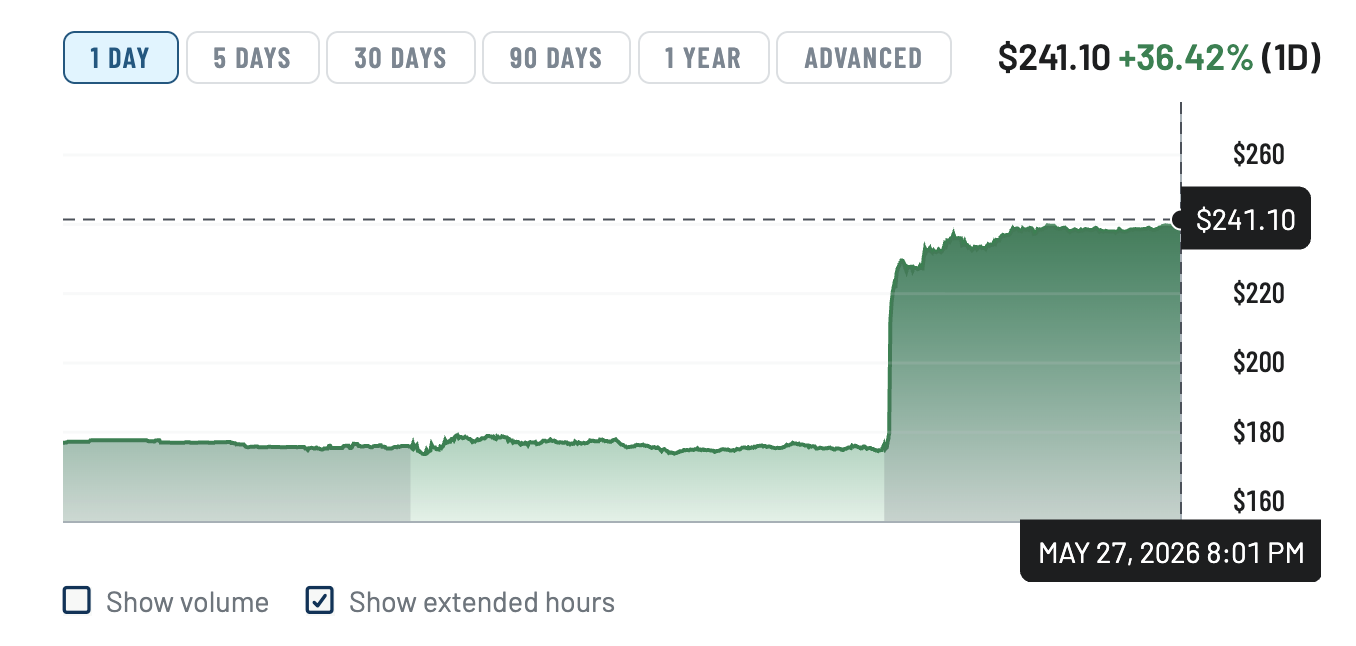
A one-point move in net revenue retention should not normally trigger a 37% stock repricing. Yet Snowflake’s rise from 125% to 126% NRR helped drive a 37.5% after-hours surge in Snowflake stock. The contradiction is the story: investors were not repricing a routine earnings beat, but the first clean break in a retention trend that had defined the bear case for more than a year. Why did one percentage point matter so much?
Product revenue rose 34% year-over-year to $1.33B, accelerating from 30% growth in the prior quarter and beating Snowflake’s own Q1 guidance by more than $60M.
Net revenue retention improved to 126% after three straight quarters at 125%, giving bulls their first clean signal that customer expansion may be stabilizing.
Full-year FY2027 product revenue guidance rose to $5.84B from $5.66B, while Q2 guidance of $1.415B to $1.420B implies roughly 30% growth.
Cortex Code is now used across more than 7,100 accounts, while Snowflake Intelligence adoption more than doubled quarter over quarter, providing the AI thesis with a measurable usage signal.
The next test is durability: Q2 NRR must hold at 126% or rise again to prove this was a turn in customer expansion rather than a one-quarter bounce.
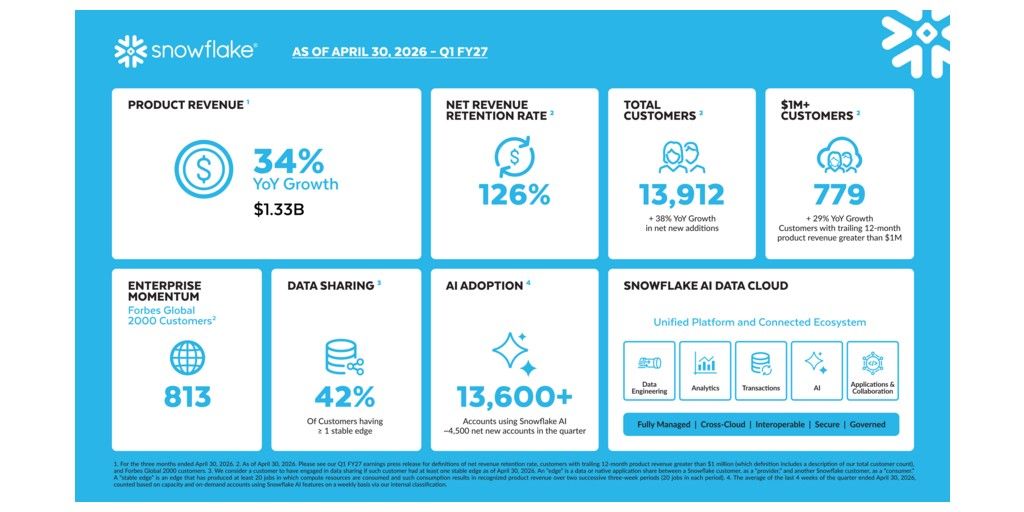
Source: Snowflake Q1 2027 Report
The market did not reward Snowflake because one retention point mathematically changed the model. It rewarded the company because the direction changed at the exact metric where the bear case had been strongest.
Net revenue retention measures how much existing customers spend compared with the prior period. At 126%, Snowflake’s customer base is still expanding usage materially, but the level alone was not the surprise. The surprise was that NRR moved higher after Q2, Q3 and Q4 FY2026 had all held at 125%.
That matters in a consumption model because revenue is tied to actual platform usage. New customers can support the top line, but existing customers spending more is the cleaner proof that Snowflake remains embedded in enterprise workloads.
One quarter does not establish a new retention floor. It does establish a new burden of proof for bears, because the metric they relied on has stopped moving against the company.
Snowflake guided Q1 FY2027 product revenue of $1.262B to $1.267B. It delivered $1.334B, up 34% year over year. That beat was large enough to matter, but it was not the only reason the stock moved.
Total revenue reached $1.39B, up 33%, while non-GAAP EPS came in at $0.39. Remaining performance obligations reached $9.21B, up 38%, showing that contracted demand remained substantial even as investors focused on near-term consumption.
The table shows why the stock reaction was not only about the revenue beat. The decisive change was that Snowflake improved retention while also lifting forward guidance and margin expectations.
| Signal | Before Q1 FY2027 | Q1 FY2027 Signal | Market Implication |
|---|---|---|---|
| Product revenue growth | 30% in Q4 FY2026 | 34% in Q1 FY2027 | Consumption accelerated rather than faded |
| Net revenue retention | 125% for three straight quarters | 126% | Customer expansion finally moved higher |
| FY2027 product revenue outlook | $5.66B, or 27% growth | $5.84B, or 31% growth | Management raised the annual path by $180M |
| Q2 product revenue guide | Not yet tested | $1.415B to $1.420B | The next quarter starts from a higher baseline |
| Non-GAAP operating margin outlook | 12.5% | 13.5% | Growth came with better margin discipline |
The most important row is NRR. Product revenue showed strong demand, but the move from 125% to 126% shifted the market’s view on whether Snowflake’s existing customers had stopped expanding.
Snowflake’s AI story is no longer built only on product launches. More than 13,600 accounts are using Snowflake AI capabilities, Snowflake Intelligence adoption more than doubled quarter-over-quarter, and Cortex Code is already in use across more than 7,100 accounts.
Those figures do not prove every AI workload is durable. Some usage may still be early-stage, experimental or tied to initial rollout cycles.
The stronger point is that AI adoption now sits beside higher product revenue, a raised full-year outlook and improving NRR. That combination moves the AI thesis from marketing narrative to measurable consumption evidence.
This is why the NRR print carries more weight than the AI language itself. If AI products deepen usage inside existing accounts, the first place investors should see it is retention.
Cortex Code matters because it sits close to developer workflow. A tool used across more than 7,100 accounts is not just a product announcement; it is a potential source of repeat platform activity.
The investment case is not that every developer using Cortex Code instantly becomes a large revenue contributor. The case is that code generation, agent development and governed data access can create more queries, more compute consumption and more reasons for customers to stay inside Snowflake.
That is where the bear case has to become more precise. It can no longer argue simply that AI is unproven. It now has to argue that early AI adoption will fail to convert into durable consumption.

Snowflake’s five-year $6B AWS agreement reinforces the scale of its AI infrastructure ambition. The commitment expands the cloud relationship and includes AWS infrastructure used to power AI and agentic applications.
For investors, the AWS deal is both support and constraint. It gives Snowflake the infrastructure runway for AI workloads, while reminding the market that enterprise AI growth will demand larger, longer and more expensive cloud commitments.
Natoma points to the other half of the strategy. Snowflake signed a definitive agreement to acquire the enterprise Model Context Protocol platform to help AI agents connect securely to tools and data inside and beyond Snowflake. The acquisition strengthens the governance layer that enterprises will need before agentic AI can move from demos to production workflows.
The strategic message is clear. Snowflake wants to be more than a warehouse for enterprise data. It wants to become the governed control layer for enterprise AI actions.
The bear case did not disappear. It lost its cleanest data point.
Valuation is the first concern. A stock that rises more than 37% after hours is pricing in sustained reacceleration, not just a better quarter. If NRR slips back to 125%, the market will have to decide whether Q1 was a turn or a temporary release of pent-up optimism.
Profitability is the second concern. Snowflake still reported a GAAP operating loss of $326.2M in Q1, even as non-GAAP operating income reached $165.8M. That spread keeps stock-based compensation and GAAP profitability in the debate, especially after a major share-price reset.
Competition is the third concern. Snowflake is trying to occupy the governance and data layer between enterprise systems and AI models, but hyperscalers remain aggressive in native AI tooling. The AWS agreement helps Snowflake scale, but it also highlights how dependent the AI buildout remains on cloud infrastructure economics.
The strongest bear argument is no longer that Snowflake lacks an AI signal. It is that the signal may not last.
Snowflake guided Q2 FY2027 product revenue of $1.415B to $1.420B, representing roughly 30% year-over-year growth. That range gives investors a clear revenue baseline, but retention will carry the heavier signal.
If NRR holds at 126% or rises again, Q1 begins to look like the start of a retention recovery. If it falls back to 125%, the rally will look more like a violent repricing of one strong quarter than confirmation of a durable turn.
That is the frame investors need. Product revenue will show whether consumption stayed strong. NRR will show whether existing customers kept expanding.
Snowflake stock jumped because investors repriced more than an earnings beat. Product revenue accelerated to 34%, full-year guidance rose by $180M and net revenue retention improved to 126%. The NRR move mattered most because it challenged the bear case that existing customer expansion had stalled.
A 126% net revenue retention rate means Snowflake’s existing customers spent 26% more than in the prior comparable period. For a consumption-based software model, that is a direct signal of customer usage. The importance is not only the level, but the fact that NRR rose after three flat quarters.
The rally could fail if Q2 NRR slips back to 125%, AI adoption does not translate into sustained product revenue growth or infrastructure costs pressure margins. The valuation now assumes that Q1 was the start of a retention recovery. A weak Q2 would challenge that assumption quickly.
Snowflake’s next report does not need to prove that every AI workload is durable. It needs to prove that Q1 was not a one-quarter retention bounce.
If NRR holds at 126% or rises again, the recovery case strengthens. If it slips back, the 37% surge will look less like confirmation and more like repricing.
The bull case has a number. It is 126%.