Published on: 2026-03-02
Updated on: 2026-03-02
Defense stocks are back at the top of many watchlists in 2026 for a simple reason. Governments are spending more, and they are spending it on the exact categories that the biggest prime contractors supply: air and missile defense, munitions, space, and strategic platforms.
In the U.S., lawmakers agreed to an $838.7 billion defense topline for fiscal 2026, and the bill specifically highlights added funding for items such as PAC-3 and THAAD interceptors, as well as solid rocket motor capacity.
At the same time, Europe is projected to increase its defense spending over the next decade. NATO's 2025 Hague declaration commits allies to invest 5% of GDP by 2035 (with 3.5% for core defense and up to 1.5% for related areas like resilience and the industrial base).
Currently, two defense stocks stand out: Lockheed Martin (LMT) and Northrop Grumman (NOC). Both have long-duration programs, large backlogs, and direct exposure to areas receiving sustained funding.
However, are they the best? To keep this practical, I will judge using five real-world tests:
Demand visibility (backlog and budget alignment).
Earnings and cash flow clarity (guidance you can model).
Execution risk (fixed-price pain, schedule, and cost swings).
Shareholder returns (dividends and buybacks, when allowed).
Valuation versus risk (what you pay for each dollar of earnings).
With that filter, Lockheed stock and Northrop stock sit near the top. Below is the more complete picture.
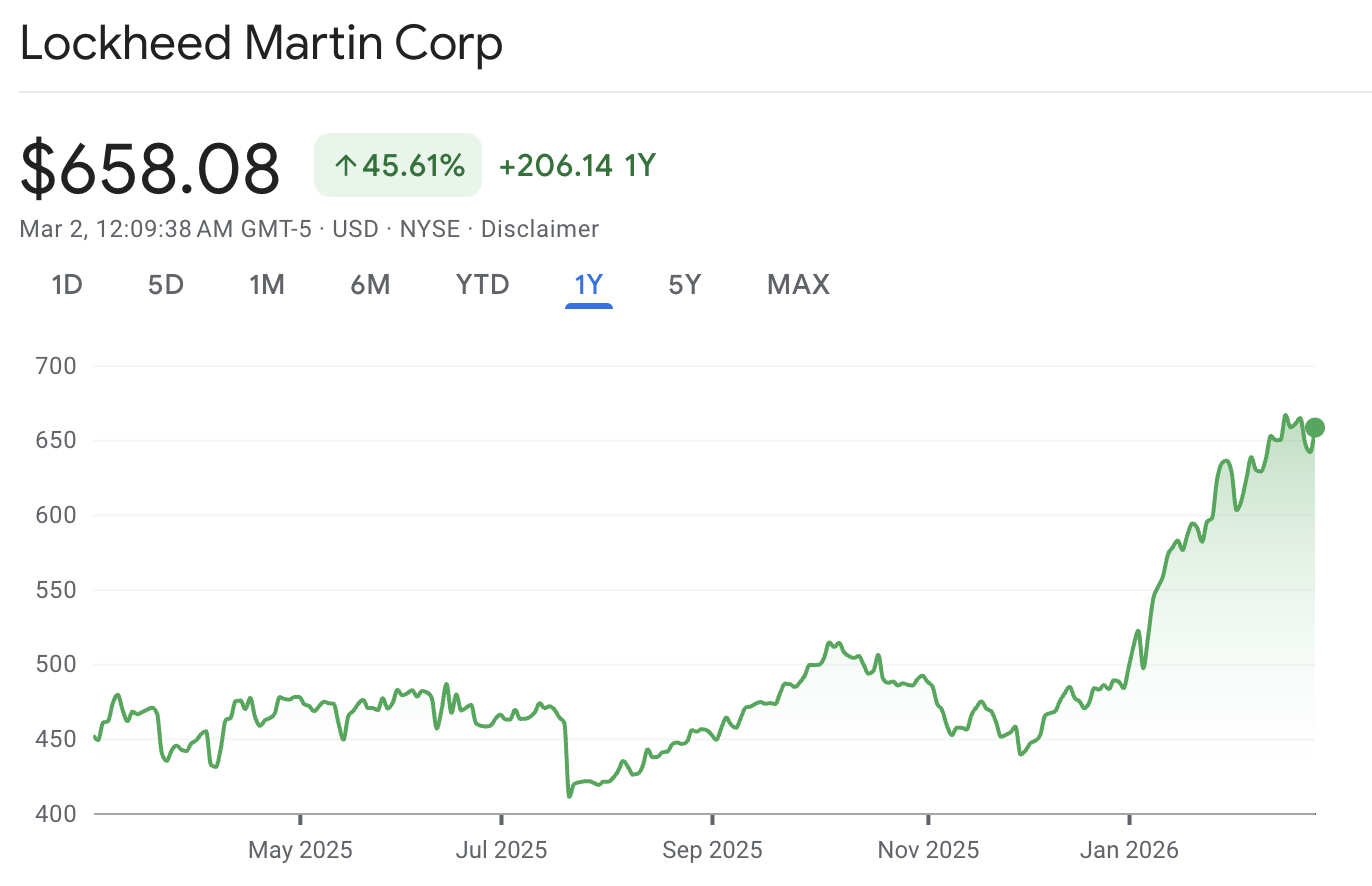
Lockheed offers a direct investment opportunity in U.S. and allied efforts for integrated air and missile defense, as well as increased munitions production.
Lockheed ended 2025 with:
Sales of $75.0 billion (up 6%).
Record backlog of $194 billion.
Free cash flow of $6.9 billion in 2025 (after an $860 million pension contribution).
For 2026, Lockheed guided to:
Sales of $77.5 to $80.0 billion.
EPS of $29.35 to $30.25.
Free cash flow of $6.5 to $6.8 billion.
Lockheed Martin has signed a framework agreement to increase THAAD interceptor production from 96 to 400 units per year.
Additionally, they have a separate framework agreement to increase PAC-3 MSE missile production capacity from approximately 600 to about 2,000 units per year over the next seven years, contingent upon funding and contract approvals.
The Senate summary highlights increased funding for PAC-3 and THAAD interceptors, as well as solid rocket motors, which corresponds to the demand signal Lockheed is currently emphasizing.
Lockheed declared a quarterly dividend of $3.45 per share for Q1 2026.
At the latest quoted price of approximately $658, this translates to an annual yield of roughly 2.1%, based on an annualized figure of $13.80.
Valuation risk: LMT trades at a premium multiple relative to some peers at the moment, which could cap upside if growth stays steady rather than accelerating.
Program concentration risk: When a stock's narrative leans on a few flagship programs, headlines can swing sentiment even if cash flow stays solid.
Budget optics risk: As defense spending rises, political pressure often shifts toward delivery speed, contract performance, and oversight.
In short, Lockheed's stock is a best fit for investors who want scale, backlog, and direct exposure to air-and-missile defense and munitions.
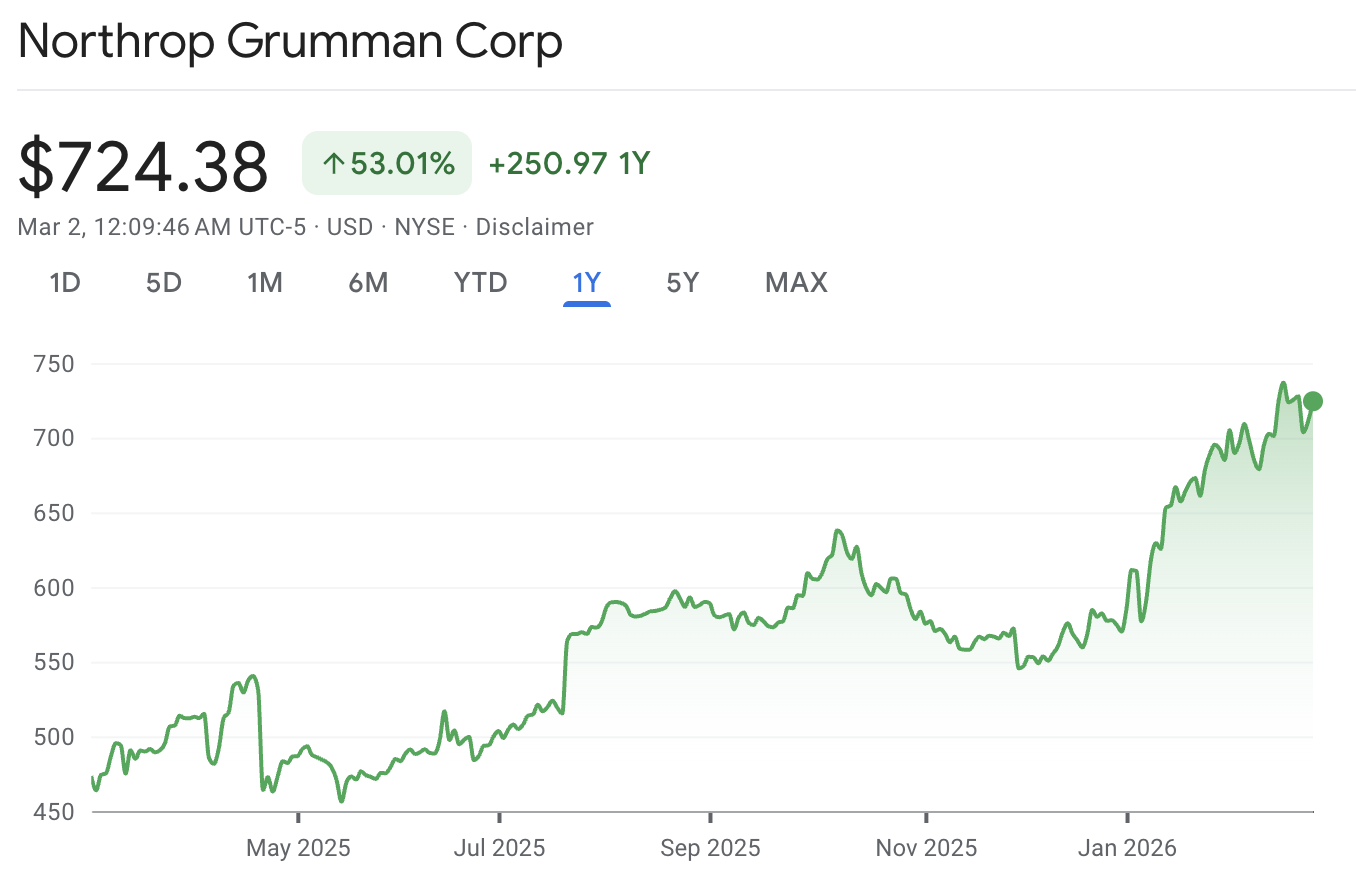
Northrop is built around programs that governments rarely cancel once they are underway, which is both a strength and a risk.
Northrop's 2025 results showed:
Backlog of $95.7 billion, a company record, with a full-year book-to-bill of 1.10.
2025 sales of $42.0 billion, and free cash flow of $3.3 billion.
MTM-adjusted EPS of $26.34 for 2025 (the company's preferred measure for guidance comparisons).
For 2026, management guided to:
Sales of $43.5 to $44.0 billion, with mid-single-digit growth.
Adjusted EPS of $27.40 to $27.90 and free cash flow of $3.1 to $3.5 billion.
The U.S. Air Force and Northrop have agreed to increase B-21 production capacity by approximately 25%, utilizing $4.5 billion in reconciliation funding allocated for this purpose.
A record backlog and a book-to-bill above 1.0 typically indicate strong revenue visibility.
Northrop declared a quarterly dividend of $2.31 per share, payable March 11, 2026.
At the latest quoted price of approximately $724, this equates to an annual yield of about 1.3%, based on an annualized amount of $9.24.
Execution risk on large programs: Large, multi-year programs can lead to more volatile margins, and schedule or cost adjustments can dominate reports for several quarters.
Capital allocation trade-offs: Management commentary has implied a tilt toward growth investment, which can reduce buyback support at the margin.
Valuation sensitivity: NOC is currently cheaper than LMT on a P/E basis, but it requires consistent execution to maintain its valuation multiple.
In short, Northrop's stock is ideal for investors seeking exposure to strategic platforms and space, while understanding that development phases may result in temporary margin challenges.
The table below uses the most recent market data available, along with each company's latest reported guidance and backlog figures.
| Stock | Latest price | Market cap | P/E | What it is best known for in a defense portfolio |
|---|---|---|---|---|
| RTX (RTX) | $202.62 | $224.0B | 33.98 | It offers defense plus a large commercial aerospace exposure, which can reduce or add volatility depending on the cycle. |
| General Dynamics (GD) | $357.05 | $88.5B | 20.99 | It is often a "steady" defense holding because it mixes platforms and government services, and it is closely tied to shipbuilding and land systems funding priorities. |
| L3Harris (LHX) | $364.54 | $55.6B | 31.63 | It tends to track the sensors, communications, and network side of modern defense spending. |
| Huntington Ingalls (HII) | $444.52 | $11.3B | 19.86 | It is the most direct "U.S. shipbuilding capacity" exposure, which can work well when Congress protects shipbuilding accounts. |
Yes. They are both top-tier, but "best" depends on what you want the stock to do for you.
| If you want… | The defense stock setup that tends to fit | Why |
|---|---|---|
| Higher income and steady buy-and-hold feel | LMT | Larger dividend yield and a very large backlog, with clear free cash flow guidance. |
| More "strategic programs" torque | NOC | Exposure to long-cycle deterrence and space programs, with guided mid-single-digit growth and elevated investment. |
If you want a broader defense basket, these names matter for different reasons, and they often behave differently when headlines hit.
| Stock | Latest price | Market cap | P/E | What it is best known for in a defense portfolio |
|---|---|---|---|---|
| RTX (RTX) | $202.62 | $224.0B | 33.98 | It offers defense plus a large commercial aerospace exposure, which can reduce or add volatility depending on the cycle. |
| General Dynamics (GD) | $357.05 | $88.5B | 20.99 | It is often a “steady” defense holding because it mixes platforms and government services, and it is closely tied to shipbuilding and land systems funding priorities. |
| L3Harris (LHX) | $364.54 | $55.6B | 31.63 | It tends to track the sensors, communications, and network side of modern defense spending. |
| Huntington Ingalls (HII) | $444.52 | $11.3B | 19.86 | It is the most direct “U.S. shipbuilding capacity” exposure, which can work well when Congress protects shipbuilding accounts. |
They are often viewed as more defensive than many sectors because both companies have large backlogs and long-term government contracts.
Lockheed is more directly tied to fighter aircraft, helicopters, and missile-defense interceptors that are being pushed to higher production. Northrop is more concentrated in strategic platforms, space work, and programs like the B-21, which can have bigger development-cycle margin swings.
The FY2026 appropriations summary emphasizes increased funding for PAC-3 and THAAD interceptors, as well as enhanced solid rocket motor capacity, which together support the munitions and missile defense supply chain. That is a direct demand signal for key programs tied to large primes.
In conclusion, Lockheed and Northrop are two of the strongest "core" defense exposures in 2026 because their portfolios line up with what budgets are funding: missile defense, munitions, strategic deterrence, and space resilience.
Lockheed is the cleaner 2026 "air defense capacity" story, and Northrop is the cleaner "strategic programs plus space" story. The better choice depends on which theme you believe will dominate headlines and funding decisions over the next 6 to 18 months.
Disclaimer: This material is for general information purposes only and is not intended as (and should not be considered to be) financial, investment or other advice on which reliance should be placed. No opinion given in the material constitutes a recommendation by EBC or the author that any particular investment, security, transaction or investment strategy is suitable for any specific person.