Published on: 2026-03-03
Updated on: 2026-03-03
AVAV stock just delivered the kind of session that makes traders feel like they watched two different stocks in one day. The stock surged initially, reaching around $303, but then quickly dropped and closed at approximately $208.32 after news broke that the U.S. Space Force might reopen the SCAR contract competition.
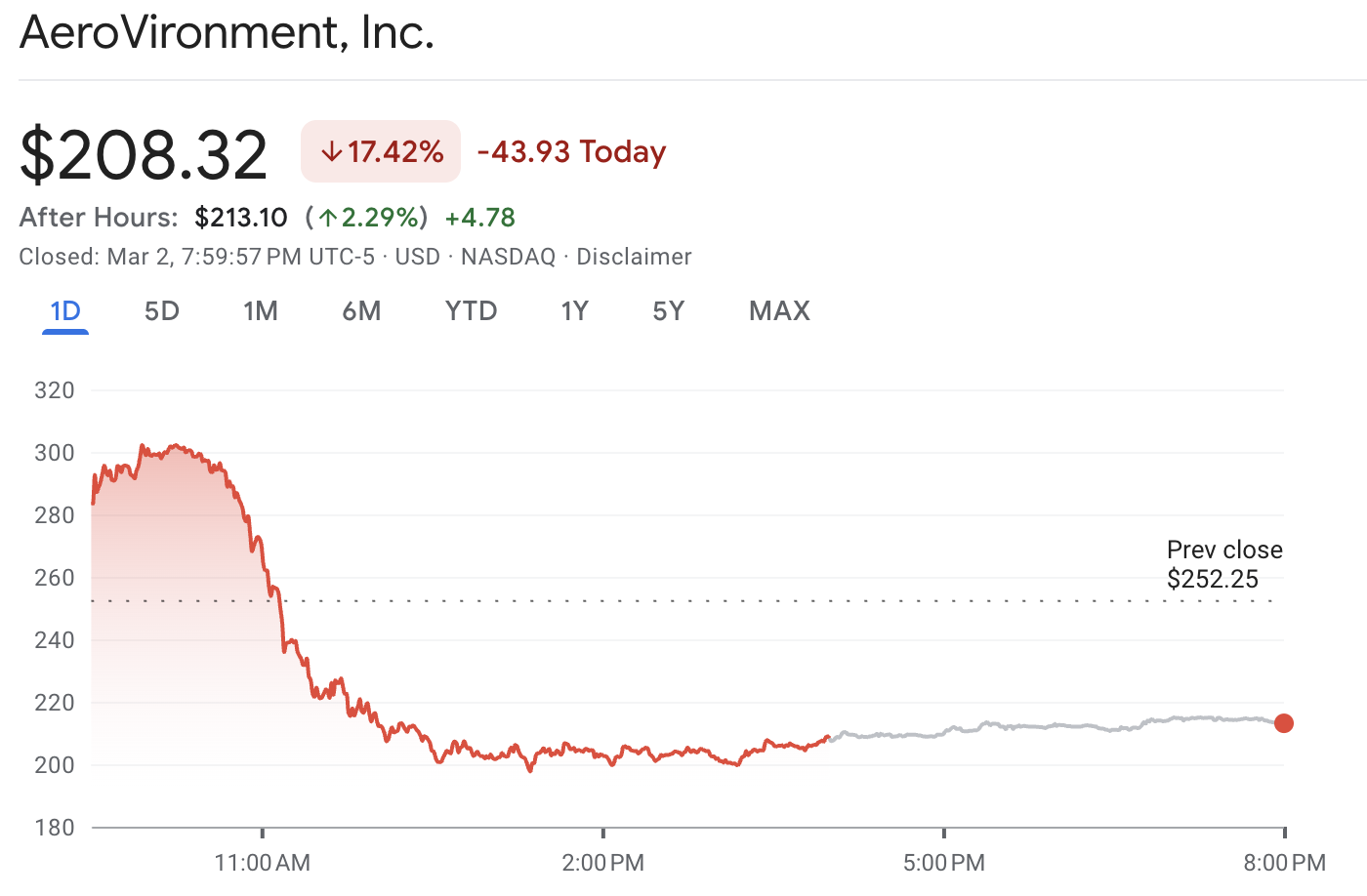
The full-day range was wide, from roughly $196.22 to $303.00, indicating the emotional impact of the announcement on the tape.
The key question is simple: Is this dip a buyable overreaction, or is SCAR risk big enough to change the medium-term story?
The swing was driven by two forces colliding:
A broad defense rally (which pushed AVAV up fast early in the session).
A sudden shift in contract confidence after a report said the Space Force is reopening the SCAR program contract, which could put AeroVironment's role at risk.
It raises the risk that AVAV could lose work associated with the BADGER phased-array antennas, a capability acquired through its $4.1 billion deal with BlueHalo.
A research downgrade added fuel as Raymond James cut the stock to "Sell" after the SCAR headline.
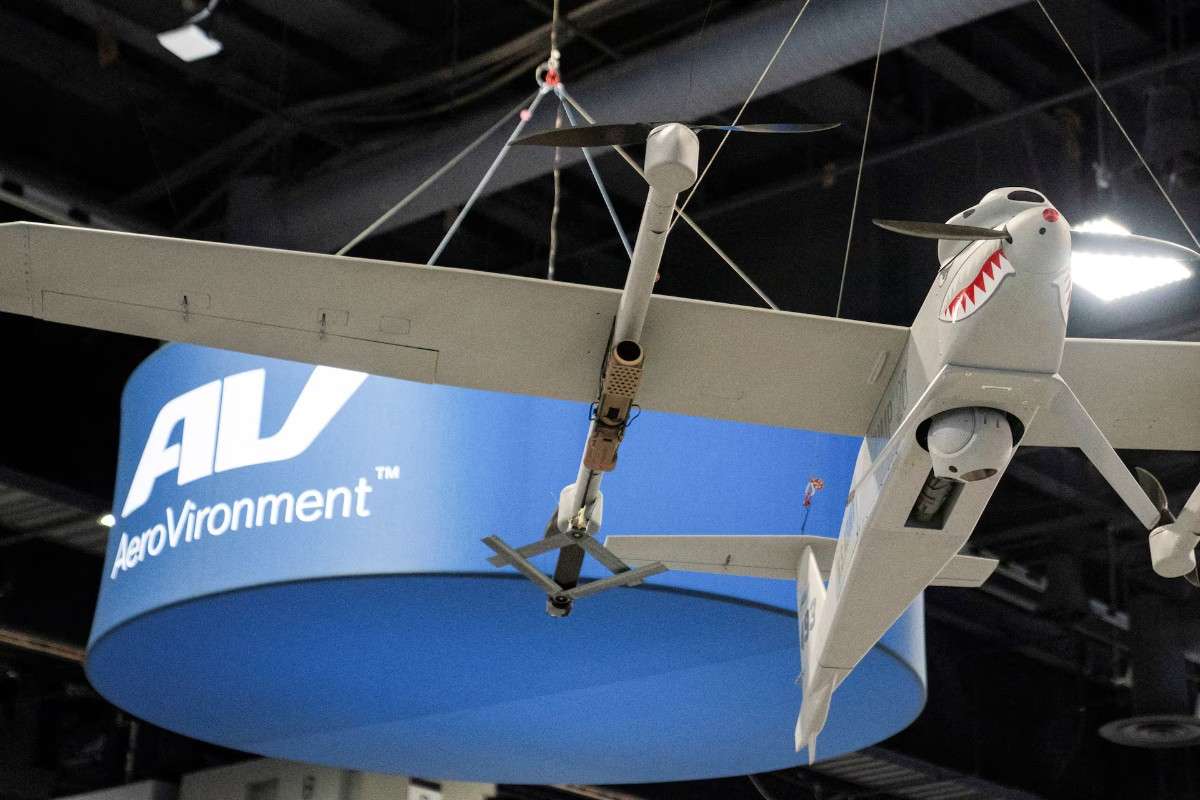
SCAR stands for Satellite Communication Augmentation Resource. It is a Space Force effort to expand satellite control and communications capacity using electronically steerable phased-array antennas rather than traditional parabolic dishes.
AeroVironment is involved in its BADGER phased-array antenna systems. In September 2025, the company announced a firm-fixed-price contract to deliver two BADGER systems to support SCAR, stating that future production options remained open.
SCAR aims to expand communications capacity and support global coverage, with a stated need for multiple antenna systems worldwide.
The risk for AVAV is not that the technology stops working. The risk is that contract terms and program requirements are being revisited, which can trigger a recompetition, a renegotiation, or a slower delivery cadence.
Two developments explain why the market is jumpy about this program:
In an 8-K dated January 16, 2026, AeroVironment disclosed that the U.S. Government issued a stop-work order (by mutual agreement) on the SCAR "Other Transaction Agreement" while both sides negotiate an amended agreement under new requirements.
The company stated that the revised agreement is expected to be a firm-fixed-price contract and that it will continue to provide capabilities and products for SCAR.
A stop-work order does not mean cancellation, but it does mean the terms are changing. That alone raises uncertainty.
The March 2 selloff was triggered by a report that the Space Force is reopening the SCAR contract, which the market read as: "This might turn into a new competition."
That is why the stock reacted so aggressively. It was not a quarterly earnings miss. It was a probability shift in a major contract storyline.
One reason the move looks outsized is that the potential SCAR impact, while meaningful, does not appear to be the main driver of AeroVironment's full-year revenue.
Even if AVAV lost the work, it would represent approximately 6% of the expected FY2026 sales, which are projected to be around $2 billion. That math implies SCAR-related revenue of roughly $120 million (6% of $2.0B). It is meaningful, but it is not business-ending.
AeroVironment's own FY2026 revenue guidance is $1.95 billion to $2.0 billion.
That lets you frame the risk in dollars:
| Scenario | What happens with SCAR | Rough FY26 revenue impact (illustrative) | Likely market reaction |
|---|---|---|---|
| Bull case | AV keeps the work after renegotiation | Limited | The selloff looks like an overreaction |
| Base case | Timing slips, revenue shifts right | Modest timing hit | Stock stays choppy until clarity returns |
| Bear case | Work is lost in a rebid | ~6% risk (~$120M on $2.0B) | Multiple compresses until growth is re-proven |
Key Takeaway
This is less of a revenue cliff and more of a shock to margins and confidence, as firm-fixed-price structures and recompetitions can alter profitability even when revenue eventually recovers.
If you step back from SCAR for a moment, AeroVironment still has much measurable momentum.
In its fiscal Q2 FY2026 materials, the company reported:
Q2 FY26 revenue: $472.5M
Non-GAAP EPS: $0.44
Funded backlog: $1.1B
Unfunded backlog: $2.8B
Record contract awards ceiling: $3.5B
Bookings: nearly $1.4B
FY26 revenue guidance: $1.95B to $2.0B
FY26 non-GAAP EPS guidance: $3.40 to $3.55
It shows the company has demand beyond any single program.
On February 26, 2026, AeroVironment announced a $186M U.S. Army delivery order for next-generation Switchblade 600 Block 2 and Switchblade 300 Block 20 systems, issued under an existing multi-year IDIQ contract.
For investors trying to decide whether to buy a dip, this is the counterweight to SCAR fear: the loitering munitions side is still getting funded and ordered.
This is not a stock you buy simply because it fell 17% in a day. It is a stock you buy if you have a plan for the SCAR headline cycle.
You believe SCAR can be recompeted and is still winnable, and you think the market is overvaluing permanent losses.
You want exposure to the uncrewed demand cycle, and you view SCAR as a manageable piece of a broader growth story that includes recent Army orders.
You are comfortable with volatility, because ATR implies wide daily ranges and gap moves are common in headline-driven defense names.
You cannot tolerate a scenario where contract terms shift toward firm-fixed price and margins compress, even if revenue ultimately returns.
You need to clarify program ownership before adding risk, as "reopening" language may cause weeks of speculation and sharp intraday fluctuations.
You prefer steadier defense exposure, in which case broader primes can offer less single-program risk, even if they have lower upside torque.
Currently, AVAV stock is showing technical weakness following a reversal. As of March 3, 2026, daily technical indicators showed Strong Sell, with several oscillators in oversold territory.
| Indicator | Value | Signal |
|---|---|---|
| RSI (14) | 36.297 | Sell |
| MACD (12,26) | -12.8 | Sell |
| ADX (14) | 33.089 | Sell (trend strength high) |
| ATR (14) | 16.1857 | High volatility |
| Stoch (9,6) | 19.232 | Oversold |
| Williams %R | -88.911 | Oversold |
| CCI (14) | -124.4466 | Sell |
| Moving average | Simple | Signal |
|---|---|---|
| MA5 | 206.23 | Buy |
| MA10 | 234.59 | Sell |
| MA20 | 243.54 | Sell |
| MA50 | 255.58 | Sell |
| MA100 | 256.25 | Sell |
| MA200 | 271.70 | Sell |
The stock is near the 5-day average but far below all medium- and long-term averages. Rebounds can be sharp, but they often face heavy selling pressure as trapped holders use the strength to reduce their risk.
| S3 | S2 | S1 | Pivot | R1 | R2 | R3 |
|---|---|---|---|---|---|---|
| 191.23 | 195.12 | 198.38 | 202.26 | 205.52 | 209.40 | 212.66 |
Practical levels after the whipsaw
First support zone: ~$202 (pivot) down to ~$198 (S1).
Deeper support zone: ~$195 to ~$191 (S2 to S3).
First resistance zone: ~$209 to ~$213 (R2 to R3).
Big trend resistance: the 50-day and 200-day moving averages in the mid-$250s to low-$270s.
The stock is oversold, but it is still below most major moving averages. Oversold can bounce. It does not always reverse the trend.
If you want to trade this like a professional, you should watch for process signals, not social media noise.
The Four Near-Term Catalysts
Clarification on the Space Force's "reopen" process.
Any update on the stop-work order renegotiation?
Management framing around backlog quality.
Execution signals in the unmanned portfolio.
The stock surged early, then sold off after a report stated the Space Force may reopen the SCAR contract competition, raising the risk that AeroVironment could lose or delay that work.
SCAR stands for Satellite Communication Augmentation Resource. It is a Space Force program tied to deployable, electronically steerable phased-array antenna systems that support satellite command and control.
Yes. In a January 2026 8-K, the company disclosed a stop-work order (by mutual agreement) to allow renegotiation under new SCAR requirements, expected to move toward a firm-fixed-price agreement.
It can be, but it is not a simple call. The stock is oversold on momentum indicators, but it remains below key moving averages, and the SCAR outcome is not settled.
In conclusion, AVAV stock's whipsaw looks dramatic. Still, the underlying issue is specific: SCAR uncertainty changed how investors price contract risk and margin visibility, and that hit a stock that had already run hard.
A dip can be buyable if you believe SCAR is a renegotiation and process problem rather than a permanent loss, and if you want exposure to rising unmanned demand that is still showing up in contract awards.
A dip is less attractive if you require near-term clarity, because firm-fixed price dynamics and recompetitions can keep volatility elevated even when the long-term thesis remains intact.
Disclaimer: This material is for general information purposes only and is not intended as (and should not be considered to be) financial, investment or other advice on which reliance should be placed. No opinion given in the material constitutes a recommendation by EBC or the author that any particular investment, security, transaction or investment strategy is suitable for any specific person.