Published on: 2026-04-15
Updated on: 2026-04-15
IonQ stock rose 20.2% in the April 14 U.S. session, closing at $35.76 after touching $36.74 intraday, which marked one of its strongest single-day moves of 2026.
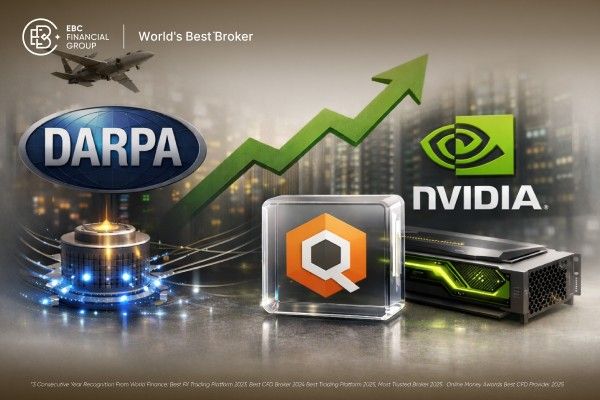
NVIDIA helped pull capital into quantum equities, but that was a sector tailwind. IonQ's DARPA selection and networking milestone gave investors a reason to treat the company differently from the rest of the trade.
DARPA's HARQ program focuses on heterogeneous quantum systems, and IonQ's role centers on interconnects and photonic integration across different qubit types, a direct fit with its networking roadmap.
IonQ entered the rally with stronger fundamentals than a year ago, including $130.0 million in 2025 revenue, 2026 guidance of $235 million at the midpoint, and $3.3 billion of liquidity.
Risk still runs high. At roughly 78 times 2026 revenue guidance, with the current market value and management's midpoint outlook, IonQ stock still prices years of execution before profits.
The HARQ award matters because DARPA is not funding a vague research theme. The agency is trying to move quantum computing beyond single-modality systems by integrating different qubit types into a single architecture, with separate roles for processing, memory, and communication.
IonQ's task fits directly into that design goal. The company said the contract supports work on high-speed quantum interconnects for communication across trapped ions, neutral atoms, and superconducting qubits.
That changes the market read. Investors are no longer looking only at IonQ as a trapped-ion hardware name with cloud access and long-dated optionality. They are looking at a company trying to own the systems layer between quantum modules.
In other words, HARQ frames IonQ less as a single machine vendor and more as an architecture company with a role in the plumbing of future quantum networks. For a stock priced on future relevance, that distinction is worth a lot.
This is also not IonQ's first federal signal. In late 2025, DARPA advanced IonQ to Stage B of its Quantum Benchmarking Initiative. In January 2025, the company announced a $21.1 million Air Force Research Laboratory project focused on secure quantum networking. In February 2026, IonQ said it had been selected to support the Missile Defense Agency's SHIELD IDIQ framework.
Today's DARPA headline fits a pattern. Federal demand is moving from broad interest toward architecture-specific engagement.
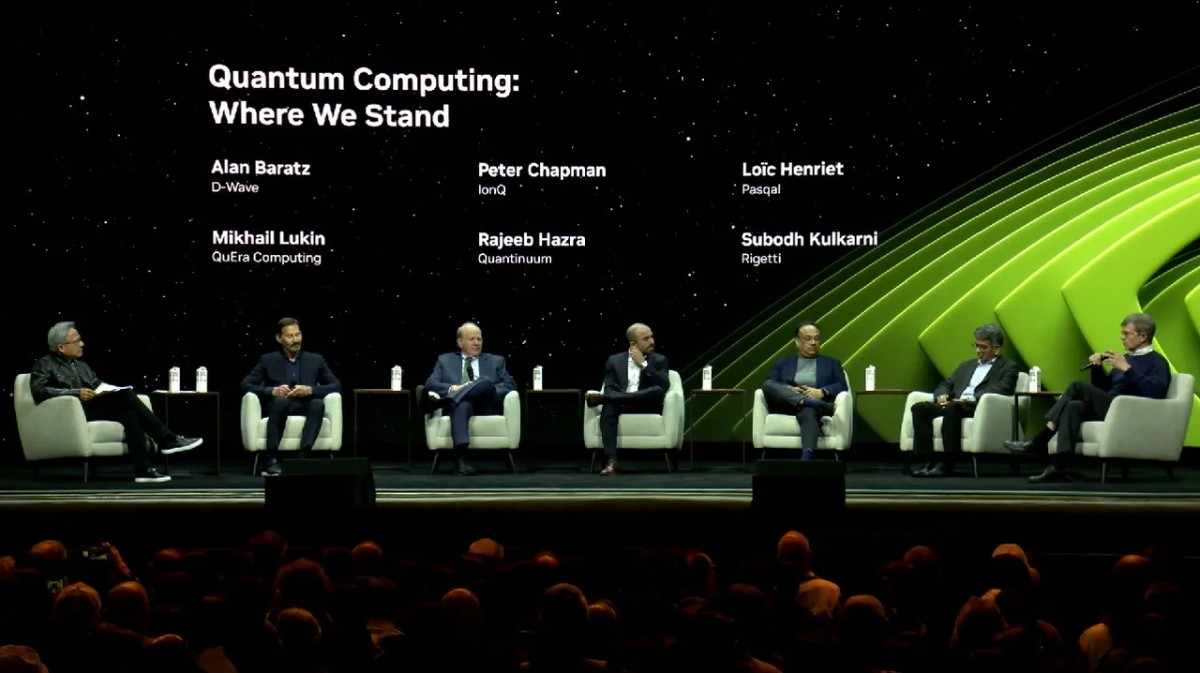
NVIDIA still played a role in today's move. News around NVIDIA's latest quantum push and World Quantum Day helped lift sentiment across the sector, and market coverage showed broad gains in quantum names, not only IonQ. That tells you some part of the move came from basket buying, thematic momentum, and a renewed appetite for anything tied to quantum computing and AI infrastructure.
IonQ already has ties to Nvidia. The company has used NVIDIA's CUDA-Q platform in hybrid chemistry workflows, worked with AstraZeneca, AWS, and NVIDIA on a quantum-accelerated drug development application, and last month announced a South Korea initiative with KISTI built around NVIDIA NVQLink. Those relationships matter because hybrid quantum-classical workflows are where commercial demand is forming first.
Still, NVIDIA is an ecosystem multiplier. DARPA is a validator. NVIDIA's announcements tend to raise the ceiling for the whole quantum stack. DARPA selection does something narrower and more valuable for IonQ equity. It signals that the company's specific roadmap aligns with a U.S. defense priority, and that signal is harder for the market to dismiss as pure narrative.
| Metric | Latest Figure | Market Read |
|---|---|---|
| Share Price, April 14 Close | $35.76 | Buyers held most of the gap into the close |
| Intraday High | $36.74 | Strong upside follow-through on the news |
| Volume | 68.0 million shares | Heavy participation, not a thin squeeze |
| 2025 Revenue | $130.0 million | Commercial scale is improving fast |
| 2026 Revenue Guidance Midpoint | $235.0 million | The market is pricing in another step up |
| Cash, Cash Equivalents, and Investments | $3.3 billion | The balance sheet supports acquisitions and R&D |
| Full-Year 2025 Net Loss | $510.4 million | Profitability still trails revenue growth |
The table shows why IonQ trades like a future platform rather than a mature software company. Revenue growth is strong, and liquidity is deep, but earnings still lag far behind the valuation.
This rally tells you the market is rewarding three traits at once: architecture relevance, federal positioning, and capital depth. IonQ's January deal to acquire SkyWater for about $1.8 billion added a domestic foundry angle to its full-stack pitch. That matters more when federal agencies are selecting performers for sensitive systems work.
A company with government ties, networking assets, and deeper semiconductor control fits the current procurement mood better than a narrow single-product story.
The risk is valuation. Using IonQ's current market capitalization and the midpoint of its 2026 revenue guidance, the shares trade at about 78 times forward sales. The company also posted a full-year 2025 net loss of $510.4 million.
That means today's move works as a repricing of strategic value, not proof of near-term earnings power. If contract awards stay small or if commercial revenue slips, the stock has little room for operational mistakes.
No. NVIDIA helped lift sentiment across the quantum group, but IonQ had stronger company-specific news. The DARPA HARQ contract and the same-day networking milestone gave investors a direct reason to buy IonQ rather than only chase the theme.
HARQ stands for Heterogeneous Architectures for Quantum.DARPA developed the program to connect various qubit types into a unified system, featuring distinct hardware optimized for memory, communication, and processing. IonQ's role centers on quantum interconnects and photonic integration.
The move does not rewrite the income statement overnight. It does improve the strategic case. IonQ has shown increased engagement with federal entities, a growing network narrative, and strong balance-sheet capacity to support growth while scaling revenue.
IonQ's stock surged today move looked like a repricing of credibility. NVIDIA helped bring money into quantum. DARPA gave IonQ a stock-specific reason to keep that money.
For a company selling a long-range architecture story, the difference between broad hype and funded validation is the difference that matters most.
Disclaimer: This material is for general information purposes only and is not intended as (and should not be considered to be) financial, investment or other advice on which reliance should be placed. No opinion given in the material constitutes a recommendation by EBC or the author that any particular investment, security, transaction or investment strategy is suitable for any specific person.