Published on: 2026-05-29
Updated on: 2026-05-29
Dell stock jumped nearly 40% post-earnings after its $51.3B AI backlog turned a strong quarter into a full valuation reset. Revenue rose 88%, AI server sales reached $16.1B, and guidance moved sharply higher, shifting the debate from whether AI demand exists to whether Dell can convert that demand into durable profit.
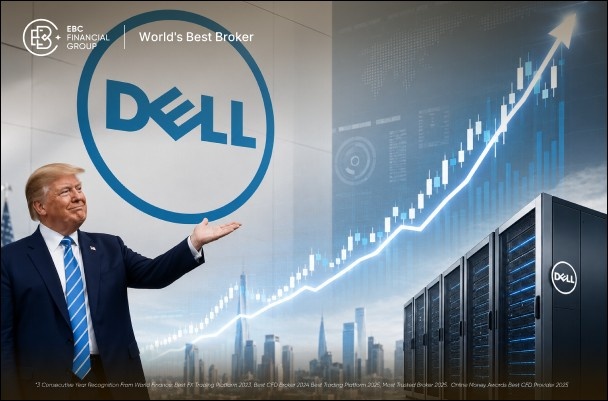
Trump’s public endorsement helped put Dell on momentum screens before earnings, but the report changed the rally's character. Political visibility may have accelerated attention; the earnings release supplied the financial proof.
Dell’s $51.3B AI backlog turned the post-earnings move into a forward visibility story, not just a beat.
Q1 revenue rose 88% to $43.8B, exposing how far consensus had lagged AI infrastructure demand.
AI-optimized server revenue reached $16.1B, proving backlog potential is now flowing into reported sales.
FY27 revenue guidance rose to $165B to $169B, forcing a full-year model reset.
Margin conversion is now the deciding factor, because AI servers can scale revenue faster than they can scale profit.
Dell’s most important Q1 number was not the 88% revenue growth. It was the $51.3B AI backlog, because backlog points beyond one quarter. Dell booked $24.4B in AI orders and recognized $16.1B in AI server revenue, showing that demand is still building while existing orders are already moving into sales.
The table shows where Dell most clearly beat the model and why the stock reaction moved beyond a standard earnings pop.
| Signal | Before Earnings | Q1 or Updated Figure | Market Implication |
|---|---|---|---|
| Revenue | About $35.7B expected | $43.8B actual | AI demand was materially under-modeled |
| Adjusted EPS | About $2.96 expected | $4.86 actual | Operating leverage exceeded consensus |
| AI server revenue | Future upside story | $16.1B actual | AI orders became reported sales |
| FY27 revenue guide | $138B to $142B prior outlook | $165B to $169B updated outlook | The full-year model moved higher |
| AI server outlook | About $50B prior target | About $60B updated target | AI visibility improved |
The most important row is the FY27 revenue guide. Dell did not merely beat Q1 expectations; it moved the full-year revenue midpoint higher by roughly $27B, forcing investors to value the company on a larger earnings base.
Infrastructure Solutions Group made that reset credible. Segment revenue rose to $29B, supported by AI server demand and broader enterprise infrastructure upgrades. That makes the quarter less dependent on speculative AI orders and more tied to actual data-center spending.

Trump’s endorsement helped shape the pre-earnings rally. Dell stock hit an all-time high on May 8 after President Donald Trump publicly encouraged Americans to buy Dell products, with shares rising as much as 14.6% intraday and closing roughly 12% higher.
The post-earnings move had a different foundation. Political attention can accelerate a trade, but it does not create $16.1B in quarterly AI server revenue or a $51.3B AI backlog. Trump helped put Dell on the radar; earnings gave investors a reason to reprice it.
Dell’s $9.7B Pentagon contract adds useful visibility, but it also raises the scrutiny attached to government exposure. For investors, the contract supports Dell’s federal technology position. In the stock narrative, execution is more important than political attention.
Dell has proved AI demand. It now has to prove AI profitability.
AI servers can generate high revenue, but they may have lower gross margins than services, storage, or higher-value infrastructure. That makes operating leverage the key signal from here. If AI server sales rise faster than operating income, the stock has priced in scale without enough profit durability.
The Q1 EPS beat shows leverage is already present. The next test is whether it holds as AI server revenue moves toward the $60B full-year target. For Dell stock, the next leg of the rally depends less on bigger orders and more on whether those orders become higher earnings.
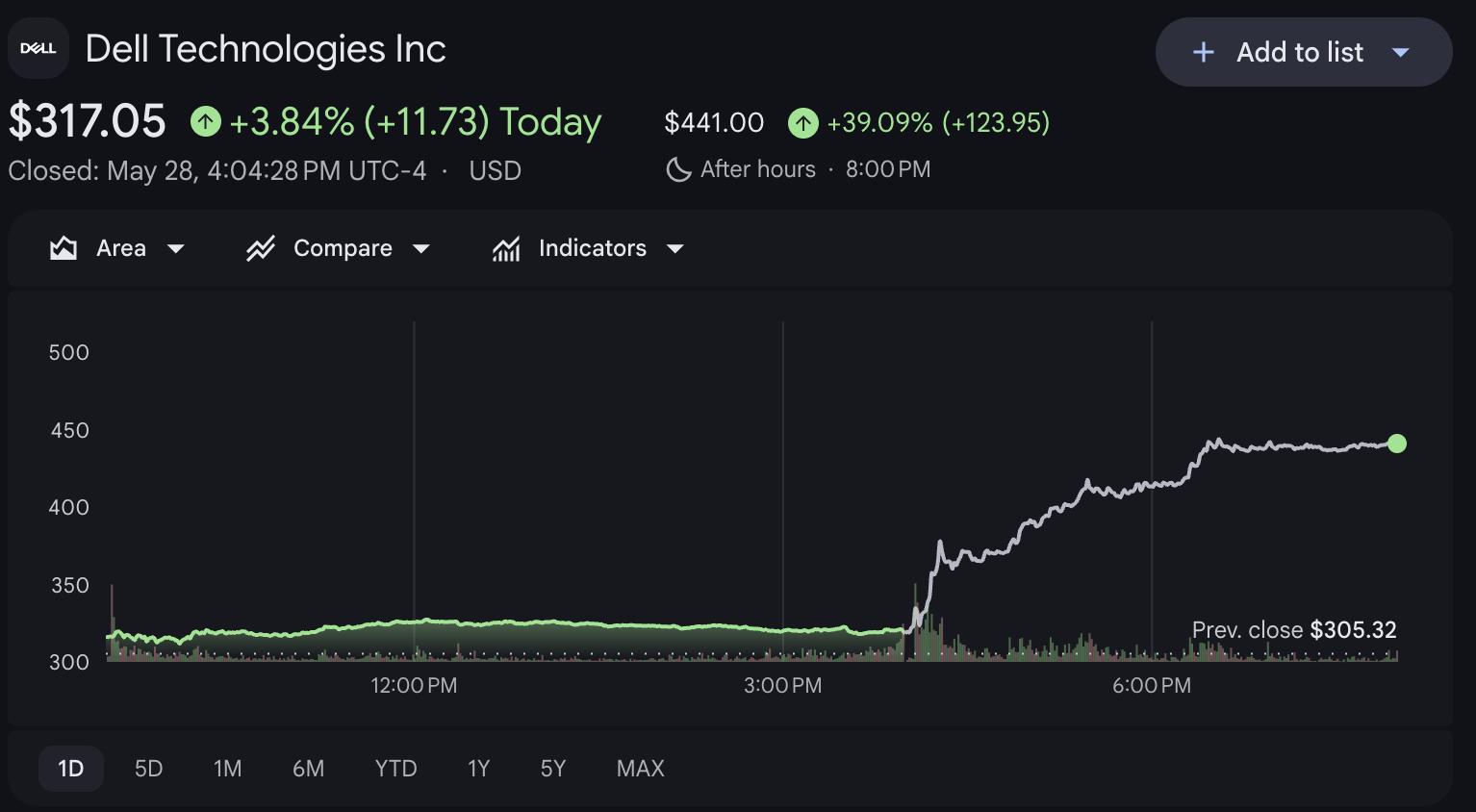
Dell closed at $317.05 on May 28, 2026, with a market value above $210B and a trailing P/E above 42. The stock later rose nearly 40% in after-hours trading, pushing the implied valuation sharply higher, though the forward multiple looked less stretched relative to Dell’s FY27 adjusted EPS guide of $17.90.
That is the shift investors are making. Dell is no longer being priced mainly as a cyclical hardware vendor. It is being priced as an AI infrastructure supplier that must keep turning backlog into revenue, earnings, and cash flow.
The risk is not weak AI demand. The risk is that the market has already priced in fast, profitable execution. Gross margin pressure could intensify if AI servers outgrow services, storage, and higher-value infrastructure. Supply constraints in GPUs, memory, networking equipment, or power capacity could slow deployment schedules.
Customer concentration could make AI server revenue lumpier than the backlog headline suggests, while political scrutiny around federal contracts and public endorsements could add another layer of volatility.
Those risks do not erase the earnings beat. They define the hurdle Dell must clear after a nearly 40% post-earnings move: the company must prove that the AI backlog can become durable earnings, not just larger shipments.
Dell stock jumped because investors treated Q1 as a forward reset, not just a beat. Revenue rose 88% to $43.8B, adjusted EPS reached $4.86, and the $51.3B AI backlog provided the market with a clearer view of future demand.
AI is the stronger financial driver. Trump’s public praise helped fuel pre-earnings momentum, but the post-earnings move came from AI server revenue, backlog, and raised guidance. The cleaner reading is that politics lifted attention while earnings changed the model.
Dell’s Infrastructure Solutions Group, or ISG, houses the company’s servers, storage, and enterprise infrastructure business. Q1 mattered because ISG revenue rose to $29B, making it the engine behind Dell’s AI repricing. It showed that AI demand was not just boosting orders, but reshaping the company’s main growth segment.
Dell is no longer priced like a simple hardware stock. The valuation can hold if the AI backlog continues to convert into earnings and cash flow. It becomes harder to defend if future quarters show strong AI shipments but weaker margin flow-through.
The rally could stall if gross margins compress, AI server deployment slows, or guidance stops rising. The biggest risk is not weak demand; it is that investors have already priced in fast, profitable execution.
The next formal trigger is Dell’s fiscal Q2 FY27 results, which are expected to fall within management’s guidance of $44B to $45B in revenue and $4.80 in adjusted EPS at the midpoint. That report will matter less for headline AI demand than for the quality of Dell’s profit flow-through.
Investors should watch the spread between AI server growth and operating income growth. If revenue accelerates while margins weaken, the rally will look like a demand spike. If operating leverage holds, Dell’s post-earnings surge will look more like the start of a new valuation regime.
Dell has already won the AI demand argument; Q2 will test whether it can win the profit argument.