Published on: 2026-03-03
Updated on: 2026-03-03
If you are evaluating how to hedge your stock portfolio against inflation in 2026, the right frame is not “beat CPI.” It is “reduce the ways inflation can quietly damage equity returns,” through margin pressure, higher discount rates, and sudden repricing of expectations.
With real yields still elevated and inflation progress uneven, portfolios that rely on long-duration growth or thin pricing power remain vulnerable to a renewed inflation impulse.
Inflation in early 2026 is being sustained less by a broad goods shock and more by services-heavy categories that move slowly.
Shelter remains a steady pressure point, and energy is mixed: gasoline is down 7.5% YoY, yet electricity is up 6.3% YoY and utility gas service is up 9.8% YoY, which keeps household cost burdens sticky even when headline CPI cools.
Pipeline signals also matter because they foreshadow margin pressure. January producer prices rose faster than expected, with headline PPI up 0.5% MoM and 2.9% YoY, and core measures firmer, driven largely by services and margins.
Wage pressure has eased versus the peak, but labor costs are still rising: the Employment Cost Index showed total compensation up 3.4% over the 12 months ending December 2025.
Inflation hedging is most effective when tailored to an equity portfolio's specific vulnerabilities during periods of inflationary stress.

Three exposures are particularly relevant in 2026:
1) Equity Duration Risk. Many “quality growth” portfolios are effectively long-duration. They depend on cash flows far in the future, so they behave like rate-sensitive assets when real yields rise. With the Fed still at 3.50% to 3.75%, inflation surprises often translate into higher real rates and a valuation reset, even if earnings do not collapse.
2) Margin Pass-Through. Inflation is not evenly distributed. Companies with short pricing cycles, subscription revenue, or strong brands can defend margins by raising prices. Businesses with long contracts, commodity-heavy inputs, or price-sensitive customers often absorb higher costs first, then lose share later.
3) Concentration Risk. Apparent stability at the index level can obscure vulnerabilities in individual stocks. Portfolios concentrated in a few high-multiple equities require hedges that specifically address the risk of rising real yields combined with multiple compression.
A practical inflation hedge consists of multiple instruments, structured to address various potential inflation scenarios.
Treasury Inflation-Protected Securities (TIPS) provide a direct linkage between a portion of the portfolio and realized inflation. They are most effective when actual inflation exceeds breakeven expectations.
The primary risk is duration exposure to real yields rather than to the Consumer Price Index (CPI) itself. With the 10-year TIPS real yield recently at 1.72%, careful consideration of position size and maturity is essential.
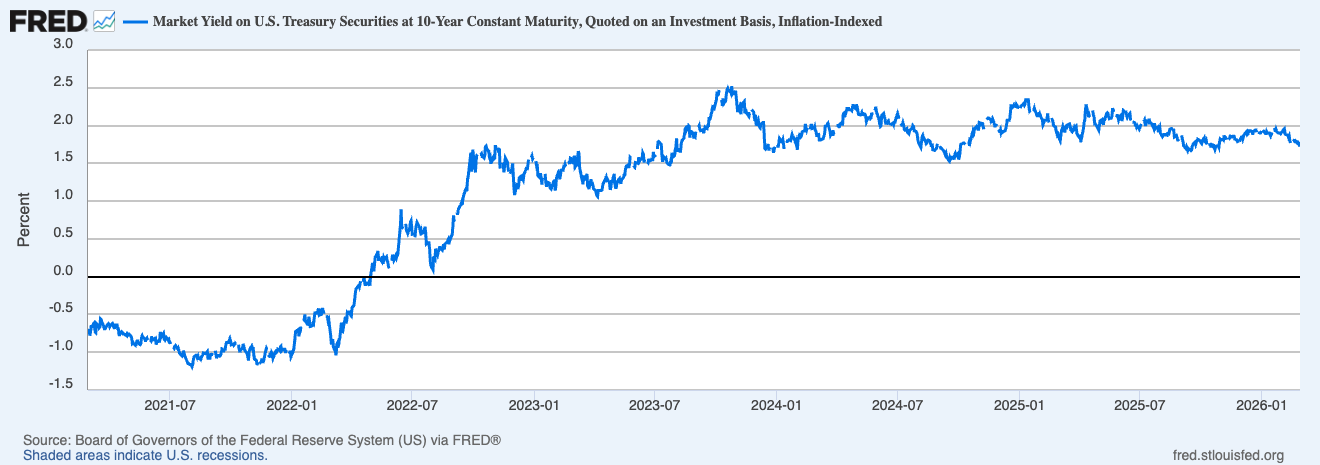
Shorter-duration TIPS allocations generally reduce drawdowns during periods of rising real yields.
Commodities tend to respond rapidly to supply-driven inflation, particularly in the energy and industrial input sectors. They can help offset scenarios that are typically detrimental to equities, such as oil price spikes, weather-related increases in food prices, or sudden supply constraints.
However, commodities are characterized by volatility and roll yield considerations, making them more suitable as modest shock absorbers rather than as primary return drivers.
Gold does not track the Consumer Price Index (CPI) on a monthly basis. Instead, it tends to perform well when inflation coincides with policy uncertainty, geopolitical tensions, or declining confidence in real purchasing power.
Gold is particularly useful in environments where inflationary pressures increase while economic growth slows, a scenario in which both equities and nominal bonds may underperform.
The most durable hedge for stock investors is owning businesses that can sustain real earnings. That means pricing power, stable demand, and balance sheets that do not depend on cheap refinancing.
A useful way to translate these concepts into portfolio construction is to think in terms of resilience through diversification.
A recent ETF-focused research note made the central point that an inflation hedge should aim for durability across different economic environments, not a single macro bet.
| Hedge Tool | What It Protects Against | Main Risk in 2026 | When It Works Best |
|---|---|---|---|
| Short/Intermediate TIPS | CPI surprises; purchasing power | Real yields rising | Inflation up, growth mixed |
| Broad Commodities Sleeve | Supply shocks | High volatility; carry | Energy-driven inflation |
| Gold | Regime risk; policy credibility | Can lag when real yields surge | Stagflation risk; risk-off |
| Pricing Power Equities | Margin defense | Valuation risk if overpaid | Services inflation; sticky costs |
| Real-Asset Cash Flows | Replacement cost; throughput | Cyclicality | Capex cycles; infrastructure |
| Options (Puts/Collars) | Defined drawdown windows | Premium cost | Event risk, CPI, Fed weeks |
Inflation does not inherently benefit “value” or “cyclical” stocks. Instead, it favors companies that can maintain real cash flows.

1) Pricing Power Over Narrative. Look for evidence, not slogans: stable gross margins, steady unit economics, and repeated price actions without volume collapse. This is why consumer staples with strong brands often act as partial inflation hedges, even when they are not “cheap.”
2) Real-Asset Linkages With Discipline. Energy and infrastructure sectors can provide inflation hedges when price increases are driven by supply constraints. The most favorable outcomes are typically achieved by companies with robust free cash flow and prudent capital allocation.
3) Rate Sensitivity Management. If the portfolio is heavy in long-duration equities, hedging inflation without addressing rate sensitivity can fail. Inflation shocks often lift real yields, and that is the channel that hits multiples.
The following are illustrative examples of U.S.-listed stocks that frequently exhibit inflation-resilient characteristics, either through pricing power or cash flows linked to real assets.
This list is not exhaustive; each company should be evaluated for valuation, balance sheet strength, and business-specific risks.
Procter & Gamble (PG): Staple demand and broad brand pricing power.
Coca-Cola (KO): Resilient consumption and global pricing architecture.
PepsiCo (PEP): Diversified pricing levers across beverages and snacks.
McDonald’s (MCD): Franchised model with pricing flexibility and scale advantages.
Exxon Mobil (XOM): Cash flows that can benefit from energy-price inflation.
Chevron (CVX): Similar inflation linkage, often with disciplined shareholder returns.
Kinder Morgan (KMI): Fee-based energy infrastructure with contracted cash flows.
Williams Companies (WMB): Natural gas infrastructure exposure, often less tied to spot prices than producers.
Caterpillar (CAT): End-market leverage to construction and replacement cycles.
Union Pacific (UNP): Pricing power via network scale and essential freight demand.
When inflation is a tail risk rather than a base case, options can be the cleanest hedge because the cost is explicit.
Put Spreads: Defined downside protection at a lower cost than outright puts.
Collars: Selling calls to help fund put protection, useful for concentrated holdings.
Timing Windows: Hedges around CPI, PCE, and major Fed meetings when repricing risk is highest.
The goal is not to predict inflation prints. It is to cap portfolio damage if a surprise drives real yields higher and compresses multiples.
1) Base Case: Disinflation Continues, Growth Holds: Keep hedges smaller and focus on quality pricing power, since blunt hedges can create drag.
2) Upside Inflation Surprise: Real Yields Rise: Add short-duration TIPS and tighten equity duration risk, since the 10-year TIPS real yield (1.72%) is the key transmission channel.
3) Stagflation Risk: Inflation Up, Growth Down: Tilt toward gold, quality defensives, and selective real-asset cash flows, and use options for drawdown control.
A practical allocation framework can be implemented by many investors without requiring a complete overhaul of their core equity holdings:
Core Inflation Sleeve (5% to 15%): Short-to-intermediate TIPS.
Shock Absorbers (3% to 8%): Commodities and gold.
Equity Structure Tilt: Pricing power, real-asset cash flows, and reduced long-duration concentration.
Event Hedges (As Needed): Options when data risk is asymmetric.
The most reliable approach is layered: use TIPS for inflation surprises, add a modest real-asset sleeve for supply shocks, and tilt equities toward pricing power. This matters because core inflation remains firmer than headline inflation, and policy remains restrictive.
Over the long term, stocks can outpace inflation, but the path matters. Inflation shocks can compress valuation multiples and squeeze margins simultaneously. Stocks with proven pricing power and stable demand tend to defend real earnings better than firms that rely on cheap capital or discretionary volume.
Yes, because the payoff is tied to surprises versus expectations. With 5-year breakevens at 2.45% and 10-year breakevens at 2.29%, the market is not pricing a large inflation buffer. Shorter-duration TIPS can reduce real-yield drawdown risk.
Because growth stocks are long-duration assets. When inflation surprises, real yields often rise, raising discount rates on future cash flows. With the 10-year TIPS real yield recently at 1.72%, that sensitivity remains meaningful in 2026.
Pricing power sectors often hold up best, including select consumer staples, healthcare, and infrastructure-linked businesses. Energy can hedge supply-driven inflation but may be cyclical in slowdowns. The common trait is the ability to protect margins and cash flows when input costs rise.
In 2026, inflation risk is driven less by individual Consumer Price Index (CPI) releases and more by the interplay of persistent service costs, wage dynamics, and the market’s limited inflation buffer.
January CPI at 2.4% and core CPI at 2.5% look reassuring, yet core PCE at 3.0% and elevated real yields keep the valuation channel active.
The most effective hedging strategy does not rely on a single “perfect” instrument. Instead, it involves constructing a layered approach that protects against inflation surprises, limits the impact of rising real rates, and emphasizes equities capable of defending real earnings.
Disclaimer: This material is for general information purposes only and is not intended as (and should not be considered to be) financial, investment or other advice on which reliance should be placed. No opinion given in the material constitutes a recommendation by EBC or the author that any particular investment, security, transaction or investment strategy is suitable for any specific person.