Published on: 2026-02-24
Updated on: 2026-02-24
Gold has been moving like a market that is constantly re-pricing the world. One day, it trades like an inflation hedge. The next day, it trades like an insurance policy. Then it trades like a crowded position that needs to be trimmed.
As of February 24, 2026, gold spot was around $5,171 per ounce. That is a level that tells you two things at once. First, demand for protection is still alive. Second, the trade is crowded enough that any shift in rates can trigger fast profit-taking.
Thus, will the gold price go down again? It can, and it does not take much. A firmer U.S. dollar, higher real yields, or calmer headlines can all trigger pullbacks. At the same time, the reasons gold is high have not vanished. Tariffs, geopolitical tension, and heavy long-term demand have all stayed in the background.
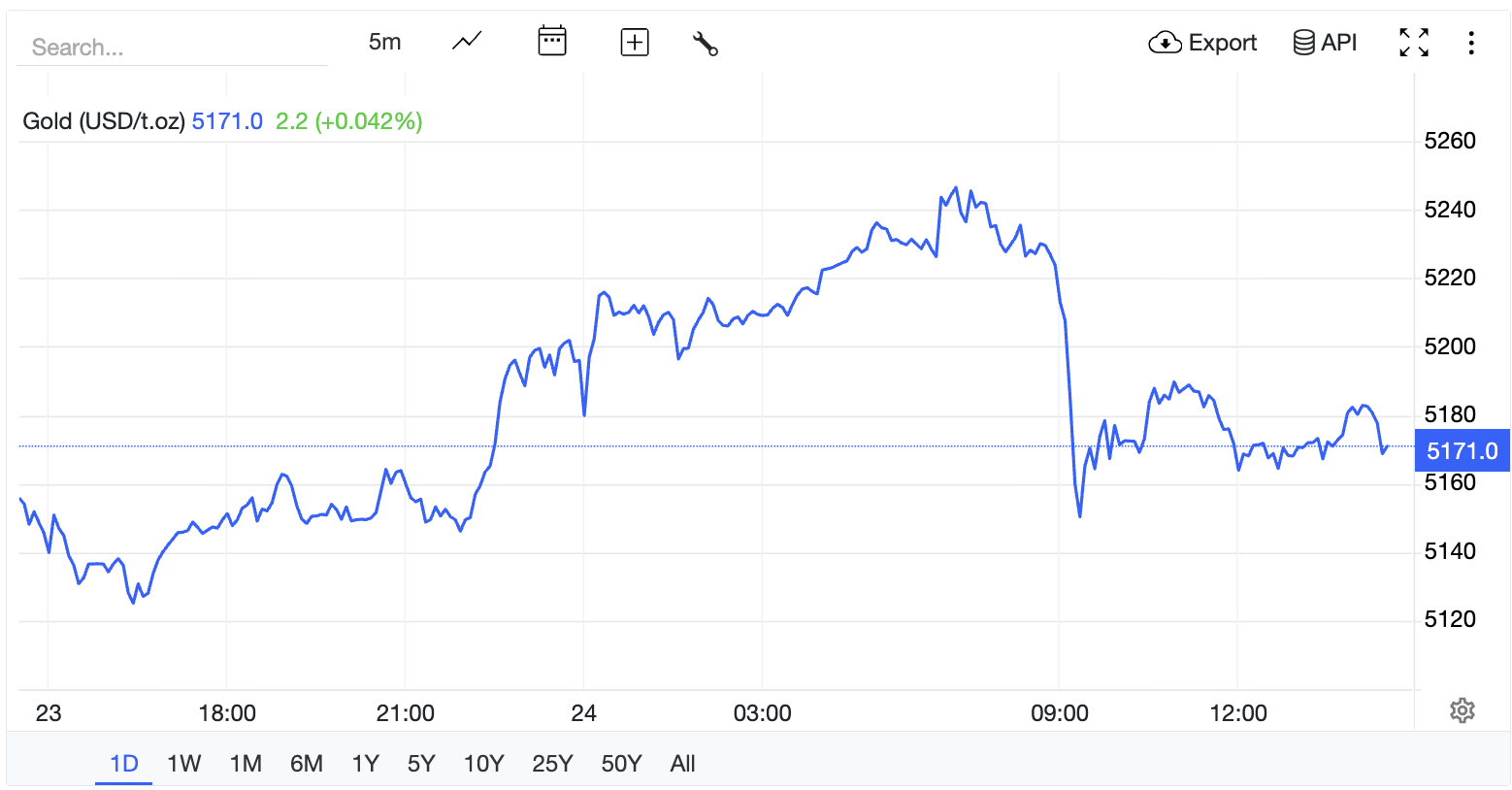
Gold rallied sharply on February 23 as global markets digested a major shift in U.S. tariff policy. Gold jumped 1.7% to about $5,191 per troy ounce during that move.
| Reference point | Price area | Why it matters |
|---|---|---|
| Recent level | ~$5,170–$5,191 | Where the market is trading now |
| January high (futures) | ~$5,318 | A widely cited resistance zone |
| Record peak (reported) | Above $5,500 | Shows how violent swings have been |
| "Round number" support | $5,000 | Psychological level that traders watch |
Three forces have largely driven gold's recent surge.
Gold often rises when trade policy turns unpredictable, because markets start to worry about growth, supply chains, and sudden inflation shocks.
This week's rally was driven by renewed tariff actions following a U.S. Supreme Court ruling that overturned previous tariffs, leading the U.S. to adopt a new global tariff framework.
Safe-haven buying tends to appear when geopolitical risks rise. The recent tensions in the Middle East and nuclear negotiations have contributed to increased gold demand.
Gold does not pay interest. That means higher real yields raise the "cost" of holding gold. The yield on 10-year inflation-indexed Treasuries was around 1.80% as of February 20, which remains a significant headwind.
Most people treat tariffs and geopolitical risks as simple "gold up" headlines. In real trading, it is messier.
Tariffs are tricky for gold because they can create two opposing effects.
Increased fear can drive gold prices higher.
They can also push inflation expectations higher, which can drive yields higher and pressure gold.
This week is a clean example. A new temporary import duty has been announced under Section 122 of the Trade Act, framed as an effort to address international payments problems. That kind of short, sharp policy window tends to keep markets on edge.
| Tariff path | What usually happens | What it often means for gold |
|---|---|---|
| Tariffs expand or become unpredictable | Risk assets wobble, safe-haven demand rises | Gold often rises |
| Tariffs settle into a clear, stable rulebook | Volatility falls, investors rotate back into risk | Gold can drift lower |
| Tariffs raise inflation fears and push yields higher | Real yields rise, dollar firms | Gold can pull back even if headlines are tense |
In summary, tariffs can raise inflation expectations; however, they may also postpone rate cuts if policymakers are concerned that inflation will persist. When that happens, real yields can rise, and gold can stall or slip even while fear stays elevated.
Geopolitical risk remains significant because it influences how investors assess safety and liquidity. Ongoing risk points include:
Continued emergency posture tied to Ukraine-related risks.
Red Sea shipping security concerns and repeated official warnings and reporting.
These forces can support gold, but the market often fades the move if bond yields re-price higher.
If you want one simple driver to watch, it is the real yields.
Where Rates Are Right Now
The Federal Reserve held the fed funds target range at 3.50% to 3.75% at its January meeting.
The 10-year Treasury yield was about 4.08% on February 20.
On February 20, the yield on 10-year inflation-indexed bonds was approximately 1.80%.
Key Takeaway
If real yields rise and stabilize, gold tends to struggle. Conversely, if real yields decline, gold typically thrives.
| Scenario | What drives it | What gold often does | What to watch |
|---|---|---|---|
| Pullback (most common after a surge) | Real yields drift higher, dollar stays firm | Retests support zones around $5,215 to $5,050 | TIPS yields, dollar index, Fed speakers |
| Sideways grind | Tariff and geopolitics keep a floor, but rates cap upside | Range trading around the $5,200 to $5,350 band | Headlines vs bond market reaction |
| Breakout higher | Risk escalation plus falling real yields | Pushes through $5,275, then targets prior highs | De-escalation failing, inflation cooling faster |
| Sharp drop (less likely, but possible) | Rapid risk-on shift plus higher real yields | Quick air pocket toward $5,033 (200-day area) | Sudden dovish-to-hawkish repricing |
A pullback is a normal part of a bull market, and gold is not immune. Right now, the macro mix is tugging in both directions:
Tariffs and tensions can keep a safety premium in the market.
Real yields and the dollar can still pressure gold if the Fed stays restrictive.
If you want one clean signal, watch the 10-year real yield. When it rises and stays up, gold often loses momentum, even if the headlines stay loud.
It can. Gold often pulls back when real yields rise, the U.S. dollar strengthens, or risk sentiment improves. Real yields recently stood around 1.80%, which remains a meaningful headwind.
Tariffs can do both. They can lift gold at first because uncertainty rises. They can also keep inflation sticky, which can delay rate cuts and lift real yields. If real yields rise, gold can pull back even during tariff-driven risk.
Gold can fall or go sideways when rates stay high, especially if real yields rise. Higher real yields increase the opportunity cost of holding gold. Despite strong headlines, gold often struggles when the bond market anticipates restrictive policies for an extended period.
Yes. The World Gold Council reported that total demand in 2025 exceeded 5,000 tonnes for the first time, supported by strong investment activity.
Longer-term signals still lean bullish because the 50-day, 100-day, and 200-day moving averages remain on buy signals. Short-term signals are mixed, which often points to consolidation or pullbacks rather than a clean trend reversal.
In conclusion, gold prices could decline again, despite their recent increase. The cleanest reasons are simple: real yields can rise, the dollar can strengthen, and markets can calm down long enough for investors to take profit. With the 10-year real yield near 1.80%, that risk is real.
At the same time, the floor under gold has been strong because uncertainty has been strong. The tariff story remains unsettled, geopolitical tensions remain a live risk, and long-term demand has been heavy, with total 2025 demand reported above 5,000 tonnes.
If you are trading gold, the most practical approach is to watch the drivers that actually move it: real yields, the dollar, and headline risk. Gold does not need a crisis to pull back, but it usually needs a clear change in those drivers to fall in a lasting way.
Disclaimer: This material is for general information purposes only and is not intended as (and should not be considered to be) financial, investment or other advice on which reliance should be placed. No opinion given in the material constitutes a recommendation by EBC or the author that any particular investment, security, transaction or investment strategy is suitable for any specific person.