Published on: 2026-02-04
Gold experienced a sharp and rapid pullback. The London fixing declined from $5,501.70 on January 29, 2026, to $4,685.45 on February 2, representing an $816 decrease over two sessions, before recovering above key psychological thresholds.
The critical insight lies not in the decline itself, but in the surrounding market dynamics. Despite 10-year real yields remaining near 1.94% and a firm trade-weighted dollar, gold’s rapid rebound indicates the presence of a structural bid that extends beyond the conventional 'rates down, gold up' paradigm.
The selloff appears to reflect de-leveraging rather than a collapse in demand. Futures positioning and volatility metrics indicate that forced risk reduction likely accelerated the decline, a process that typically subsides once positions are reset.
A price floor is emerging due to robust investment and official-sector demand. In 2025, total demand reached 5,002.3 tonnes, with investment rising to 2,175.3 tonnes and central-bank net purchases remaining elevated at 863.3 tonnes. This combination typically absorbs price declines more rapidly than in previous cycles.
Macroeconomic headwinds persist, but these factors appear to be already reflected in current prices. With 10-year nominal yields at approximately 4.29% and real yields near 1.94%, the interest rate environment remains challenging. Gold’s resilience near $5,000 suggests a diversification premium in addition to its traditional role as an inflation hedge.
A sustained upward movement in gold prices will likely require one of three catalysts: lower real yields, a weaker dollar, or an increased risk premium driven by geopolitical or financial stability concerns. In the absence of these factors, gold may still appreciate, but with increased volatility.
From a technical perspective, the market has re-established a 'support-then-liquidation' structure. The $4,650 to $4,700 range (London fix) now serves as a demand base, while the previous peak zone between $5,300 and $5,600 represents a concentrated liquidity area.
 1) Positioning and margin mechanics, not fundamentals
When gold runs into new highs with rising participation, leverage builds quietly through futures, options, and structured exposure. In the latest Commitments of Traders snapshot (positions as of January 27, 2026), non-commercial traders held 252,100 long contracts versus 46,704 shorts, a net long of about 205,396 contracts. That is roughly 42% of open interest, an inherently unstable configuration if volatility spikes.
Once volatility rises, two things happen at the same time:
Risk limits tighten (internally at funds and externally via clearing conditions).
Liquidity thins around inflection points, so prices gap through levels instead of trading smoothly.
This process transforms a typical correction into a rapid, cascading decline. The underlying mechanics compel selling irrespective of long-term investment conviction.
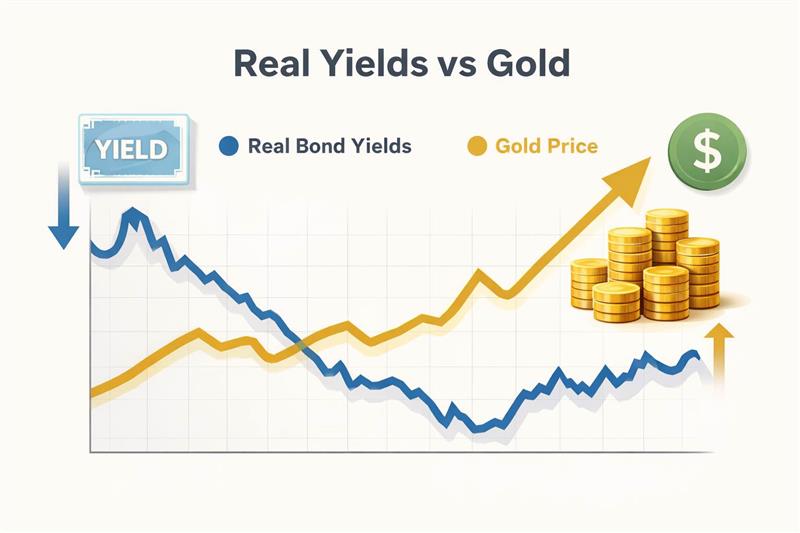
The classic gold headwind is the real return available in safe assets. As of February 2, 2026, the 10-year TIPS real yield was about 1.94%.
That is not a recessionary rate regime. It is a regime where cash and bonds compete aggressively with non-yielding assets.
However, gold did not transition into a sustained downward trend. This outcome is significant, as it suggests the market is valuing gold not solely as a function of interest rates, but also as a reserve asset and a form of financial insurance.
The Cboe Gold ETF Volatility Index has been printing levels in the 40s, with a recent dashboard reading showing an intraday high near 48.68 and a prior close around 44.08.
Elevated implied volatility necessitates broader hedging ranges, intensifies gamma effects near option strike prices, and accelerates mechanical selling when key support levels are breached.
Gold is now in a demand regime where investment flows can outweigh traditional jewelry demand. In 2025, total supply was 5,002.3 tonnes, and total demand matched it, but the composition shifted sharply:
Investment: 2,175.3 tonnes (up 84% year over year)
ETFs and similar products: +801.2 tonnes
Bars and coins: 1,374.1 tonnes
Meanwhile, jewelry consumption weakened under high prices.
This distinction is important for post-correction outlooks. Jewelry demand is typically price-sensitive and slow to adjust, whereas investment demand is more responsive and often increases following a stabilization in volatility.
Gold market balance: 2024 vs 2025 (tonnes)
| Category | 2024 | 2025 | Change |
|---|---|---|---|
| Total supply | 4,961.9 | 5,002.3 | +1% |
| Mine production | 3,650.4 | 3,671.6 | +1% |
| Recycled gold | 1,365.3 | 1,404.3 | +3% |
| Total demand | 4,961.9 | 5,002.3 | +1% |
| Investment demand | 1,185.4 | 2,175.3 | +84% |
| ETFs and similar products | -2.9 | 801.2 | Major inflow shift |
| Bar and coin | 1,188.3 | 1,374.1 | +16% |
| Central bank demand | 1,092.4 | 863.3 | -21% |
| Jewelry consumption | 1,886.9 | 1,542.3 | -18% |
The key development is not a reduction in central bank purchases, but rather the surge in investment demand, which has become the dominant market force. This type of demand can re-emerge rapidly after a pullback, particularly when investors interpret the decline as an improved entry point rather than a fundamental shift.
Central-bank net purchases reached 863.3 tonnes in 2025.
Although the pace of central bank purchases may vary from quarter to quarter, this activity alters the market structure. Official-sector buying is driven by allocation strategies, is patient, and generally remains unaffected by short-term price declines. This behavior establishes a 'buy-the-dip' dynamic, particularly when speculative excess is reduced.
Physically backed gold ETFs experienced a record year. In 2025, global annual inflows reached $89 billion, assets under management rose to $559 billion, and holdings climbed to 4,025 tonnes from 3,224 tonnes in 2024.
This is a double-edged sword:
It increases gold’s accessibility, so capital can come in fast when macro risk rises.
It also means outflows can pressure prices during risk-on phases.
Following a sharp decline, the scale of ETFs can act as a stabilizing force by facilitating rebalancing flows. Systematic strategies and multi-asset portfolios often increase exposure once volatility subsides.
In the current setup, gold is trading against the real yield curve more than it is against the nominal yield curve. As of early February:
10-year nominal yield: about 4.29%
10-year real yield: about 1.94%
10-year breakeven inflation: about 2.36%
A sustainable upside push typically aligns with one of these developments:
Real yields fall because growth slows or policy turns more accommodative.
Breakevens rise because inflation risk returns.
The dollar weakens, improving non-dollar affordability and global demand.
Gold does not need all three. It usually needs one.
The broad trade-weighted dollar index was around 117.90 on January 30.
A strong dollar typically limits gold’s appreciation in dollar terms. However, recent market behavior indicates a more complex relationship, as gold can advance even with a firm dollar when investors are pricing in political risk, reserve diversification, or tail risk.
Consequently, the narrative that 'gold only rises when the dollar falls' has become less reliable.
The recent pullback did not negate gold’s broader uptrend. Instead, it shifted the key trading range to a narrower set of price levels where systematic strategies are more likely to respond.
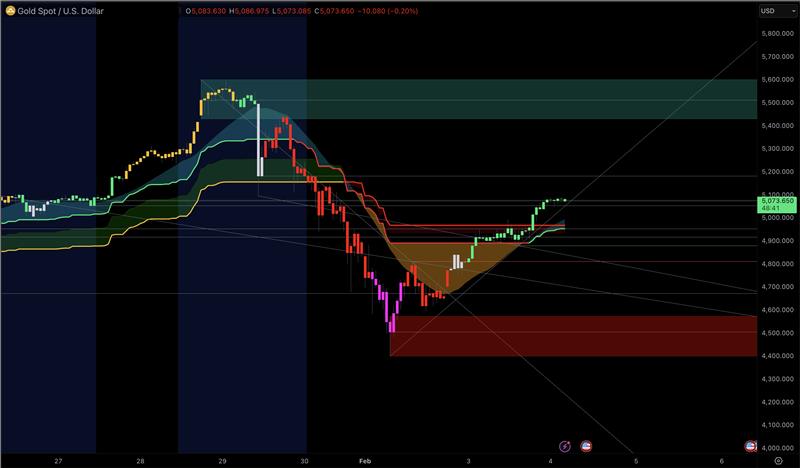
Key technical levels and signals (XAUUSD)
| Indicator | Reading | Signal |
|---|---|---|
| RSI (14) | 60.95 | Bullish momentum, not overbought |
| MACD | 171.6 | Positive trend impulse |
| EMA 20 | 4,994.69 | Near-term support |
| EMA 50 | 4,962.53 | Secondary support |
| EMA 200 | 4,971.63 | Long-term trend support |
| Pivot (Classic) | 5,079.51 | Near-term magnet level |
| Resistance (R1 / R2) | 5,096.66 / 5,108.54 | Upside breakout zone |
| Support (S1 / S2) | 5,067.63 / 5,050.48 | First defense area |
Current technical signals indicate that momentum remains positive, with prices trading above key moving averages associated with trend-following strategies. A sustained advance above the 5,100 level increases the likelihood of retesting previous highs, while a decline below 5,050 raises the probability of a deeper mean reversion toward the mid-4,000s, where prior buying interest was observed.
If real yields remain at current levels and the dollar stays firm, gold may recover, but this is likely to occur through range-bound price expansion rather than a direct upward trend. In such a scenario, the market typically:
Rebuild above $5,000 as confidence returns.
Struggle near the prior supply zone around $5,300 to $5,600, where profit-taking and hedging flows concentrate.
If real yields decline from the 1.9% level while volatility remains elevated, gold has the potential to retest its previous peak. This is because a lower real-yield discount rate increases the present value of gold’s role as a financial hedge.
If real yields rise significantly and implied volatility remains elevated, gold may undergo additional waves of liquidation. In this environment, prices can fall below 'fair value' due to reduced liquidity and forced deleveraging.
| Indicator | Latest reading | Why it matters for gold |
|---|---|---|
| Gold (spot reference) | $5,085.01 (Feb 4, 2026) | Shows rebound strength after the drop |
| London gold fixing | $5,501.70 (Jan 29) → $4,685.45 (Feb 2) | Defines the pullback magnitude and the new demand shelf |
| 10-year nominal yield | 4.29% (Feb 2) | Higher nominal rates can cap rallies |
| 10-year real yield | 1.94% (Feb 2) | Key opportunity-cost anchor for bullion |
| 10-year breakeven inflation | 2.36% (Feb 3) | Captures inflation risk pricing |
| Broad dollar index | 117.90 (Jan 30) | Dollar strength can tighten gold’s upside |
| Speculative positioning | Net long ≈ 205,396 contracts | Leverage concentration can amplify selloffs |
| Gold ETF flows and holdings | 2025 inflows $89bn; holdings 4,025t | Flow-driven upside fuel, also adds two-way risk |
| Central-bank net purchases | 863.3t (2025) | Structural demand tends to buy dips |
Gold prices may recover if the recent selling was primarily driven by leverage and if market flows stabilize. Given robust investment demand and continued central-bank purchases, price declines are likely to be absorbed more rapidly than in cycles dominated by jewelry demand.
Real yields. With 10-year real yields around 1.94%, any sustained move lower tends to support gold because it reduces the opportunity cost of holding non-yielding assets.
Not necessarily. While a strong dollar can present a headwind, gold may still appreciate if investors seek insurance, reserve diversification, or protection against geopolitical risk. The correlation weakens when gold functions as a strategic asset rather than solely as an inflation hedge.
Yes. Central-bank net purchases totaled 863.3 tonnes in 2025, a historically elevated level. This consistent demand can shorten the duration of selloffs by providing price-insensitive support during periods of weakness.
ETFs directly translate investor risk appetite into physical gold demand. Record inflows and holdings in 2025 demonstrate the strength of this channel. While this can accelerate price rallies during periods of heightened risk, it can also lead to rapid drawdowns if significant outflows occur during risk-on phases.
The February 2 fixing near $4,685 serves as a significant demand indicator, while the previous supply zone is located near the January peak between $5,300 and $5,600. The former highlights where buyers entered the market, and the latter identifies likely areas of seller resistance.
The recent decline in gold does not appear to signal the onset of a traditional bear market. Instead, it resembles a leverage-driven correction within an asset supported by structural demand. This assessment is supported by the rapid rebound, sustained official-sector purchases, and the significant scale of investment demand that has transformed the gold market in 2025.
The future trajectory of gold prices will depend on developments in real yields, the strength of the dollar, and investor willingness to pay for tail-risk protection. Even if these catalysts emerge unevenly, the current post-correction environment is conducive to higher prices over time, albeit with continued volatility.
Disclaimer: This material is for general information purposes only and is not intended as (and should not be considered to be) financial, investment or other advice on which reliance should be placed. No opinion given in the material constitutes a recommendation by EBC or the author that any particular investment, security, transaction or investment strategy is suitable for any specific person.
(FRED)(cftc.gov)(World Gold Council)