Published on: 2026-05-25
Updated on: 2026-05-25
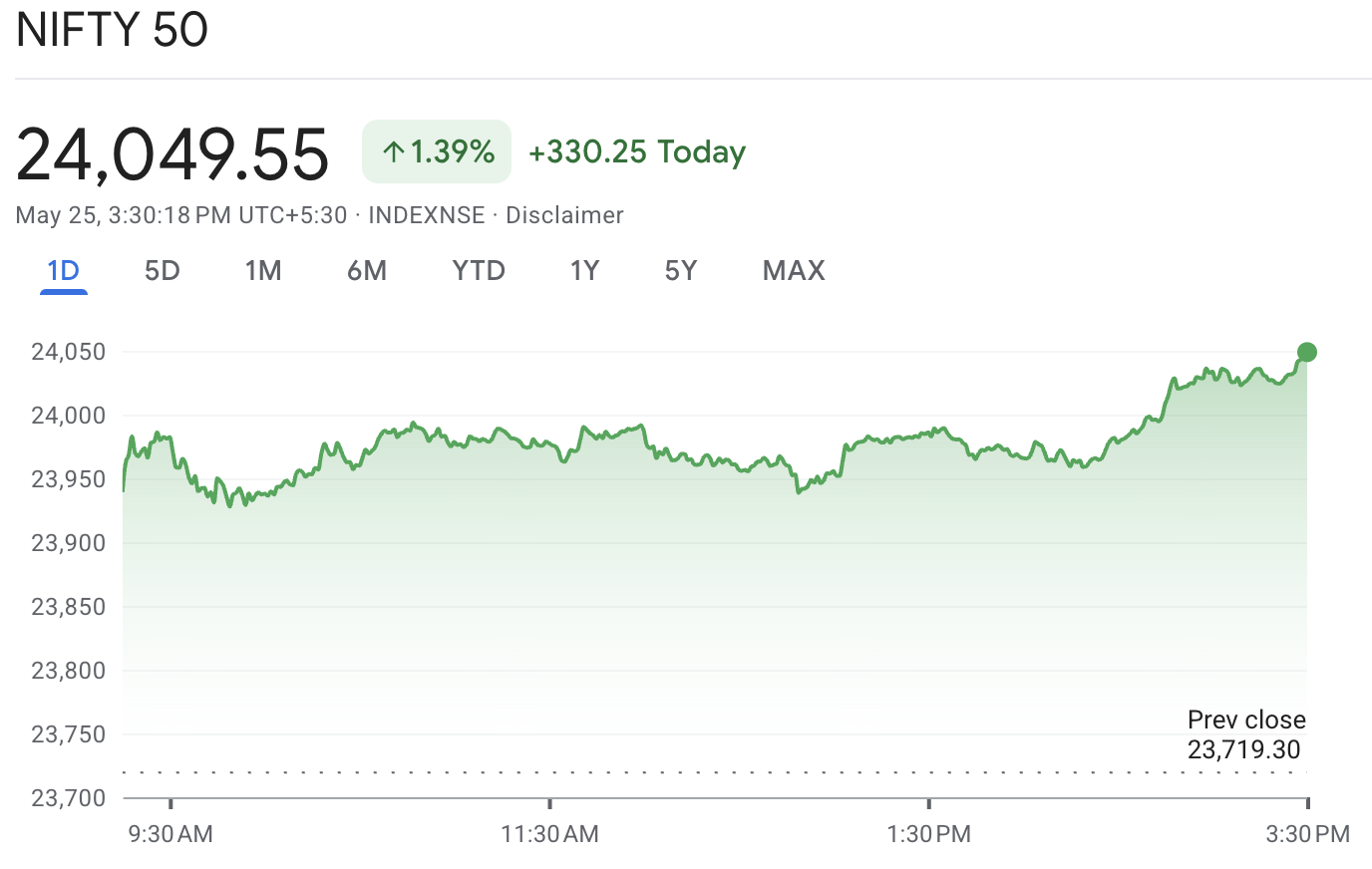
The Nifty 50 reclaimed the 24,000 level on 25 May 2026 as falling crude oil prices, stronger global risk appetite and a rebound in financial stocks lifted Indian equities. The index rose more than 1% and traded around 24,033 by late afternoon, recovering a key resistance zone that had capped recent upside attempts.
The rally was not driven by domestic flows alone. Brent crude fell below $100 per barrel as hopes of a US-Iran peace deal reduced the geopolitical risk premium, easing pressure on India’s inflation outlook, import bill, rupee and bond market.
The Nifty 50 reclaimed 24,000, turning a major resistance zone into the market’s first tactical support test.
The index rose roughly 314 points by late afternoon, implying a gain of about 1.3% from the previous close of 23,719.30.
Brent crude traded below $100 per barrel, with ET reporting Brent near $98 and WTI around $91.30 on Monday morning.
April CPI inflation stood at 3.48%, while food inflation was 4.20%, keeping India’s inflation backdrop relatively stable.
Financial services remain the largest Nifty 50 sector at 35.27% of index weight, making bank strength crucial to the breakout.
The next market test is whether the Nifty can hold above 24,000 and extend toward the 24,450–24,600 zone.
India’s equity market reacts sharply to crude because oil affects several macro channels at once. It moves the import bill, current account balance, fuel costs, inflation expectations and the rupee.
When oil prices fall, the market prices lower external risk. That gives domestic quities more room to absorb foreign outflows, global volatility and earnings uncertainty.
The current rally is therefore more than a technical bounce. It reflects a repricing of India’s oil sensitivity after crude moved from a source of pressure to a short-term source of relief.
The Nifty 50 had been struggling around the 23,800–24,000 resistance band before Monday’s rally. A move through that zone signals that buyers are willing to re-enter large-cap Indian equities when crude softens and global cues improve.
The breakout carries more weight because it came with strong gains in financial and auto-linked stocks. ET reported that the Sensex gained more than 1,000 points, while Nifty reclaimed 24,000 as HDFC Bank, Bajaj Finance, M&M, L&T, Bajaj Finserv, Maruti and UltraTech Cement led the advance.
Market breadth also improved. Around 2,116 NSE stocks advanced, while 456 declined, and India VIX fell more than 5% to 16.83, pointing to lower near-term hedging pressure.
India remains highly exposed to imported crude, so even moderate oil price changes can alter the macro outlook. A sustained fall in Brent can reduce import costs, ease pressure on the current account and support confidence in the rupee.
The sensitivity is large. A sustained $10 per barrel move in crude can change India’s annual oil import burden by roughly $18 billion, depending on volumes, exchange rates, freight costs and product mix.
That is why lower crude usually supports India’s equity risk premium. It reduces the probability of a negative loop from oil prices to inflation, currency weakness and tighter financial conditions.
| Indicator | Latest Reading | Market Interpretation |
|---|---|---|
| Nifty 50 | Around 24,033 | 24,000 resistance reclaimed |
| Previous close | 23,719.30 | Monday rally built from a low base |
| Daily move | About +314 points, +1.3% | Strong risk-on recovery |
| Brent crude | Below $100 per barrel | Oil risk premium eased |
| April CPI inflation | 3.48% | Inflation remains below RBI’s 4% target |
| April food inflation | 4.20% | Food prices remain the key domestic watchpoint |
| Financial services weight | 35.27% | Banks remain the largest index driver |
| 20-day moving average | Around 23,892 | Nifty trading back above short-term trend support |
Financial services dominate the Nifty 50, so bank strength has an outsized effect on the benchmark. NSE Indices data show HDFC Bank at 10.73%, ICICI Bank at 8.21%, State Bank of India at 4.03% and Axis Bank at 3.31% of the index.
Lower crude helps banks indirectly by reducing inflation pressure, supporting the rupee and easing stress in bond yields. That can lower the macro risk premium applied to lenders.
The rally still needs confirmation from fundamentals. Credit growth, deposit costs and asset quality remain the core drivers for banking earnings.
Autos benefit when fuel costs ease because lower petrol and diesel pressure can improve household sentiment. Passenger vehicles and two-wheelers are especially sensitive to disposable income and financing conditions.
Paint companies benefit through crude-linked input costs such as solvents, monomers and packaging materials. The margin impact depends on inventory cycles and pricing discipline, but lower oil improves the sector’s cost outlook.
Aviation is one of the clearest beneficiaries because jet fuel is a major operating cost. Lower crude improves operating leverage, although currency movements and fare discipline still determine the final earnings impact.
The immediate test is whether the Nifty can hold above 24,000 on a closing basis. A sustained move above this level would improve the short-term structure and open room toward the 24,450–24,600 resistance band.
Failure to hold 24,000 would not invalidate the recovery. It would suggest that the market needs stronger confirmation from global risk appetite, foreign flows and earnings revisions.
The rally has a stronger foundation if banks, autos, industrials and consumer shares participate together. A narrow move led only by a few heavyweight stocks would be less durable.
The main risk is a crude rebound. Brent moving back above $100 would revive concerns over India’s import bill, inflation expectations and currency stability.
Foreign investor selling is another constraint. ET reported that foreign investors remained net sellers of Indian equities and had sold heavily through May, even as Monday’s rally improved sentiment.
Earnings also remain central. The Nifty 50 cannot rely only on oil relief if corporate profits fail to support current valuations.
The Nifty 50’s move above 24,000 marks a clear improvement in short-term sentiment. Lower oil, a firmer rupee, softer bond yields and strength in financial stocks have shifted the market’s macro balance in India’s favour.
The next phase depends on follow-through. A clean close above 24,000, supported by broad sector participation, would confirm that investors are beginning to treat India’s oil exposure as a market tailwind rather than a near-term vulnerability.
NSE India, live market data
https://www.nseindia.com/market-data/live-equity-market?symbol=NIFTY%2050
NSE India, market homepage
Ministry of Statistics and Programme Implementation, CPI data
MoSPI April 2026 CPI press release
https://mospi.gov.in/uploads/PressRelease/CPI%20Press%20Release%20of%20April%202026.pdf
Petroleum Planning & Analysis Cell, Government of India
Reserve Bank of India, statistics and macro data
ICE Futures Europe, Brent Crude Futures data