Published on: 2026-05-25
Updated on: 2026-05-25
The Nikkei 225 topped 65,000, but its 2.88% morning gain outpaced Topix’s 1.50% rise, showing a record high with uneven breadth.
SoftBank, Advantest and Tokyo Electron remain central to the rally, tying Japan’s breakout to global AI risk.
The Nikkei’s price-weighted structure can magnify high-priced winners and overstate broad market strength.
The yen still supports exporters, but the BOJ’s 6-3 April vote split shows currency weakness can become a valuation risk.
Japan’s reform story gives the rally a second pillar, with banks, industrials and capital-efficiency laggards positioned to decide whether the move broadens.

The Nikkei 225 above 65,000 is still being priced through a narrow group of AI and semiconductor leaders. If the rally fails to rotate into banks, industrials and shareholder-return laggards, 65,000 becomes a crowded AI trade dressed as a broad Japan breakout.
The 65,000 breakout is being carried by a familiar group: SoftBank, semiconductor equipment names, AI hardware suppliers and high-priced Nikkei heavyweights.
| Stock / group | Why it moved the Nikkei | What it signals |
|---|---|---|
| SoftBank Group | AI exposure and portfolio revaluation | Sentiment is doing heavy work in the rally |
| Advantest | Chip-testing demand tied to AI processors | Japan is trading as part of the AI hardware cycle |
| Tokyo Electron | Semiconductor equipment exposure | Global chip spending remains a key driver |
| Fast Retailing | High share price and large Nikkei influence | Index structure can amplify single-stock moves |
| Kioxia, Fujikura, Ibiden, Lasertec | Memory, cables, substrates and chip tools | The rally is tied to AI infrastructure, not Japan’s economy alone |
The stock map shows why 65,000 is not just a Japan recovery signal. The index can keep rising, but the next confirmation has to come from banks, industrials, exporters and reform laggards rather than another surge in the same AI-linked names.
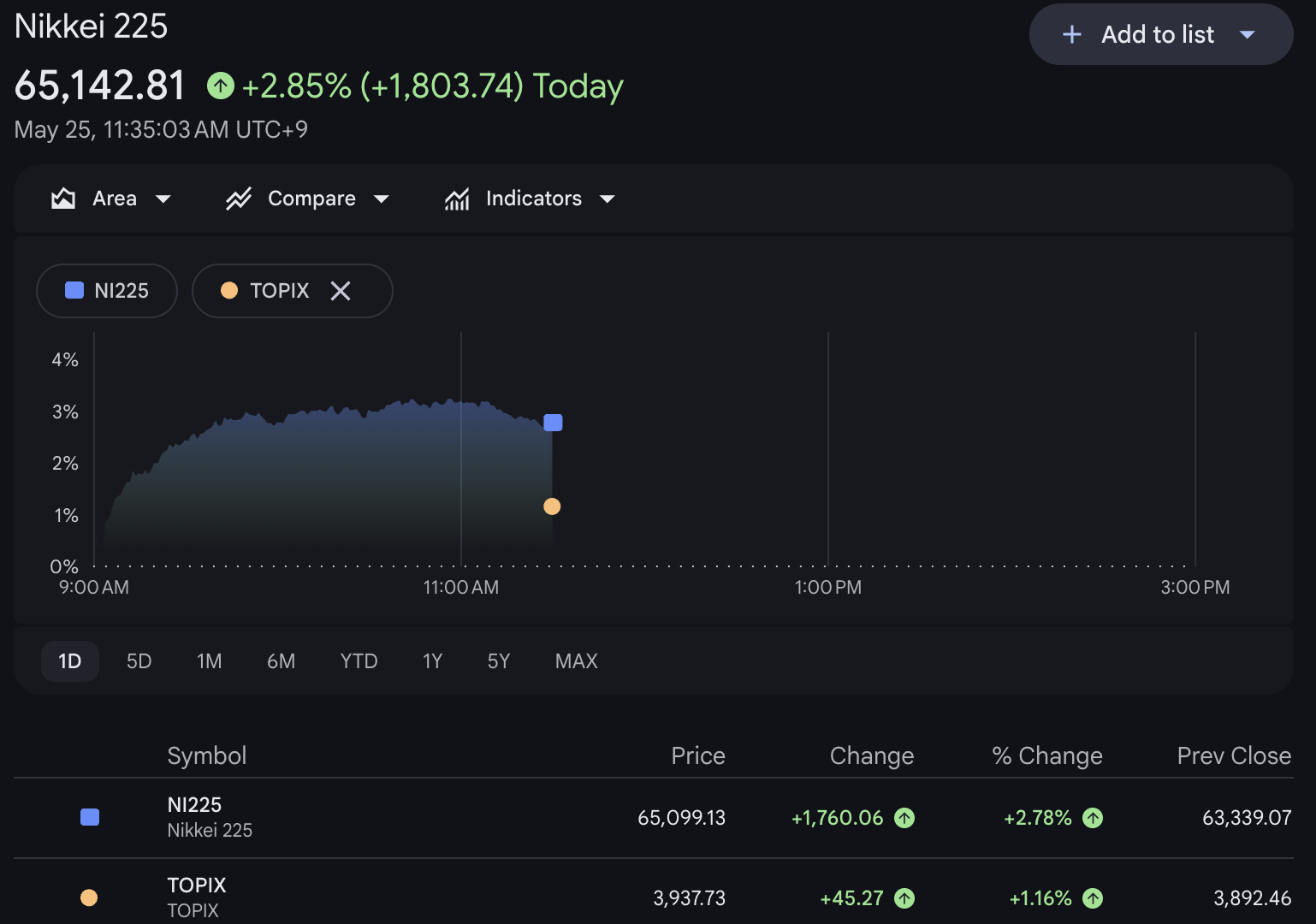
A record Nikkei print can overstate the strength of the average Japanese stock. The index is price-weighted, so high-priced shares can pull the benchmark higher faster than their wider economic footprint would suggest.
That is why Topix matters. Its gain during the breakout confirms broader participation, but its slower rise shows Japan’s market is not moving with the same force as the headline index.
At 65,000, the next confirmation has to come from financials, machinery, exporters and shareholder-return names. Another surge in the same AI-linked heavyweights would keep momentum alive, but it would not solve the rally’s narrow leadership risk.
Japan’s AI trade is rising on global order books, not just on local optimism. Advantest, Tokyo Electron, Kioxia, Fujikura, Ibiden and Lasertec sit close to the hardware chain behind AI chips, data centres and semiconductor capacity.
AMD’s Q1 2026 Data Center revenue reached $5.8 billion, up 57% year-on-year, showing that AI infrastructure spending is still feeding the earnings story behind chip-linked equities. AMD said the growth was driven by EPYC processors and the ramp of Instinct GPU shipments.
That demand strengthens the read-through for Japan’s AI hardware chain. Advantest supplies semiconductor test systems used in advanced chip production, Tokyo Electron provides equipment for next-generation semiconductor manufacturing, and Ibiden makes IC package substrates that support higher-performance chips.
The risk is crowding. If US AI stocks fall after earnings, guidance or capex commentary, Tokyo’s semiconductor winners can drop before Japan’s domestic data changes. The next leg in the Nikkei may say less about Japan’s economy than about whether traders are still willing to pay premium multiples for AI-linked yen exposure.
The yen is no longer a one-way boost for the Nikkei. Weakness still lifts exporters’ overseas earnings, but a sharper slide pulls BOJ tightening risk into the same trade that has supported Japanese stocks.
The April BOJ meeting exposed that pressure point. Policymakers held the overnight call rate around 0.75%, but the vote split 6-3, with three members pushing for 1.0%.
That split changes the equity signal. A controlled yen decline supports exporters. A disorderly move raises import inflationary pressure, lifts rate expectations, and compresses multiples for AI and semiconductor names.
Banks can absorb that backdrop better than long-duration growth stocks. The Nikkei becomes more fragile if yen pressure, BOJ repricing and crowded AI leadership arrive together.
Corporate reform gives Japan’s rally a second engine beyond AI. Companies with excess cash, weak returns, low valuations or poor capital discipline are under pressure to raise dividends, buy back shares, unwind inefficient holdings or show a credible path to better returns.
That pressure comes from the Tokyo Stock Exchange’s cost-of-capital campaign. The exchange first pushed Prime and Standard Market companies to manage with greater attention to the cost of capital and stock price in March 2023, then updated the request in April 2026 with a sharper focus on investor expectations and capital allocation.
AI delivered the fastest gains. Reform gives the rally a wider runway through banks, insurers, trading houses, machinery, domestic cyclicals and undervalued industrial groups.
Japan’s market now runs on two trades: AI momentum and corporate-reform rerating. The Nikkei holds a stronger base when both trades advance together. It weakens when AI keeps rising while reform-sensitive sectors lag.
| Signal | Keeps 65,000 intact | Puts 65,000 at risk |
|---|---|---|
| Topix | Narrows the gap with the Nikkei | Keeps lagging while the headline index rises |
| Leadership | Banks, industrials, exporters and reform-sensitive stocks join | SoftBank and chip names carry the move alone |
| Yen | Stable weakness supports exporter earnings | Sharp yen moves pull BOJ rate risk into equities |
| AI cycle | US AI capex and chip guidance stay firm | Nasdaq profit-taking spills into Tokyo semiconductor names |
| Reform | Buybacks, ROE improvement and portfolio reviews broaden | Capital-efficiency gains stay limited to a small group |
| Close above 65,000 | Confirms buyers defended the breakout level | A failed close turns the milestone into resistance |
The strongest version of the rally is rotation, not acceleration. A close above 65,000, supported by Topix, banks, industrials, and reform-sensitive shares, would give the breakout a broader base. Another surge, led mainly by the AI-heavy leadership group, would keep momentum alive but leave the index tied to the same AI trade that carried it through the milestone.
A move back below 65,000 would not erase Japan’s reform story. It would reveal how much of the latest rally came from AI duration rather than a broader domestic rerating.
The easy rerating phase has passed, which means new positions now depend on the rotation thesis proving out, not on whether 65,000 holds for one more session. A healthier setup requires financials, industrials, exporters and reform-sensitive companies to join the move rather than another surge in the same AI-linked leaders.
Topix is the cleaner breadth signal. The Nikkei captures momentum in high-priced leaders, while the Topix gives a wider view of Japan’s listed market. If Topix keeps narrowing the gap, the rally has a stronger base. If it lags, 65,000 remains more exposed to concentration risk.
Banks, insurers, machinery, exporters and undervalued industrials are the key areas to watch. These sectors are more closely linked to higher nominal growth, shareholder returns, and capital-efficiency reform than the AI stocks that led the move through 65,000.
Can banks, industrials and reform-sensitive laggards start lifting Topix before the next US AI earnings cycle tests whether 65,000 was Japan’s breakout, or just a semiconductor rally priced in yen?