Published on: 2026-01-07
Updated on: 2026-01-07
Oil prices are declining as the market no longer values scarcity. With supply exceeding demand, excess barrels are stored, and rising inventories shift crude from a fear-driven to a balance-sheet-driven trade. Prices fall until production slows, demand increases, or producers reduce supply.
Current price weakness follows a familiar pattern: when a surplus is expected, any supply-related headline can accelerate declines. Recent reports of additional Venezuelan barrels reaching the United States reinforced expectations of ample supply and weak seasonal demand in early 2026.
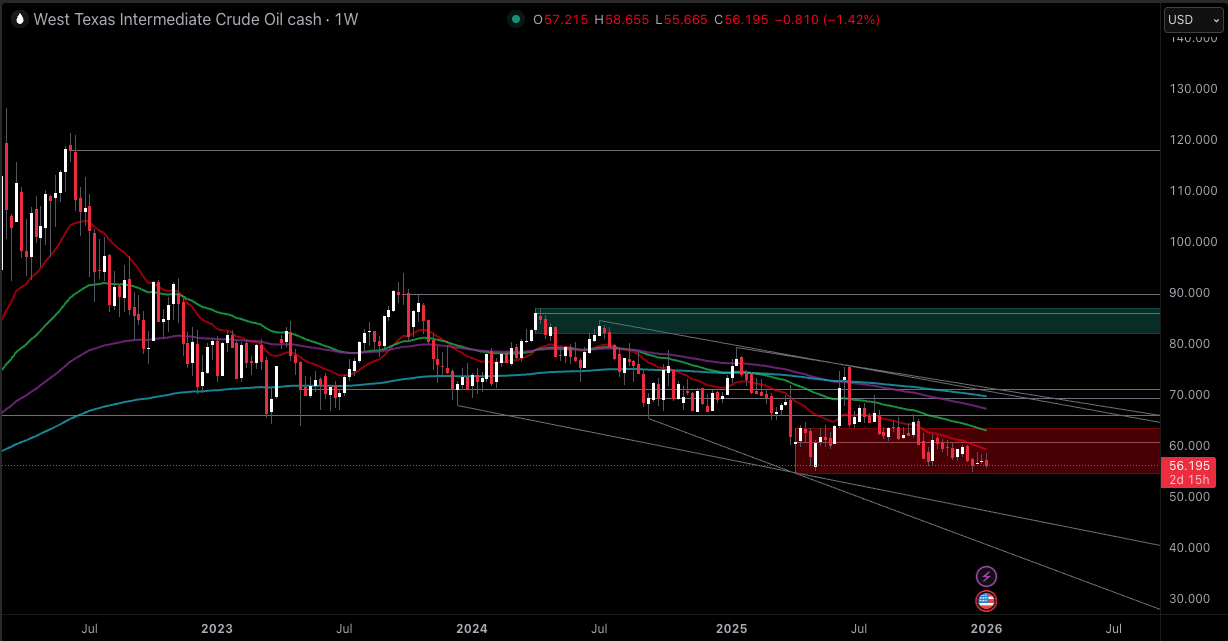
The Venezuela development is significant as a signal rather than a standalone event. In a market anticipating excess supply in 2026, even the possibility of more barrels can pressure prices. Because oil is priced at the margin, small changes in expected flows can have outsized effects.
The destination of additional supply also matters. Redirected barrels can depress local prices and influence global benchmarks, especially when market sentiment is already negative.
The most reliable way to push oil lower is not a dramatic demand crash. It is a steady surplus that sends barrels into tanks. When storage rises week after week, sellers start competing for buyers, and price becomes the tool that clears the market.
This dynamic makes 2026 inventory expectations highly influential. Anticipated sustained builds cause rallies to fade, as the market expects more oil than can be absorbed at current prices.
The futures curve also signals market conditions. Contango, where future prices exceed spot prices, often indicates excess supply and increased storage needs. This structure can limit price rebounds, as storing oil becomes preferable to immediate purchases.
The downturn is driven by steady, diverse non-OPEC supply growth. When multiple sources contribute to increased supply, it becomes more difficult for any group to offset the surplus without consistent discipline.
This presents a strategic challenge for 2026. If non-OPEC+ supply growth continues, OPEC+ must choose between deeper cuts to support prices, accepting lower prices to maintain market share, or adopting a middle approach to reduce volatility.
Global oil demand is still rising in many forecasts, but growth is modest. That is the uncomfortable middle ground where prices can still fall. Demand does not need to collapse for oil to slide. It only needs to grow more slowly than the supply.
There are bright spots, especially in large importing regions where lower prices can encourage fuel use. But strong consumption in one region is not enough on its own. To rebalance the global economy, demand strength must be broad and sustained across major economies.
OPEC+ can guide market direction but cannot set a specific price. Its influence depends on credibility, coordination, and effective implementation. Markets respond to actual policy changes that affect supply balance.
OPEC+ has paused planned production increases into early 2026, citing seasonal demand and market conditions. This pause helps marginally by preventing additional supply.
However, a pause does not address existing surplus. If inventories continue to build, the market typically seeks a longer pause, deeper cuts, or stricter enforcement of limits.
This is the least disruptive option and may slow price declines, but it may be insufficient if non-OPEC supply and inventories continue to rise.
This is the fastest way to support prices by directly reducing the surplus. However, it poses political and fiscal challenges, as cuts lower revenue for volume-dependent members and make compliance more difficult under budget pressure.
This is the scenario markets fear most during downturns. If producers focus on volume, prices may fall until higher-cost suppliers reduce output and demand increases.
Producer groups typically act when price declines become severe enough to justify cuts and when they believe competitors will not quickly replace lost supply. The low $50s to low $60s range is significant: if prices remain there, a cautious approach may suffice, but further declines increase pressure for stronger measures.
A drop to $50 typically requires multiple bearish factors. It occurs when the market holds excess oil and lacks compelling reasons to maintain positions.

A likely base case for 2026 is a broad trading range, with rallies fading unless inventories tighten consistently. In a surplus, prices struggle as sellers hedge on strength and producers are slow to cut supply until losses are clear.
The surplus widens early in 2026, confirmed by several consecutive inventory builds.
OPEC+ signals patience, meaning no deeper cuts beyond the current pause.
In this scenario, $50 is not a dramatic forecast. It represents a clearing level where the market anticipates supply restraint, slower production growth, and stronger demand to start rebalancing.
Even with oversupply, oil prices do not decline in a straight line. Logistics, refinery issues, shipping constraints, and regional bottlenecks can tighten specific markets despite a loose global balance.
If these frictions increase, prices may stabilize above $50 despite a surplus, as local shortages support margins and draw barrels through the system.
Inventory trends: Single weeks are less important than sustained multi-week patterns.
Futures curve: A deeper contango often signals excess supply and storage pressure.
OPEC+ guidance: Whether the pause is extended and whether compliance language gets stricter.
Non-OPEC supply momentum: Monitor the growth rate outside the OPEC+ framework.
Demand strength in major importers: Broad, sustained demand is necessary to shift the market narrative.
Oil prices are down due to concerns about oversupply and rising inventories. New supply headlines reinforce expectations of additional barrels entering the market during a seasonally weak demand period.
OPEC+ can slow or reverse declines by removing sufficient supply for an extended period to alter inventory trends. A brief pause in planned increases may help, but persistent inventory builds often require stronger measures.
$50 oil is possible if the surplus widens early in the year and producer response is limited. In this scenario, $50 acts as a clearing level that slows supply and encourages stronger demand.
Contango occurs when futures prices exceed spot prices, often reflecting excess supply and increased storage needs. This structure can limit rallies, as holding inventory becomes more attractive than immediate purchases.
Not always. Gasoline prices depend on refining conditions, fuel inventories, taxes, and local supply chains. While crude is a key input, the timing and extent of price changes can vary.
Oil prices are falling because global production exceeds demand at current prices, leading to higher storage expectations. Supply headlines have the greatest impact when they reinforce the broader surplus narrative, prompting swift market reactions in bearish conditions.
OPEC+ can support prices only by aligning policy with the scale of the surplus. Pausing planned increases buys time but does not eliminate excess supply. If inventories continue to rise into early 2026, further declines are likely, making $50 a practical issue of timing and producer response.
Disclaimer: This material is for general information purposes only and is not intended as (and should not be considered to be) financial, investment or other advice on which reliance should be placed. No opinion given in the material constitutes a recommendation by EBC or the author that any particular investment, security, transaction or investment strategy is suitable for any specific person.