Published on: 2025-12-23
Updated on: 2025-12-29
Gold is closing out 2025 with price action that's forcing traders to recalibrate their usual reference levels. With gold already at record highs near $4,497, the market has the feel of a late-cycle move marked by strong momentum, shallow pullbacks, and many late buyers chasing breakouts.
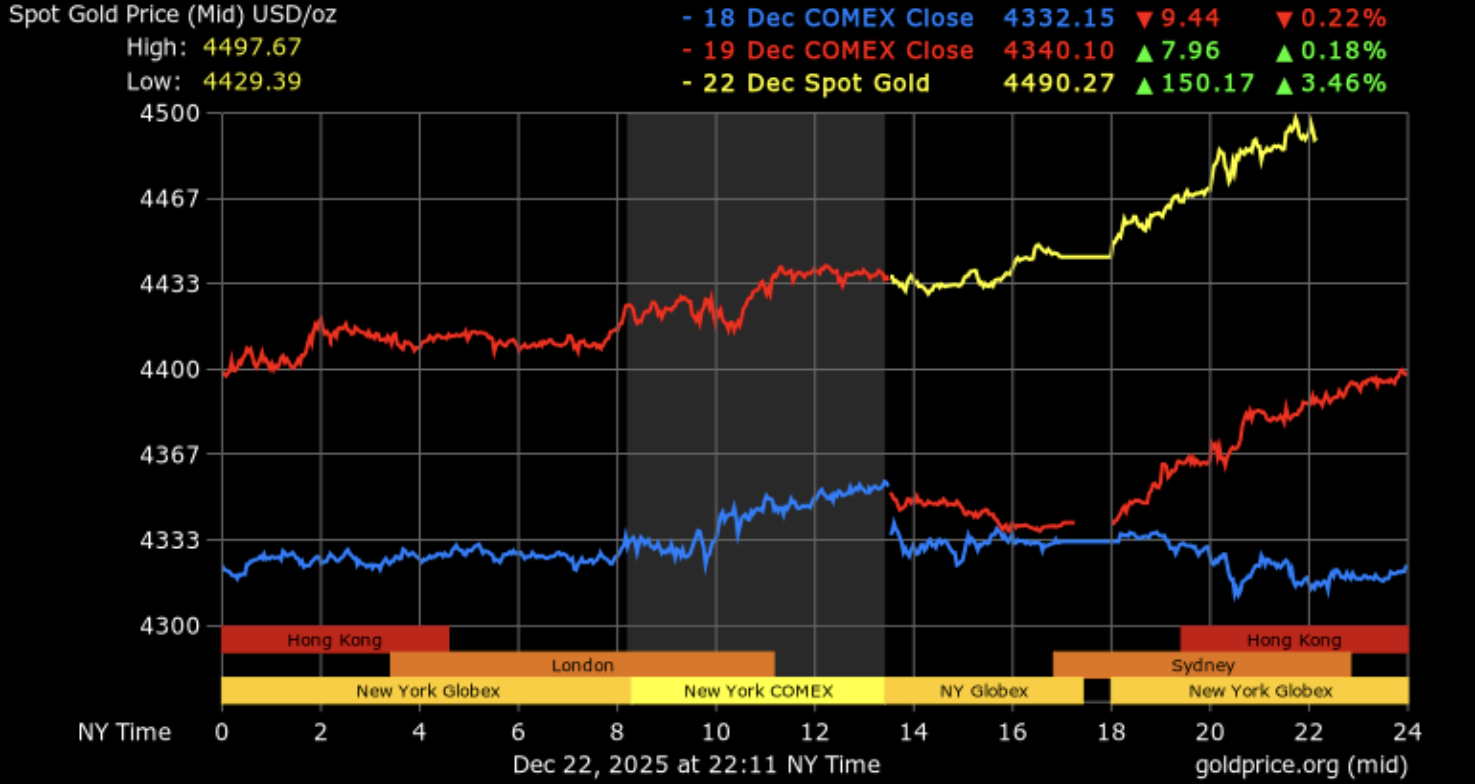
That's the framework traders must heed as they approach 2026. When gold rallies this strongly, it can continue to surge even when indicators appear overextended. At the same time, the first real shift in rates, the dollar, or risk mood can turn a vertical rally into a fast, ugly retracement.
In the following forecast article, we present a practical outlook for 2026 based on the latest market data, positioning indicators, and a comprehensive technical map featuring tradable levels.
Overall technical bias: Bullish, with overheating risk.
Short-term (next 1–2 weeks): The price can maintain a bid stance while above the $4,474–$4,462 pivot support zone. A clean push and hold above $4,503–$4,516 opens continuation risk.
Medium-term (next 1–3 months): If price maintains above the rising long-term averages around $4,316–$4,326, dips are more likely to be bought than sold.
2026 base case: Rangebound-to-higher, with wide swings. The median analyst forecast for the 2026 average is $4,275, which can still include deep pullbacks and sharp spikes.
2026 Bull case: A sustained breakout above $4,500 sets up a path toward the next big magnet near $5,000 (a key extension level from the 2025 range).
2026 Bear case: Should rates stay persistent and the dollar strengthen, a pullback toward the low $4,200s and even the $3,500–$3,800 range becomes feasible.
| Indicator | Latest value | What It Implies |
|---|---|---|
| Spot price | $4,485.55 | Price is pressing fresh highs, momentum traders are in control. |
| 52-week range | $2,595.90 – $4,486.75 | Huge 2025 expansion, which usually means 2026 volatility stays elevated. |
| RSI (14) | 84.561 (Overbought) | Trend is strong, but late entries get punished on even a normal pullback. |
| MACD (12,26) | 27.88 (Buy) | Momentum is still positive, not rolling over yet. |
| ADX (14) | 74.515 | Trend strength is extreme. Great for trend-following, dangerous for chasing. |
| ATR (14) | 12.5915 | Day-to-day range is active. Position size matters more than prediction. |
| 200-day MA | $4,316.24 (simple) | The “line in the sand” for the long trend. A break below changes behavior fast. |
| 50-day MA | $4,380.31 (simple) | Near-term trend support. If this snaps, pullbacks get deeper. |
| Pivot S1 / Pivot / R1 (Classic) | $4,474.40 / $4,482.53 / $4,494.98 | A tight battlefield zone: expect whipsaws here in thin liquidity. |
The unique angle here is that an RSI above 80 is not a "sell signal." It's more like a warning label. It indicates that the market is fluctuating rapidly, and late entries require stricter discipline.
In strong gold trends, "overbought" can last longer than people expect, but the first clean break of trend support usually triggers the fastest pullback.

On a pure price-structure read, the uptrend remains intact: spot is holding above the key daily moving averages, and the longer-term averages continue to slope higher.
The bigger question for 2026 is not "is gold bullish?" It's how the market behaves after a year like 2025, when gold is up roughly two-thirds and recording new highs.
When gold does this, you usually see one of two paths:
Stair-step trend: Pullbacks remain minor, purchasers protect the 20–50 day range, and the price gradually ascends.
Blow-off then reset: price keeps rallying, then one macro shock flips sentiment, and the pullback overshoots because too many positions are crowded the same way.
Currently, momentum still looks more consistent with the first scenario, but the risk of the second is increasing, with positioning stretched and headlines driving an outsized share of the move.
These levels combine the current long-term trend anchors with retracement zones from the 2025 range.
| Support zone | Why it matters | What to watch |
|---|---|---|
| $4,474 – $4,462 | Daily pivot support band | If price holds here, dips are still "buy-the-pullback." |
| $4,380 – $4,316 | 50-day to 200-day average zone | A break below tends to flip the tape from trend to correction. |
| ~$4,040 | 23.6% retracement of the 2025 range | First "bigger" support if the market finally cools off. |
| ~$3,764 – $3,541 | 38.2% to 50% retracement | If gold trades here, 2026 becomes a two-way market, not a one-way rally. |
This is where the 2026 "gold price targets" conversation gets real. Once gold is above $4,400, traders stop arguing about "fair value" and start trading the next magnets.
| Upside level | Why it matters | 2026 implication |
|---|---|---|
| $4,503 – $4,516 | Near-term resistance pivots | A clean hold above can extend momentum. |
| $4,500 (psych) | Round-number gravity | Breaks often trigger stop runs and fresh trend entries. |
| ~$5,001 | Range extension target | This is the “headline” upside zone if the trend stays intact. |
| ~$5,655 | Higher extension zone | More realistic in a risk-off shock than in a calm market. |
Those targets are derived from a simple framework: the $5,001 area aligns with a commonly used extension of the 2025 high-to-low range ($2,595.90 to $4,486.75). It's not "magic", it's how larger traders often map potential upside when price is in open air.
For 2026, a clean invalidation is simple:
A sustained daily break below roughly $4,260 (5% beneath current levels), followed by an inability to regain the 200-day zone around $4,316–$4,326, would suggest the uptrend is losing control.
That does not guarantee a crash. It just changes the game from "buy dips" to "sell rallies until proven otherwise."
Forecasting gold with one single number is how people get trapped. Thus, our approach is a range with clear triggers, based on expansion, interest rates, and risk tolerance.
Using today's spot price near $4,486 as a reference, that translates into the following working ranges:
| 2026 scenario | Implied move | Price range (from $4,485.55) | What it would feel like on the tape |
|---|---|---|---|
| Rangebound / macro consensus | -5% to +5% | $4,261 – $4,710 | Choppy, headline-driven, lots of false breaks. |
| Moderate upside | +5% to +15% | $4,710 – $5,158 | Dips bought, slow grind higher, $5,000 tests. |
| Risk-off surge | +15% to +30% | $5,158 – $5,831 | Fast spikes, bigger gaps, trend followers dominate. |
| Correction / reflation | -20% to -5% | $3,588 – $4,261 | The market stops rewarding longs, rallies get sold. |
This is the key takeaway for traders: Even a "normal" 2026 can still fall within the $400–$1,200 range. That's why the best gold traders focus more on levels and risk control than on one perfect forecast.

Gold loves falling real yields. For example, around the year-end rally, markets were expecting additional cuts in 2026, which supports the "lower opportunity cost" argument for holding gold.
The World Gold Council also notes that "macro consensus" pricing includes additional Fed cuts and easing inflation, even if the path is not straight.
This has been the structural story of the cycle.
Central banks were on track to buy about 850 tonnes in 2025.
The World Gold Council highlights ongoing central-bank buying. They anticipate that total purchases for 2025 will fall between 750 and 900 tonnes, while the results for 2026 could differ significantly based on macroeconomic factors and policy choices.
If that bid remains steady, it puts a floor under dips, even when Western investor flows cool.
Additionally, gold ETFs with physical backing experienced inflows of $82bn in 2025, the highest since 2020.
ETF demand matters because it can push gold prices quickly when momentum is already strong.
Gold's surge in 2025 didn't arise from a single occurrence. A continual flow of geopolitical and geoeconomic pressure fueled it.
If the worldwide situation remains strained, gold maintains demand even in a year without recession.
Gold can still fall hard, even in a bull market. These are the risks traders must monitor closely.
A stronger dollar and higher real yields are the cleanest bearish cocktail for gold. It is the typical "reflation return" type outcome where stronger growth and a stronger dollar can pull gold lower.
Gold is not just "up". It is up in a way that invites position trimming. Thus, thin year-end liquidity and overbought conditions can increase volatility.
That dynamic often carries into January and February when the market resets.
High prices do real damage to jewellery demand, particularly in price-sensitive markets. For example, high prices dented jewellery demand, including a reported drop in India, even as bar and coin investment rose.
Jewellery is not the marginal driver in a crisis, but it matters for the "floor" when investment demand pauses.
A significant trend in 2025 is that recycling continues to be low, even with increased prices, partly due to some households using gold as collateral for loans rather than selling it. That can tighten supply and keep the market supported longer than expected.
Risk note: None of these drivers moves in a straight line. Gold may remain "overbought" for several weeks, then experience a sharp correction in just a few days when liquidity decreases or macroeconomic news changes.
Yes, on the daily chart. RSI is around 84, which is stretched. That being said, "overbought" in gold usually indicates trend strength rather than an immediate peak.
The first area is around $4,474–$4,462 (near-term pivot support). Below that, the larger trend support is located in the $4,380–$4,316 range (50-day to 200-day zone).
If gold holds above $4,500 and momentum stays intact, the next major magnet is around $5,000.
A "risk-on" year marked by strong growth, rising yields, and a firmer dollar can reduce the incentive to hold gold. In that case, pullbacks can extend into the low $4,200s or even the high $3,000s, depending on how fast flows unwind.
Yes. Central bank acquisitions have remained significant, and recent monthly figures indicate ongoing purchases.
In conclusion, gold is bullish heading into 2026, but it's also stretched after a historic run into the $4,400s.
If the price remains above the significant trend area between $4,380 and $4,316, the market may continue to advance towards $4,500 and possibly $5,000 as the next major objective.
The main risk is not one scary headline. It's a change in rates, real yields, and flow behaviour. In 2026, levels will matter more than opinions, because gold can swing hundreds of dollars even in a "normal" year.
Disclaimer: This material is for general information purposes only and is not intended as (and should not be considered to be) financial, investment or other advice on which reliance should be placed. No opinion given in the material constitutes a recommendation by EBC or the author that any particular investment, security, transaction or investment strategy is suitable for any specific person.