Published on: 2026-02-23
Updated on: 2026-02-23
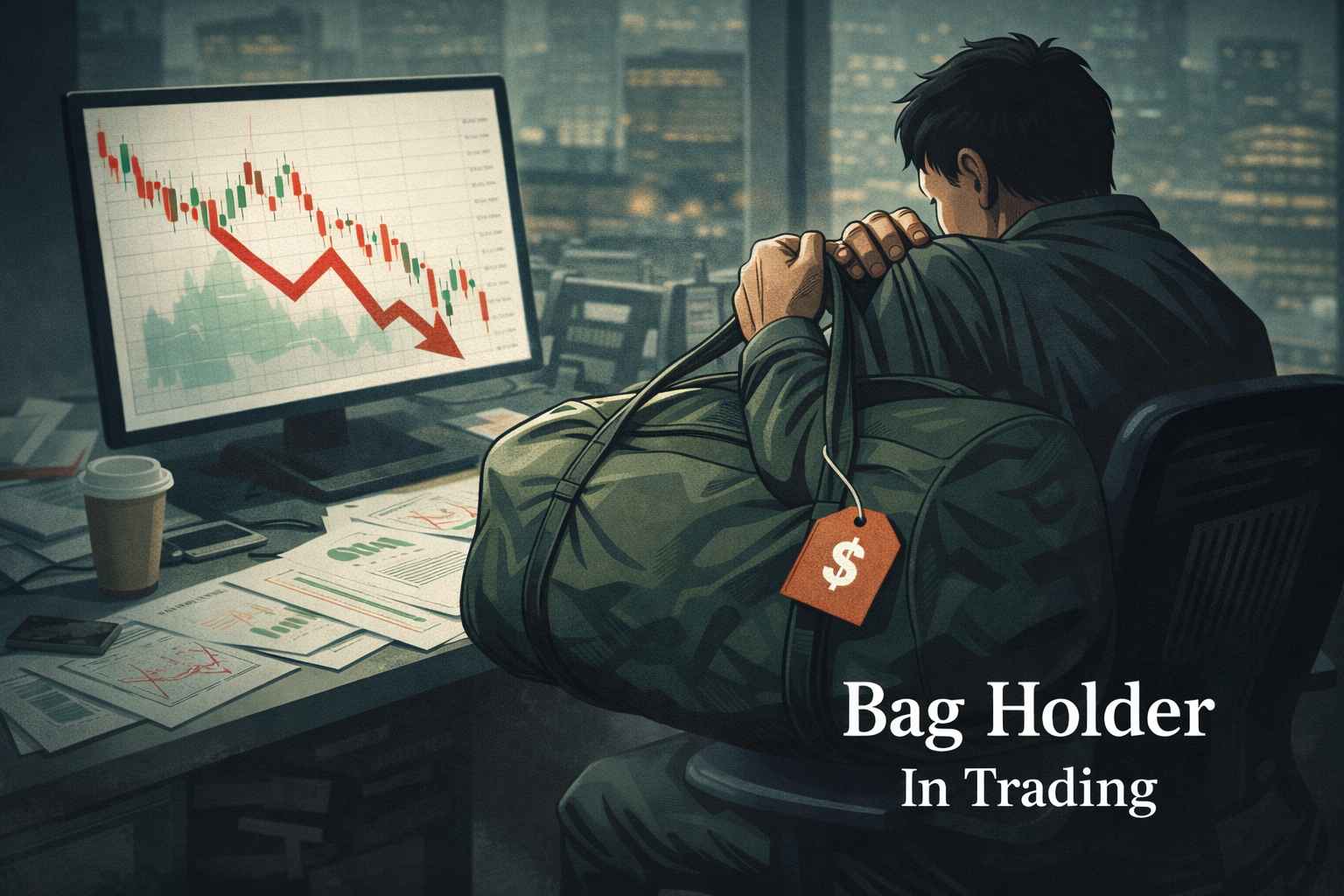
A bag holder (also written bagholder) is a market slang term for an investor who buys an asset near its peak and continues to hold it as the price declines significantly. Although the term is blunt, it accurately captures a recurring pattern observed across various market cycles, including penny stocks, cryptocurrencies, and speculative equities.

Today, the primary challenge is not insufficient information, but its speed and volume. Social media, influencer-driven trades, and swiftly evolving narratives can prompt investors to enter positions without a defined exit strategy. Bag holders are seldom inattentive; instead, they are often constrained by hope, pride, and fixation on their entry price.
Bag holding tends to increase during late-cycle rallies and hype-driven markets, characterized by high liquidity, rapid dissemination of narratives, and temporary disconnection of prices from underlying fundamentals.
Typically, bag holders lack a robust decision-making framework, such as a defined exit strategy, a clear investment time horizon, or a substantiated rationale for maintaining the position beyond the expectation of price recovery.
This pattern frequently emerges in high-volatility segments, including small-cap stocks, speculative growth equities, illiquid securities, and cryptocurrencies, where rapid price increases are often followed by swift reversals.
Prolonged retention of a losing position can distort overall portfolio composition, increase concentration risk, result in missed investment opportunities, and encourage emotionally driven decisions.
Bag holding typically follows a recognizable sequence: a rapid price increase, a peak accompanied by heightened attention, a swift decline, and an extended period of stagnant prices with unsuccessful recovery attempts.
The most effective safeguard is not achieving an optimal entry point, but rather establishing a written exit plan that addresses price targets, timeframes, and investment rationale, along with prudent position sizing to ensure individual errors remain manageable.
In investing, a bag holder (also written bagholder) refers to an investor who remains invested after others have exited, typically having purchased late at elevated prices and subsequently retaining the position despite adverse performance.
This behaviour differs from long-term investing, which is grounded in a rational assessment of value, time horizon, and acceptance of market volatility. Bag holding arises when investment decisions are driven primarily by emotion, leading to subjective and reactive responses to market movements.
| Trait | Long-term investor | Bag holder |
|---|---|---|
| Reason for buying | Valuation, cash flow, business quality | Hype, momentum, fear of missing out |
| Holding period | Intentional and explained | Unplanned and constantly extended |
| Risk control | Position size fits portfolio | Position grows into a “must win” |
| Decision trigger | Thesis changes, better alternatives | “I’ll sell when it gets back to my price” |
| Behaviour under pressure | Rebalances, stays disciplined | Averages down blindly or freezes |
If you want one clean test, a long-term investor can explain what would make them sell. A bag holder usually cannot.
Bag holding frequently results from common cognitive biases, particularly the reluctance to acknowledge mistakes. In behavioural finance, the disposition effect describes the tendency to sell winning positions prematurely while retaining losing ones, a pattern associated with loss aversion and the expectation of eventual recovery.
Markets do not account for individual entry prices; they reflect only current supply and demand dynamics. When investment decisions focus on recovering to the original purchase price, forward-looking analysis is compromised.
The objective is not to assign blame, but to identify when a position transitions from a rational investment decision to an emotionally driven one.

This rationale exemplifies bag holding. Although it may appear logical, it is retrospective and unsupported by current market fundamentals; the entry price is merely a reference point from memory.
A more constructive approach is to consider whether, absent current ownership, the asset would be purchased at its present price.
Increasing a position may be justified when new information enhances the investment outlook. However, doing so solely to mitigate the discomfort of a loss is inadvisable.
A prudent guideline is to add to a position only if the original investment thesis remains valid and there is a clear, articulable improvement since the initial purchase.
This phenomenon is prevalent in speculative assets, where narratives evolve but fundamental business indicators remain static. Examples include stagnant revenue growth, unchanging profit margins, persistent cash outflows, or delayed project timelines.
When updates primarily consist of slogans, vague partnerships, or unsubstantiated future promises, the position is based on narrative rather than a substantiated investment thesis.
A significant warning sign is declining trading volume and widening bid-ask spreads, which indicate reduced liquidity and increased difficulty in executing sales without price concessions.
This is important because limited liquidity can transform a manageable loss into a substantially unfavorable exit. Investors often recognize liquidity constraints only when attempting to sell.
Many positions held by bag holders transition from trending upward to trading within a range. Temporary price increases are quickly met by selling pressure, resulting in lower highs or persistent resistance at that level.
You do not need complex indicators to see this. If rallies keep failing, the market is telling you demand is weaker than supply.
Both behaviours are warning signs. Avoidance usually means the position feels like a mistake you do not want to face. Obsession often means the position is too large relative to your comfort.
A good position should not control your mood. If it does, the risk is already too high.
Hope is not a catalyst. A catalyst is something specific that can plausibly change the market’s view within a defined time window, such as a credible earnings turnaround, a debt refinancing, a product launch with measurable demand, or a regulatory decision.
If you cannot name one, you are likely in “waiting mode,” which is where bag holding thrives.
| Warning sign | What it sounds like | What it usually means | A practical next step |
|---|---|---|---|
| Anchored to entry price | “Back to even and I’m out” | You are not evaluating the asset today | Write a sell rule not tied to entry |
| Averaging down emotionally | “I’ll lower my average” | You are managing feelings, not risk | Pause adds until the thesis improves |
| Story over numbers | “Big things coming soon” | Confirmation bias has taken over | Re-check the financials and timeline |
| Liquidity fading | “It barely trades now” | Exit risk is rising | Plan staged exits, reduce size |
| Bounces keep failing | “It can’t break above…” | Sellers dominate rallies | Set a time-based exit window |
| Mood and attention swing | “I can’t stop checking” | Position is too big | Cut size to regain clarity |
| No catalyst | “It has to recover” | You are holding without a reason | Replace hope with a defined trigger |
Most bag holders are not undone by one bad pick. They are undone by position size and the lack of a sell plan.
If one position can wreck your month, it is too large. A simple approach is to decide the maximum loss you will tolerate on a position and size it so that the loss is manageable if the price moves against you.
This is not about being perfect. It is about staying liquid and clear-headed.
A stop loss is a pre-decided point at which you accept that the trade is not working. It can be a price level, a percentage, or a breakdown of a clear support zone.
The key is commitment. If you keep moving the stop “just a bit lower,” it stops being risk management and becomes bag holding in slow motion.
Some positions do not collapse. They just go nowhere for months. A time stop forces discipline: if the thesis has not progressed by a set date, you reduce or exit.
This prevents “dead money,” which is one of the most expensive forms of bag holding because it quietly steals time.
Rebuild the thesis in one paragraph. If you cannot write it clearly, you probably do not have one.
Separate price from pride. Your entry price is not a target that the market must respect.
Reduce first, decide later. Cutting the position size can restore clear thinking without forcing an all-or-nothing decision.
Set one non-negotiable exit rule. A price level, a deadline, or a catalyst that must occur.
Avoid “revenge averaging.” Only add if new information truly improves the outlook.
A bag holder becomes an investor again the moment decisions become forward-looking and rule-based.
A bag holder in a stock is an investor who keeps holding a losing position after the hype fades and the price falls, often because they hope it will return to their entry price. The key features are the lack of a clear exit plan and the growing emotional attachment to the position.
In crypto, a bag holder is usually someone who buys late in a fast rally and holds through a steep drop, sometimes into a long period of low activity. The term is common in meme coins and small tokens, where hype can dissipate quickly, and liquidity can dry up.
Not always, but it is usually a warning sign. Long-term investing can look like a bag holding during a normal drawdown. The difference is whether the thesis is still valid and whether the position size fits your risk limits. If your only reason for holding is hope, it is typically unhealthy.
Behavioural finance links this pattern to loss aversion and the disposition effect, where investors avoid realising losses and keep waiting for a rebound. It feels safer emotionally, even when it is costly financially.
Use three guardrails: position sizing that keeps any single loss manageable, a written exit plan based on price or time, and a thesis check that forces you to sell when the original reason for buying no longer holds. Diversifying across ideas also reduces the pressure to “be right” on one trade.
A bag holder is not defined by taking a loss. Everyone takes losses. A bag holder is defined as someone who loses discipline. It is what happens when an entry price becomes a goal, hope becomes a plan, and position size becomes too large to think clearly.
The fix is simple, even if it is not easy: decide in advance what would make you sell, size positions so you can survive being wrong, and treat every holding as a fresh decision based on today’s facts, not yesterday’s emotions.
Disclaimer: This material is for general information purposes only and is not intended as (and should not be considered to be) financial, investment or other advice on which reliance should be placed. No opinion given in the material constitutes a recommendation by EBC or the author that any particular investment, security, transaction or investment strategy is suitable for any specific person.