Published on: 2025-12-17
Updated on: 2025-12-17
CoreWeave stock has been under steady pressure, and the chart now appears significantly different from the rapid run-up seen earlier in the year.
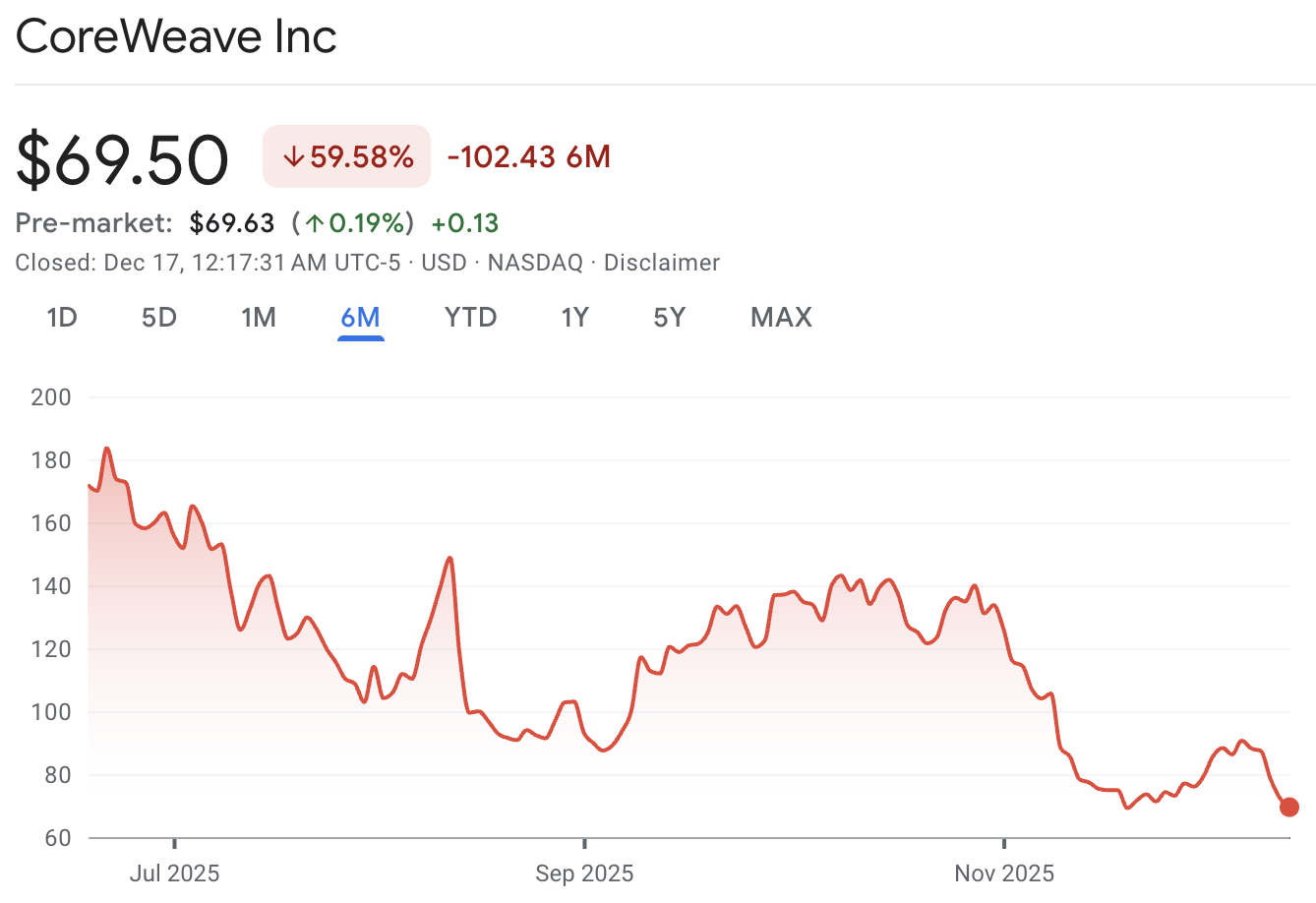
CRWV stock is trading around $69.50, and the slide has been sharp enough to flip the conversation from "growth story" to "execution story." This type of selloff usually happens when traders stop paying for potential and start paying for proof.
For CoreWeave, investors are watching three key issues:
Whether new capacity comes online on schedule
How costly growth is to finance
How much dilution risk is embedded in the capital plan

CoreWeave can scale fast, but expanding capacity requires ongoing funding. When the market's risk appetite cools, stocks with heavy funding needs tend to sell off first, even if top-line growth still looks strong.
In its latest quarterly update, CoreWeave reported Q3 2025 revenue of $1.364 billion. However, it also highlighted the model's heavy carrying costs, with net interest expense of $310.6 million and a net loss of $110.1 million for the quarter.
CoreWeave's Q3 revenue growth is impressive, but the interest line is doing real damage. A stock can rally on growth for a while, but once the market focuses on "how is this funded?", the multiple can compress quickly.
The AI data-centre buildout is increasingly exposed to credit conditions, especially for less financially robust tenants and intermediaries.
When financing gets more expensive, the whole chain feels it: developers, landlords, and the computer renters.
CoreWeave warns that its substantial debt load could limit financial flexibility, hinder additional capital raising, and divert cash flow toward servicing obligations. That is exactly the type of language institutions react to when the tape turns defensive.
Even with strong demand for AI compute, the market will discount any story where a small number of customers can swing utilisation and pricing power. Concentration does not have to "break" to hurt the stock; it only has to raise the perceived risk premium.
Once a stock breaks key moving averages and momentum turns "sell", systematic flows often add pressure. That can keep the stock heavy even on days with no fresh news.
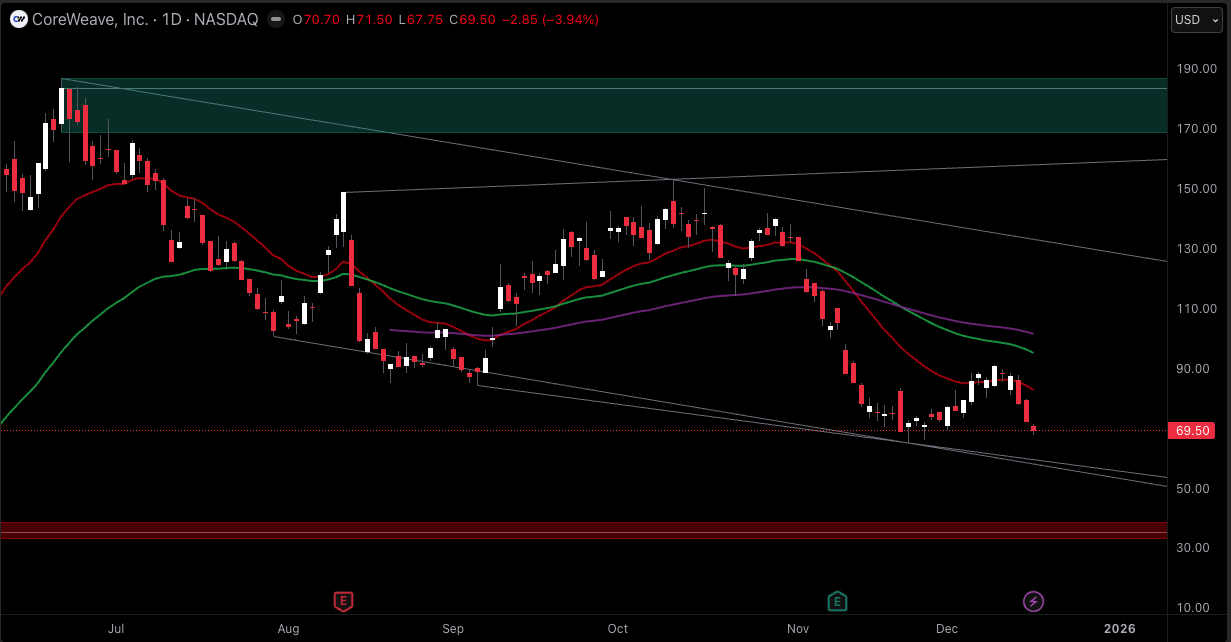
The move has been steep across multiple time frames.
| Time frame | Start level | Latest close | Move |
|---|---|---|---|
| 1 Week (5 sessions) | $90.66 | $69.50 | -23.34% |
| 1 Month | $75.33 | $69.50 | -7.74% |
| 6 Months | Near mid-year peak around $187 | $69.50 | about -60% to -65% from the peak |
CRWV's recent trading is not a slow bleed. It is a volatility event:
large daily ranges
heavy volume on down days
multiple "air pockets" where support failed.
In the latest session shown in the table, the stock ranged from $71.50 to $67.75 and finished at $69.50 on roughly 35.6 million shares of volume.
This wasn't quiet selling, it was active de-risking.
| Indicator | Value | What It Suggests |
|---|---|---|
| Last close | $69.50 | Price is in a weak zone |
| 1-day change | -3.94% | Sellers still in control |
| 5-day change | -23.34% | Downtrend is accelerating |
| RSI (14) | 33.33 | Near oversold, bounce risk rising |
| MACD (12,26) | -5.96 | Trend still bearish |
| MACD signal (9) | -6.85 | Selling pressure has been persistent |
| MACD histogram | +0.89 | Bear trend, but downside momentum is easing |
| 20-day SMA | $78.12 | Price is well below short-term average |
| 50-day SMA | $103.78 | Bigger trend damage, rallies face overhead supply |
| Bollinger (20,2) upper | $91.79 | Overhead "mean reversion ceiling" |
| Bollinger (20,2) lower | $64.44 | Key volatility support zone |
| ATR (14) | $7.45 | Daily swings are large (risk management matters) |
| Avg volume (20D) | 29.38M | Liquidity is strong, moves are "real" |
CRWV is trading far below its 20-day and 50-day moving averages, which is a classic downtrend look. A stock can stay below these averages longer than most expect, especially after a momentum unwind.
The 50-day average of around $103.78 is also a reminder of how much prior buying is now trapped above the market. That overhead supply often turns into resistance on bounces.
RSI near 33 signals intense, rapid selling and a stretched market, but it does not confirm a bottom.
MACD remains negative, maintaining a broader bearish trend. However, a turn higher suggests downside momentum is fading, and the selloff is losing pace.
This mix often leads to one of two outcomes:
a sharp relief bounce that fails into resistance, or
a short base near support, then another attempt lower if buyers do not step in.
These levels matter because they coincide with recent swing highs and lows, key volatility bands, and widely watched retracement zones.
Key support
$67.65 to $67.70 (near the latest pivot support zone)
$65.20 to $65.80 (recent swing low area and a major "line in the sand")
$64.40 (lower Bollinger band zone)
If the stock loses the $65 area cleanly on strong volume, it often signals that traders are no longer treating the drop as a temporary shakeout.
Key resistance
$71.35 to $71.45 (first meaningful retracement and near-term cap)
$75.15 (next retracement zone)
$78.20 (50% retracement area, also close to the 20-day average)
$85.65 to $86.25 (bigger retracement and prior congestion)
A simple way to read resistance in this kind of tape: the market will likely "test" levels quickly, but it will only "clear" them if volume supports the move and daily closes start holding above them.
Bullish Checklist:
RSI stabilises and starts rising while the price holds above the pivot zone.
The stock reclaims MA20 (~74) and holds it on a retest.
The bear case is straightforward: the trend is down, and the stock is below major averages.
Bearish Checklist:
Failed rallies into resistance (68.8–69.7 near-term, then MA20).
A clean break under the 66.99–67.38 support area.
Not necessarily. The selloff is more about financing and execution risk than the end of AI demand.
Yes, Q3 2025 revenue was $1.364bn.
On the daily snapshot, RSI(14) is 29.45, which is near oversold territory and often increases the odds of a short-term bounce.
A first step would be reclaiming the MA20 area (around 73.96) and holding above it.
In conclusion, CoreWeave is sliding as investors pivot from applauding AI growth to scrutinising what it costs to deliver it. The Q3 print shows real scale, but it also highlights a heavy interest burden that makes the equity behave like a leveraged bet on flawless execution.
Technically, the stock is in a "Strong Sell" posture with oversold momentum, which is exactly the mix that can produce sharp dead-cat bounces and equally sharp failures.
Until price starts reclaiming key moving averages and the funding narrative steadies, treat rallies as tests, not trend changes.
Disclaimer: This material is for general information purposes only and is not intended as (and should not be considered to be) financial, investment or other advice on which reliance should be placed. No opinion given in the material constitutes a recommendation by EBC or the author that any particular investment, security, transaction or investment strategy is suitable for any specific person.