Published on: 2026-08-04
By 4 August, USD/JPY had recovered to around 157.6, retracing roughly 28% of its fall from the 28 July high to the post-intervention low.
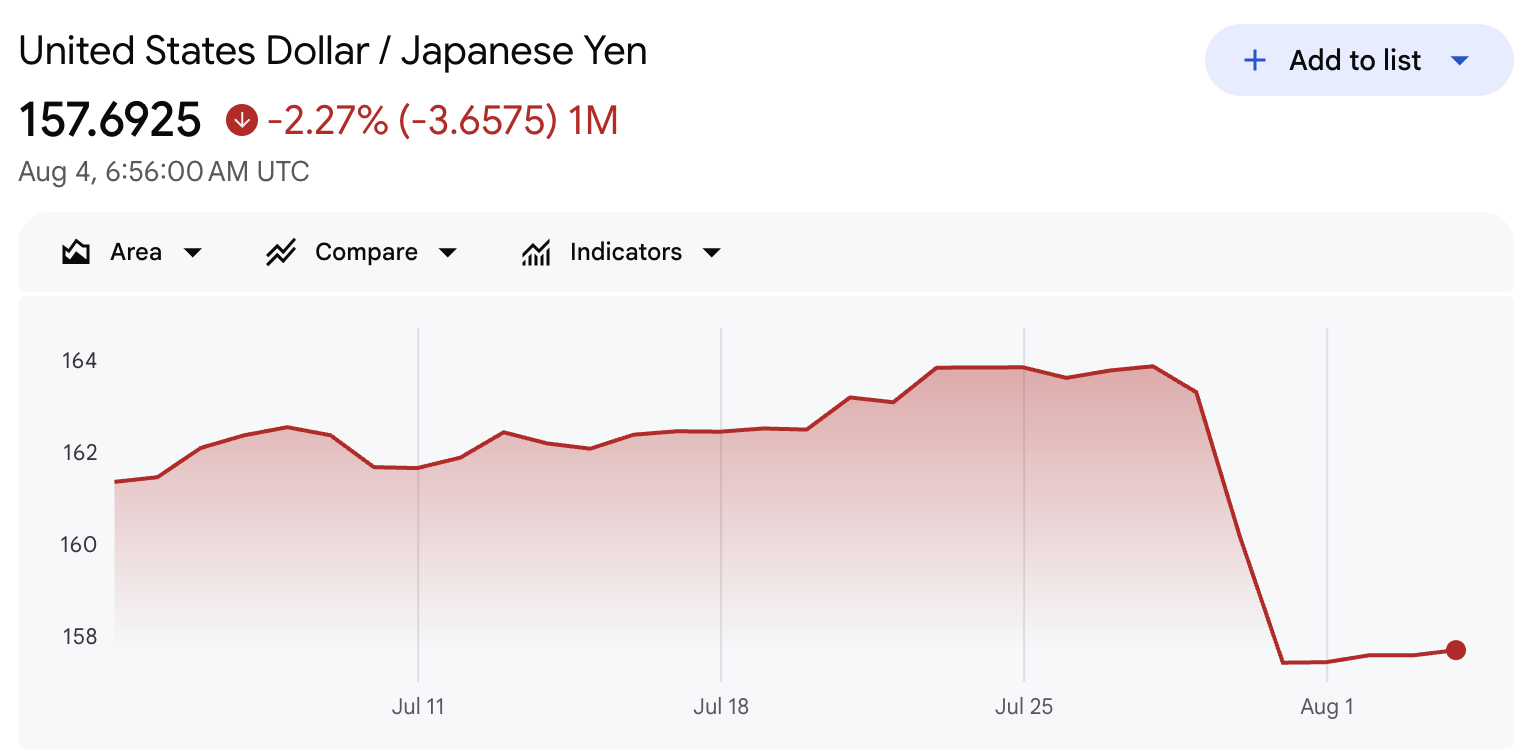
Japan’s Ministry of Finance said on 3 August that it purchased yen in coordination with the U.S. Treasury on 31 July, the first coordinated U.S.-Japan operation to strengthen the currency since 1998, following a solo Japanese intervention the previous day. It halted a disorderly move and forced a rapid reduction in short-yen positions without changing the interest-rate gap behind them.
USD/JPY fell from 163.94 to around 155.20 before recovering to about 157.6, retracing roughly 28% of the decline.
Market estimates put the combined two-day intervention near ¥13.8 trillion, or about $87 billion. Official figures have not been released.
That is equivalent to about 54% of Japan’s reported foreign-currency deposits, though the comparison does not measure remaining capacity.
A simplified calculation puts the policy-rate gap near 2.6 percentage points and the one-year carry break-even near 153.6 from a 157.6 entry.
The operation disrupted crowded positioning and raised the risk of renewed official action, but left the differential intact.
The official confirmation followed the initial 3% yen jump, when BoJ money-market data and the scale of the move had already pointed toward official buying.
| Item | Detail |
|---|---|
| Pre-intervention high | 163.94 on 28 July |
| Post-intervention low | 155.20 on 3 August |
| USD/JPY on 4 August | Approximately 157.6 |
| 30 July solo operation | Estimated ¥8.45 trillion, about $53 billion |
| 31 July joint operation | Estimated ¥5.33 trillion, about $34 billion, Japan’s side |
| Reported U.S. execution | Euros sold, not dollars, to purchase yen |
| Bank of Japan policy rate | 1.00%, held 31 July, 8-1 vote |
| Federal Reserve target range | 3.50%-3.75%, held 29 July, 9-3 vote |
| Japan’s reserves, end-May | $1.306 trillion, including $162.2 billion in deposits |
Both figures are Bloomberg estimates derived from Bank of Japan money-market data, not official amounts. Japan confirmed the purchase but not its size, and the most recent monthly disclosure ends on 29 July, before these operations.
The move was larger than the official purchase alone could produce, because the purchase was the trigger rather than the whole cause.
Once USD/JPY broke sharply below 163, the move developed into a yen carry trade unwind as traders holding long-dollar positions met stop-losses and margin calls. Closing them required buying yen, which pushed the pair lower and triggered the next layer of stops. Coordination with Washington reduced the willingness to trade against it.
Clearing crowded positioning is largely a one-time effect. Once the most exposed trades close, that source of yen demand fades.
The Federal Reserve held its target range at 3.50% to 3.75% on 29 July by 9-3, the three dissenters preferring a 25 basis point increase. The Bank of Japan held its overnight call rate target at around 1.00% on 31 July by 8-1, with Hajime Takata proposing 1.25%. The Fed-BoJ interest-rate gap remained substantial. Using the Fed midpoint of 3.625%, the simplified gap was 2.625 percentage points.
Two calculations follow, pointing in opposite directions.
On a simplified spot-and-interest basis, the 5.3% fall from 163.94 to 155.20 was equivalent to roughly two years of that differential. Intervention does not need to move interest rates to damage a carry position. It needs only to make exchange-rate risk large enough to overwhelm the yield.
Working the other way, a simplified one-year calculation using the two policy rates puts the break-even for a long-dollar position opened at 157.6 near 153.6, though actual returns would depend on funding, rollover and execution costs. The three hawkish dissents also show a rate increase remains part of the near-term debate, reducing confidence that the gap will narrow quickly.
Intervention has therefore made the carry trade more dangerous without making it unprofitable, the condition under which traders cut position size rather than exit.
Japan’s foreign exchange reserves are large, but their composition should be taken into account, too. Ministry of Finance data for end-May put total reserve assets at $1.306 trillion, of which $162.2 billion sat in deposits and $931.7 billion in securities.
The estimated $87 billion total is equivalent to roughly 54% of that deposit figure. The comparison illustrates the operation’s scale but should not be read as a measure of reserve depletion or remaining capacity. The template is a balance-sheet snapshot, and converting securities into intervention liquidity could involve sales, maturities or secured financing, each with different market effects.
One announcement is worth noting in that context. Japan disclosed plans to use the Federal Reserve’s Foreign and International Monetary Authorities repo facility, which lets eligible authorities obtain dollar liquidity against Treasury collateral.
It gives Tokyo another route to short-term dollars and may reduce the need for outright securities sales if further intervention is required.
Reuters reported, citing three sources, that the U.S. Treasury sold euros rather than dollars to buy yen. The detail does not appear in Japan’s official confirmation, but if accurate it means Washington deployed its own reserve assets rather than only lending credibility.
Treasury Secretary Scott Bessent confirmed the action, said the United States would not hesitate to join further intervention, and backed Japan’s efforts to correct what he called the yen’s substantial undervaluation.
Future action could draw on a broader set of official resources, and coordination increases the possibility of operations during U.S. trading hours. That raises the risk of holding short-yen positions while changing nothing about the return.
The forces keeping the yen weak are more continuous, including household purchase of foreign funds, overseas instituional portfolios and pension funds, corporate investment abroad, and an energy import bill inflated by higher crude prices.
The Bank of Japan expects national core inflation to move clearly above 2% from the second half of fiscal 2026, citing energy costs and yen depreciation. The latest nationwide reading was 1.6% in June, while preliminary Tokyo core inflation accelerated to 1.9% in July.
The precedent is instructive. Japan spent a record ¥11.7 trillion, about $73 billion, defending the yen in late April and early May. By late July the currency had surrendered those gains and reached a four-decade low.
Both governments described the objective identically: countering excessive volatility and disorderly movements. Neither claimed to target a level. Measured against that objective it worked: the disorderly move stopped, one-sided positioning was reduced and the credibility of future threats rose. Measured against a durable ceiling, a 28% retracement within days settles nothing either way.
Three developments would test the analysis above.
A sustained move above 160 without an official response would suggest the deterrent is fading faster than assumed. Masahiko Loo of State Street Investment Management has identified 162 to 165 as a zone where intervention risk may rise, noting that officials focus on the pace and disorderliness of moves rather than a declared target.
An accelerated BOJ tightening cycle would challenge it most directly, because it narrows the differential rather than the price. Each 25 basis points closes roughly a tenth of the gap.
A third view holds that coordination may not help. Robin Brooks of the Brookings Institution has argued it could ultimately weaken rather than strengthen confidence in the yen. That is his interpretation rather than an established outcome, but on that reading repeated official buying provides temporary exit points without changing longer-term demand for the currency.
The longer-term effect remains uncertain while the interest-rate gap and private capital flows continue to favour the dollar. Further coordinated action would raise the risk of holding short-yen positions, but a lasting reversal would probably require a clearer change in monetary policy or underlying flows.