Published on: 2026-09-03
Updated on: 2026-09-03
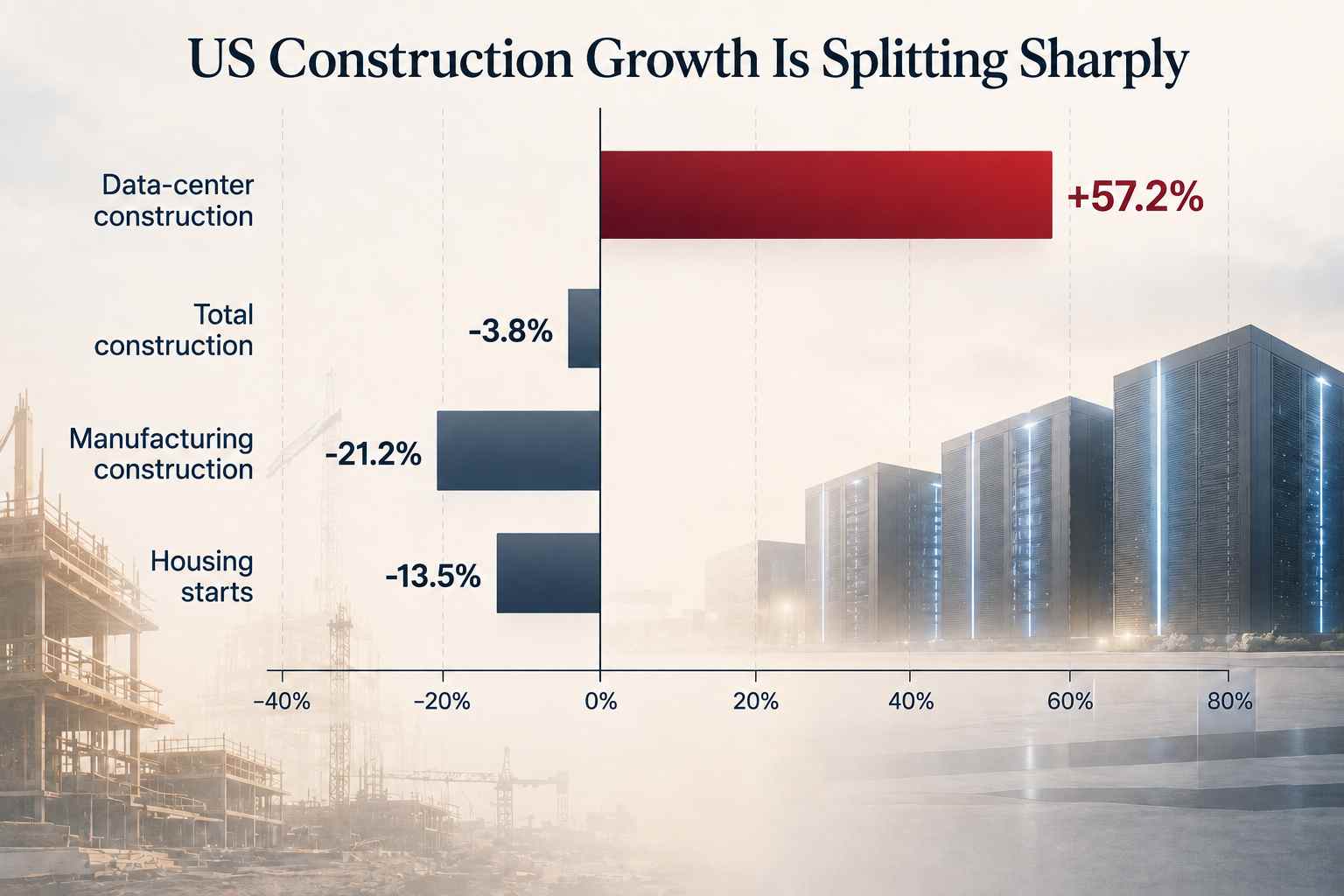
US data center construction ran at roughly $75.2 billion annualized in July 2026, up 57.2% on the year. Total US construction spending was 3.8% below its July 2025 pace. One category is pulling hard against a broad slowdown.
They are holding up construction rather than the economy. Strip data centers out of the July figures and total US building would have run roughly 5.1% below its year-ago pace instead of 3.8%.
 The Federal Reserve’s Beige Book, published on September 2, gave that split a voice. A contact in the Chicago district said that without data centers, construction would be in a recession.
Data center construction: roughly $75.2bn annualized in July 2026, up 6.2% on the month and 57.2% on the year.
Total construction: $2,157.6bn annualized, 3.8% below July 2025.
Share of the category: data centers passed 60% of private office construction spending in July.
The offset: manufacturing construction fell 21.2% year over year and housing starts fell 13.5%.
The Fed’s read: several districts report concentrated data center demand, making growth concentration the risk to watch rather than an outright construction collapse.
The Census Bureau put total construction spending at a seasonally adjusted annual rate of $2,157.6 billion in July, released September 1. The total was estimated 0.5% lower on the month, a change Census flags as statistically indistinguishable from zero, and 3.8% below July 2025. Data center construction inside that total rose 6.2% on the month and 57.2% on the year.
Private office construction, the Census line that contains data centers, climbed 21.3% year over year on the strength of that one component.
On those figures, data centers accounted for more than 60% of private office construction spending in July, which means the category no longer describes a single market. It covers conventional office space, still soft, and server halls absorbing most of the dollars. Reading the 21.3% gain as a commercial property recovery misreads the release.
The measurement basis warrants equal care. Census reports the value of work put in place each month, meaning money physically spent on site. Separate industry datasets track construction starts, or the value of projects breaking ground, and those showed roughly $84.1 billion of data center groundbreakings through July, close to three times the 2025 pace.
The two series answer different questions, so adding them together would overstate current activity.
The September 2 Beige Book, based on conditions since early July and information collected through August 24, is the qualitative counterpart to that release. Its national summary recorded residential construction declining while nonresidential construction rose on balance, with several districts reporting heavy concentration of data center work.
Chicago described nonresidential construction as unchanged over the period, with data centers and other mega-site projects the main centers of activity. The recession line appears there, attributed to a contact rather than the Bank.
Cleveland reported robust growth in demand for manufactured goods, driven by data center development and defense spending, while consumer spending fell for a fourth consecutive period.
Richmond found data center construction straining an already tight skilled labor pool, with contacts citing competition from non-local firms chasing the work. A Maryland construction company put through a 35% pay increase to retain staff.
Across the three districts, the same data center cycle appears in construction activity, factory orders and skilled-trade wages.
They are offsetting one rather than concealing it, and the subcategory detail shows where.
Private residential spending sits at $859.0 billion annualized, down 7.3% on the year and falling for a fourth straight month. Housing starts dropped 12.4% in July to 1.239 million annualized, 13.5% below July 2025, though permits rose 5.0% on the month, a tentative counterpoint to the fall in starts.
Manufacturing construction was 21.2% below its year-ago level, with computer, electronic and electrical plant work accounting for most of the year-to-date decline. Lodging fell 9.6% and commercial 4.9%.
The Associated Builders and Contractors calculated that July’s entire increase in nonresidential spending came from data centers, and that excluding them, nonresidential spending fell for a second straight month to its lowest level since September 2023.
A subtraction sizes the offset. At a 57.2% growth rate, the comparable July 2025 data center run rate was roughly $47.8 billion.
| July, annualized | 2026 | 2025 | Change |
|---|---|---|---|
| Total construction | $2,157.6bn | $2,242.6bn | Down 3.8% |
| Data centers | ~$75.2bn | ~$47.8bn | Up 57.2% |
| Total excluding data centers | ~$2,082.4bn | ~$2,194.8bn | Down ~5.1% |
That last row is arithmetic from published figures rather than a Census series, and it still leaves data center related work inside categories such as power, so it illustrates concentration rather than describing an economy without data centers.
A finished data center is capital-heavy and labor-light. Power, cooling and racked hardware absorb the money, and the operating facility runs on a modest permanent staff. Construction is the labor-intensive phase, and it is the phase the economy is in.
Richmond’s 35% retention raise and Chicago’s report of unusually large increases for electricians both reflect that. The Bureau of Labor Statistics identifies data center expansion as a source of projected demand for electricians, HVAC workers and power-line installers, which is where the employment effect concentrates rather than in broad payroll growth.
Manufacturing feels it earliest. Cleveland’s producers tied robust order growth directly to data center development alongside defense, with electrical equipment, transformers and switchgear at the front of the queue.
Power construction rose 5.3% year over year in July, and industry analysis links part of that growth to the infrastructure needed to serve these facilities. Fed contacts separately reported rising steel, copper and aluminum costs, several blaming tariffs. Engineering, permitting and construction lending move with the same pipeline, adding a multiplier the construction figure understates.
Demand risk is the version most discussed. If the largest operators trim capital budgets, projects are deferred or canceled and the construction line falls quickly, because the pace is set by a small number of buyers whose decisions move together.
Capacity risk is nearer and gets less attention. Investment intentions can stay intact while grid interconnection queues, transformer lead times, trade shortages and local politics bind. Richmond’s contacts flagged the last of those, with data center moratoriums raising alarms in the Washington area over a possible slowdown in construction and capital investment.
Data centers are not carrying the US economy. They are carrying a measurable share of one of its most cyclical sectors, and the ex-data-center estimate above shows how much weakness across several major building categories it is offsetting.
The resolution runs one of two ways. Housing and conventional commercial building recover, spreading activity out again and reducing the concentration to a footnote. Or data center spending plateaus while the rest stays soft, at which point the dependence stops being arithmetic and becomes visible.
Roughly $75.2 billion at a seasonally adjusted annual rate in July 2026, per Census Bureau data released September 1. The figure covers building work put in place, not servers, chips or leasing costs.
They are supporting parts of it. Census data and the September 2 Beige Book show data centers driving nonresidential construction, factory orders and skilled trade wages, though they are not responsible for aggregate US growth.
AI computing capacity requires buildings, power infrastructure and cooling systems that take years to deliver, so operators are committing capital well ahead of the capacity coming online.
US Census Bureau, Monthly Construction Spending, July 2026:
US Census Bureau and HUD, Monthly New Residential Construction, July 2026:
Federal Reserve, Beige Book, September 2, 2026:
https://www.federalreserve.gov/monetarypolicy/files/BeigeBook_20260902.pdf
Associated Builders and Contractors, July nonresidential construction spending analysis: