Published on: 2026-09-03
Updated on: 2026-09-03
Four record closes in a row. The peso has lost 6.03% against the dollar since December.
The policy rate is 5.00%. July inflation was 6.2%. The gap between those two numbers explains more than the hikes do.
Oil is the fastest channel. Brent near $95 converts into dollar buying almost immediately in Manila.
The external account is the slower one. A Q1 current account gap of 4.8% of GDP creates demand no rate decision can switch off.
Not a crisis. Reserves of $103.32 billion still cover 6.7 months of imports, though the trend is heading the wrong way.
What turns it around is a checklist, not a forecast. Seven conditions are set out at the end.
The Philippine peso fell to a record 62.652 per dollar in international trading on 2 September 2026. The domestic market printed an intraday low of 62.69 and closed at an all-time weak 62.565, a fourth consecutive record close.
The slide came six days after the Bangko Sentral ng Pilipinas raised its policy rate to 5.00%, its third increase since April. Higher local rates have not steadied the currency.
Three pressures explain the disconnect. Crude near $95 a barrel, an external account that keeps pulling dollars out of the country, and US yields near three-year highs.
Energy did most of the damage. Brent traded near $94.86 a barrel on 2 September, roughly 13% higher over a month, after renewed US-Iran strikes revived supply fears around the Strait of Hormuz.
The Philippines imports almost all the crude it burns, so each move higher converts directly into extra dollar buying by domestic refiners, power producers and fuel distributors.
| Indicator | Latest Reading | Why It Weighs on PHP |
|---|---|---|
| USD/PHP closing rate, 2 Sept | 62.565 | Fourth straight record close |
| BSP policy rate | 5.00% | Third hike since April, 75bp cumulative |
| July headline inflation | 6.2% | Sits above the policy rate |
| Q1 2026 current account | -4.8% of GDP | Structural demand for dollars |
| Brent crude | ~$94.86/bbl | Up ~13% in a month |
| US 10-year Treasury yield | 4.81% intraday | Highest since November 2023 |
The dollar side was equally unhelpful. The 10-year US Treasury yield reached 4.814% intraday on 2 September, its highest since November 2023, before settling near 4.79%.
Futures pricing moved to around a 70% probability of a 25 basis point Federal Reserve hike at the 15 to 16 September meeting, up from roughly 37% a week earlier. Higher US yields narrow the peso’s relative rate advantage and pull capital toward dollar assets.
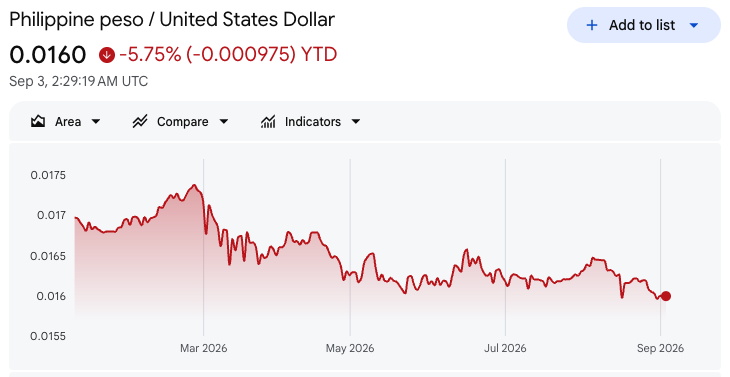
Emerging Asia felt the squeeze broadly, but Philippine paper took a heavier hit. Local benchmark 10-year bonds have lost roughly 23.6% in price terms this year, according to LSEG-compiled data. The peso has now shed 6.03% against the dollar since its 58.79 close on 29 December 2025.
Raising a policy rate does not mechanically lift a currency. What investors price is the return left after inflation, the expected path of policy on both sides of the trade, and how many pesos the economy must sell to pay for its imports.
On the first count the arithmetic is unflattering. The policy rate stands at 5.00% while July headline inflation ran at 6.2%, with core at 4.2%. Markets trade expected rather than realised inflation, yet the forward view offers thin comfort.
The BSP’s own projections put 2026 inflation at 6.1% and 2027 at 5.4%, both above the 2% to 4% target band. Maybank analysts cited precisely this combination of low real rates and an unfavourable external position when explaining the peso’s underperformance.
Guidance compounded the problem. The 27 August hike was read as dovish after Governor Eli Remolona said he hoped further tightening would not be needed, even as US rate expectations moved the other way. A rate rise delivered alongside a signal that the cycle is nearly finished offers limited carry appeal.
The central bank has been present in the market. It intervenes to address disorderly conditions and smooth extreme volatility rather than to defend a level. Remolona has been blunt about the limit: the BSP can slow the peso’s descent, but it cannot fix the exchange rate without running down reserves.
The transmission runs in a straight line. A higher crude price lifts the import bill. Importers then need more dollars to settle the same volume of cargo, which adds steady, price-insensitive demand for the greenback in the local spot market.
That demand widens the trade-in-goods deficit, the single largest drag on the current account. The Philippines ran a current account shortfall equivalent to 4.8% of GDP in the first quarter of 2026, and the balance of payments swung back to a $1.47 billion deficit in July as import-related outflows and external debt payments resumed.
A weaker peso then raises the local cost of that same imported energy. Fuel feeds into transport, electricity and food distribution, which is why transport inflation was still running at 11.9% in July after three straight months of disinflation.
Imported inflation strengthens the case for more tightening, which weighs on growth and, as this episode demonstrates, carries no guarantee for the currency.
A record nominal exchange rate is not, on its own, a currency crisis. The peso floats. There is no peg to break and no published level the BSP has committed to defending. Genuine distress would show up as an inability to fund external obligations, not as a run of record closes.
The buffers remain intact. Gross international reserves stood at $103.32 billion at end-July, equal to 6.7 months of import cover and about 3.7 times short-term external debt on a residual maturity basis. Personal remittances reached $19.12 billion in the first half, up 2.4% year on year, alongside continued business process outsourcing and tourism receipts.
The qualifier is direction of travel. Reserves are at an 18-month low, remittance growth from the United States and the Middle East has been modest or is showing signs of slowing, and the current account gap has widened rather than narrowed. Pressure is accumulating. Funding capacity is not yet in question.
The turning point depends on a set of conditions, not a price. Watch for:
Sustained cooling in crude, not a single session of relief, which would shrink the monthly import bill
A retreat in US Treasury yields or a softer Federal Reserve tone after the September meeting
Broad dollar weakness against Asian currencies, which would ease pressure across the region
Further disinflation in Philippine CPI, with the August print due on 4 September
Improvement in monthly balance of payments and reserve data
Additional BSP tightening, or firmer guidance that the cycle is not finished
Evidence that intervention is containing disorderly moves rather than merely slowing the trend
Forecasters are not calling for a collapse. MUFG has shifted its USD/PHP profile to around 62.20 for the third quarter and 62.00 for the fourth, easing toward 61.00 in the first half of 2027, on the assumption of one further BSP hike and a gradual narrowing of the trade gap.
PIDS senior fellow John Paolo Rivera has flagged 63 as a plausible near-term test, while noting it is a psychological marker rather than a policy trigger.
For now, the peso’s difficulty is broader than interest rates. Until oil settles and the external accounts improve, the burden of stabilisation falls on forces the BSP does not control.
Elevated oil prices, a widening current account deficit, high US Treasury yields and inflation above the policy rate have combined to erode the peso’s real return.
The international spot market reached a record 62.652 per dollar on 2 September 2026. In domestic trading, the peso weakened as far as 62.69 and closed at an all-time weak 62.565 the same day.
They can help, but only if the resulting real return competes with dollar assets and the external deficit narrows. Three hikes since April have not been sufficient on their own.