Published on: 2026-09-03
SNOW stock jumped more than 20% in extended trading after Snowflake reported 37% product-revenue growth, marking its third consecutive quarter of acceleration and extending a growth recovery that began late last fiscal year.
Management estimated that newer AI products contributed roughly half of the recent acceleration, while the heavier AI workload mix was already large enough to lower full-year product gross-margin guidance from 75% to 74%.
At roughly 21 times guided FY27 product revenue after the rally, sustaining high-30s consumption growth now becomes the test for Snowflake’s higher valuation.
Snowflake’s product revenue reached $1.49 billion, up 37% year over year, extending a growth sequence of 30% in Q4 FY26, 34% in Q1 FY27 and 37% in Q2 FY27.
FY27 product-revenue guidance rose to $6.07 billion from $5.84 billion, while the Q3 forecast of $1.588 billion to $1.593 billion implies another 37% to 38% growth.
Management estimated that newer AI products contributed roughly half of Snowflake’s recent growth acceleration. A higher AI workload mix is also contributing to the reduction in full-year non-GAAP product gross-margin guidance from 75% to 74%.
At a post-earnings price near $375, SNOW trades at roughly 21 times guided FY27 product revenue on a simplified enterprise-value basis, raising the execution threshold as faster growth and improving profitability must support a much richer valuation.
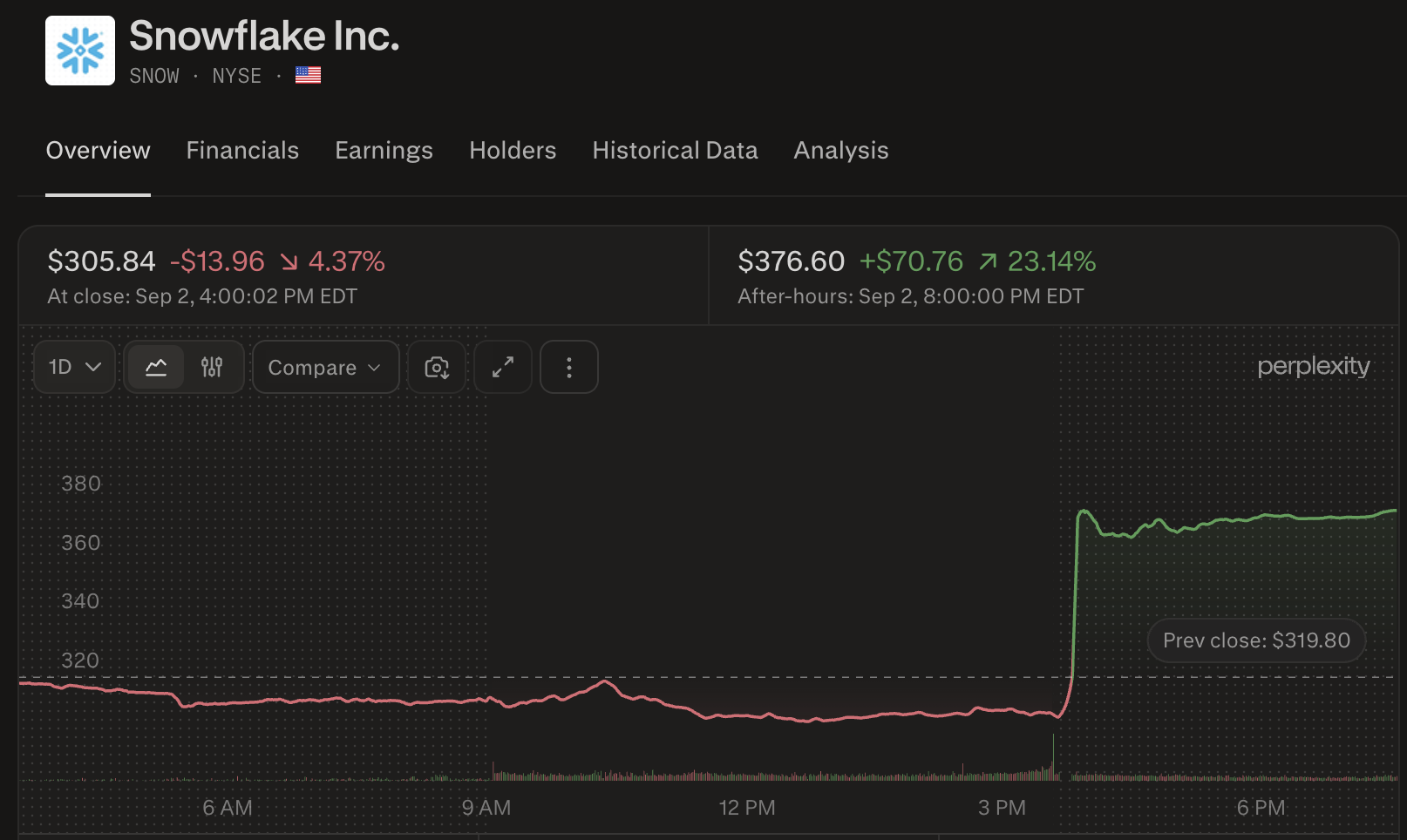
Image Source: Perplexity
The more consequential surprise was product revenue, not adjusted EPS. Snowflake had guided Q2 product revenue to $1.415 billion to $1.420 billion, then delivered $1.492 billion, roughly 5% above the midpoint of its own forecast. Q3 guidance now calls for another 37% to 38% increase, extending the stronger consumption trend beyond one quarter.
The full-year reset is equally significant. Snowflake entered FY27 forecasting $5.66 billion of product revenue, raised that to $5.84 billion after Q1 and lifted it again to $6.07 billion after Q2. Those two revisions have added $410 million to the original outlook in six months.
Snowflake recognises product revenue largely as customers consume compute, storage and data-transfer resources, so the upside surprise carries more weight than it would under a fixed subscription model. Delivering product revenue roughly 5% above Snowflake’s own quarterly guidance suggests customer usage ran ahead of the assumptions embedded in that forecast.
The 20%+ repricing reflects a business entering Q3 with a materially higher revenue path than the one management expected at the start of the fiscal year.
Snowflake’s product-revenue growth has accelerated for three consecutive quarters, and its Q3 guidance points to that pace holding near the high-30s. Growth increased from 30% in Q4 FY26 to 34% in Q1 FY27 and 37% in Q2 FY27, turning what initially looked like stabilisation into a sustained upward sequence.
The progression is clearer when viewed quarter by quarter.
| Period | Product revenue | YoY growth |
|---|---|---|
| Q4 FY26 | $1.23B | 30% |
| Q1 FY27 | $1.33B | 34% |
| Q2 FY27 | $1.49B | 37% |
| Q3 FY27 guide | $1.588B–$1.593B | 37%–38% |
The full-year outlook now implies 36% product-revenue growth. Management expects the Observe acquisition to contribute roughly one percentage point, which puts growth excluding that contribution at about 35% by calculation. Acquisitions therefore explain only a small part of the stronger FY27 trajectory.
RPO provides the main counter-signal. Remaining performance obligations grew 30% year over year in Q2, down from 38% in Q1 and 42% in Q4 FY26, even as recognised product revenue accelerated. Snowflake cautions that RPO does not translate directly into future product revenue because customers control when contracted capacity is consumed.
The divergence does not overturn the acceleration thesis, but continued slowing in RPO would become more significant if recognised revenue growth also begins to lose momentum.
Yes, although Snowflake does not disclose AI revenue as a separate financial line. CFO Brian Robins said Q2 included a meaningful step-up in AI revenue, while CEO Sridhar Ramaswamy estimated that newer AI products contributed approximately half of the recent growth acceleration. Core data workloads, migrations and other products accounted for the remainder.
The margin outlook provides harder evidence than adoption figures alone. Snowflake lowered its FY27 non-GAAP product gross-margin guidance from 75% to 74% as the expected revenue mix shifted toward faster-growing AI products, which currently carry lower contribution margins. AI has therefore become financially meaningful enough to affect Snowflake’s consolidated product economics.
The broader profitability outlook is still improving. Snowflake raised FY27 non-GAAP operating-margin guidance from 13.5% to 14.5% even as product gross-margin expectations declined. That combination suggests operating leverage elsewhere in the business is currently strong enough to absorb part of the lower-margin AI mix while Snowflake prioritises adoption and revenue growth.
Snowflake’s consumption model gives AI agents a direct route into product usage. CoWork and Cortex Agents are charged according to usage rather than fixed seat counts, while the services an agent invokes can generate additional consumption across models, search, SQL execution and compute.
A single business task can therefore involve several Snowflake workloads. An agent might retrieve enterprise data, generate and execute a query, search another source and call a model before returning an answer. More agent activity can increase both AI consumption and use of the underlying data platform without requiring an equivalent increase in licensed users.
Snowflake says customers using AI are already consuming more across its broader data platform, while CoWork consumption is scaling and contributing revenue alongside other AI tools. That gives agent adoption a second potential revenue effect beyond the AI service itself.
Lower model costs and improving workload efficiency work in the opposite direction by reducing the cost of completing each task. Snowflake benefits most when the number and complexity of AI workflows expand faster than the unit cost of running them declines. The durability of the AI revenue opportunity therefore depends less on user counts than on how much productive work those users increasingly delegate to agents.
Under an AWS agreement amended in April 2026, Snowflake committed to a cumulative minimum of $6 billion in cloud-infrastructure spending over five years through March 31, 2031. Annual minimums range from $900 million to $1.25 billion. If Snowflake falls short of those thresholds, it must pay the difference, although those payments can be applied toward qualifying AWS infrastructure services during the agreement term.
The expanded relationship covers infrastructure supporting Snowflake’s data and AI workloads, including AWS Graviton compute. Its economics ultimately depend on how much customer consumption grows against those AI infrastructure costs.
Snowflake’s customers retain flexibility over when and how much capacity they consume, while the AWS agreement carries minimum spending obligations. Strong workload growth would absorb that infrastructure through higher revenue-generating usage. A sustained consumption slowdown would leave Snowflake with less flexibility to reduce cloud spending at the same pace as demand.
At a post-earnings price near $375, SNOW trades at roughly 21 times guided FY27 product revenue on a simplified enterprise-value basis. The calculation uses Snowflake’s latest officially reported 346.6 million common shares outstanding as of May 15, together with its July 31 balance sheet. Snowflake ended Q2 with about $4.33 billion of cash and investments against $2.28 billion of convertible senior notes, producing an estimated enterprise value near $128 billion at that share price.
The multiple reflects expectations well beyond one strong quarter. Snowflake now guides for 36% product-revenue growth, a 14.5% non-GAAP operating margin and a 23% adjusted free-cash-flow margin for FY27. Maintaining growth near the mid-30s while expanding profitability would support that premium. An earlier return toward slower growth would make it considerably harder to sustain.
Reported profitability still provides an important counterweight. Snowflake posted a 17% GAAP operating loss margin in Q2 while its non-GAAP operating margin reached 15.3%. Stock-based-compensation-related charges account for a substantial part of that reconciliation, so improving adjusted margins do not yet translate into comparable GAAP profitability.
The rally has changed the valuation question. Snowflake has already demonstrated that growth can accelerate again. Near the post-earnings price, the more demanding test is how long that acceleration can last before the revenue multiple begins to compress.
Snowflake expects Q3 product revenue of $1.588 billion to $1.593 billion, implying another 37% to 38% year-over-year increase. Holding growth near that level would extend the acceleration into a fourth consecutive quarter and strengthen the evidence that AI consumption is adding durable volume rather than producing a short-lived surge.
The next test is whether Snowflake can sustain that usage while improving the economics of the AI workloads now contributing more heavily to revenue.