Published on: 2026-09-02
Updated on: 2026-09-02
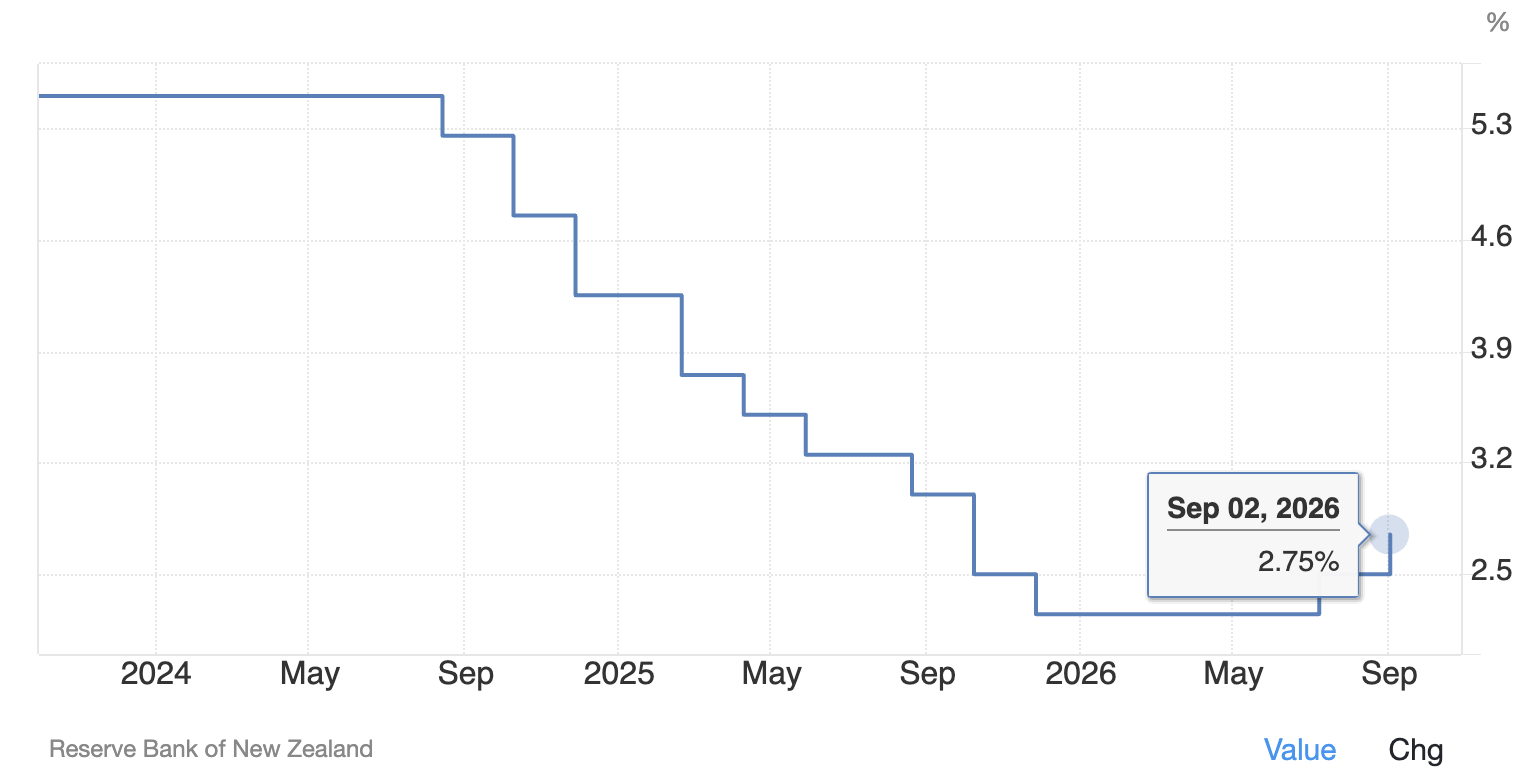
The RBNZ lifted the OCR to 2.75%, its second consecutive hike, again agreed by consensus.
Fuel drove the 4.1% inflation print. Excluding vehicle fuels, the rate is 2.9%.
Most core inflation measures already sit inside the 1% to 3% target band.
The bank may raise the OCR again this year. Its track reaches 3.0% in early 2027, 3.2% by late 2027.
The outlook stays broadly similar to May, making this confirmation rather than a hawkish shift.
The recovery is split. Exporters are relatively resilient, households in Auckland and Wellington are not.
NZD/USD slipped toward 0.5855, with 0.5900 the first hurdle and 0.5990 the ceiling.
The Reserve Bank of New Zealand raised the Official Cash Rate by 25 basis points to 2.75% on Wednesday, a second consecutive increase agreed by consensus across the Monetary Policy Committee.
Markets had all but fully priced the move. The weight of the statement lies elsewhere, in a warning that the OCR may need to rise again this year while household spending stays subdued.
Headline inflation stands at 4.1%. Excluding vehicle fuels it is 2.9%, which frames the decision as insurance against future price setting rather than a response to an overheating economy.
| Indicator | Latest |
|---|---|
| Official Cash Rate | 2.75% |
| September move | +25bp |
| Previous OCR | 2.50% |
| June quarter CPI | 4.1% |
| CPI excluding vehicle fuels | 2.9% |
| Inflation target band | 1%–3% |
| Committee decision | Consensus |
| Central OCR projection | 3.0% early 2027; 3.2% late 2027 |
| Inflation back in target band | Mid-2027 |
The Official Cash Rate moved from 2.25% to 2.50% on 8 July, the first increase in more than three years and also a consensus decision. Wednesday takes it another quarter point higher, an outcome 27 of 31 economists in a Reuters survey had expected.
 Annual inflation climbed to 4.1% in the June quarter, above the 1% to 3% target band, driven mainly by higher fuel and related prices arising from the conflict in the Middle East. Those costs have since flowed into air fares and food prices.
The committee framed the increase as a gradual withdrawal of stimulus rather than a tightening campaign. Moving now, in its own words, reduces the risk that the OCR needs to increase by more later. Future decisions will depend on its judgement of the balance of risks to medium-term inflation.
A second argument concerns financial conditions. Higher wholesale rates have fed through to mortgage and business lending rates, but pass-through to term deposit rates has been more limited, lowering the cost of new bank funding relative to wholesale rates and diluting the intended transmission of policy.
Headline and underlying inflation are unusually far apart. Excluding vehicle fuels, annual CPI inflation eased to 2.9% in the June quarter, and most measures of core inflation are already inside the target band.
The RBNZ estimates that higher fuel prices contributed around 0.9 percentage points directly to quarterly CPI inflation in the June quarter, with indirect effects adding roughly another 0.1 points. Longer-term inflation expectations remain near 2%, most one and two-year measures have fallen since May, and expected wage growth is consistent with inflation returning to target.
So the committee is not trying to reverse an oil shock with interest rates. It is trying to stop that shock from changing behaviour.
The meeting record sets out the concern precisely. Price setting can be front-loaded, meaning firms may lift domestic prices by more than import costs justify, with elevated administered price inflation compounding the effect. Inflation then persists long after fuel prices fade.
The RBNZ expects inflation above 3% for the rest of this year, back within the target band by mid-2027 and at the 2% midpoint later that year.
Growth was lacklustre in the June quarter. The committee believes the recovery resumed in the third quarter, though it remains uneven across sectors and regions.
Export-facing New Zealand is holding up. Resilient trading partner demand and strong food commodity prices are supporting income growth and business investment across the South Island and parts of the North Island, and the terms of trade are projected to resume a long-run upward trend.
The domestic economy is not. Weak income growth, job insecurity and flat house prices continue to weigh on household spending and residential investment, with the committee naming Auckland and Wellington specifically. Unemployment is elevated and hiring has not kept pace with new entrants to the labour market, leaving youth and the long-term unemployed most exposed.
Households have responded by saving more, and strong growth in dwelling consents has yet to translate into construction nationwide. Spillovers from the export sector remain limited, on the committee’s own assessment.
Further tightening is delicate for exactly this reason. Higher mortgage rates bear most directly on domestic households and businesses already facing weaker income growth and soft housing conditions, while the relative strength lies in export-exposed sectors driven by external demand and commodity prices the RBNZ does not control.
Possibly, and the bank has said as much in plain terms. Its public statement notes that it may need to increase the OCR further this year. The central projection has the rate near 3.0% in early 2027 and around 3.2% by the end of that year, rising only marginally beyond the forecast horizon.
| Period | OCR |
|---|---|
| Before 8 July 2026 hike | 2.25% |
| 8 July 2026 | 2.50% |
| 2 September 2026 | 2.75% |
| Early 2027 projection | ~3.00% |
| Late 2027 projection | ~3.20% |
The RBNZ describes that outlook as similar to the May Statement, which is the qualification worth carrying into the next meeting. Wednesday confirmed an existing direction rather than opening a hawkish new one.
The decision was unanimous, but the risk assessment was not. Governor Anna Breman, Hayley Gourley, Karen Silk and Prasanna Gai saw upside risks to inflation relative to the central projection, citing persistence in energy and petrochemical prices and the risk of stickier price setting. Paul Conway and Carl Hansen judged risks balanced, weighing embedded inflation against weak house prices and precautionary household behaviour.
All six agreed that downside risks to activity are significant, and that stronger output may not translate into hiring if firms prioritise efficiency and technology.
The committee made it clear that the OCR path is not pre-determined. October is live, but nothing about it is committed.
The Kiwi weakened on the announcement. NZD/USD slipped toward 0.5855 in Asian trading, after reaching 0.5930 on Tuesday and closing back below 0.5900. It traded near a three-month high around 0.5990 in late August.
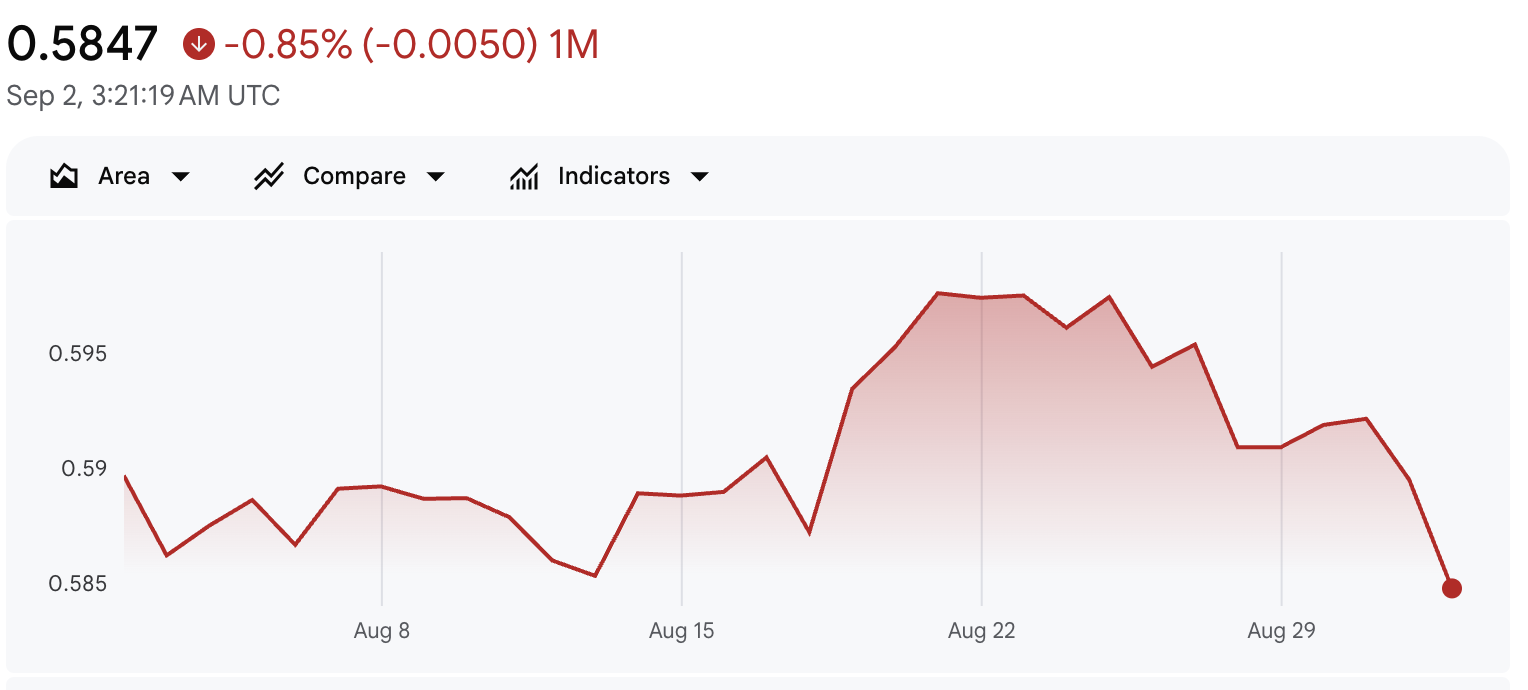
With the move fully priced, the currency was always going to trade the projected rate path rather than the decision itself, and a projection close to May offers no fresh yield support. The trade-weighted index had already appreciated by roughly 1.4% since May on relative rate expectations, so much of this tightening was in the exchange rate before Wednesday.
Two events now shape the near-term path. The first is Breman’s press conference, where any explicit reference to October or to the pace of further increases would carry more weight than the statement. The second is Friday’s US August employment report, where forecasts cluster around payroll growth of 50,000 to 65,000 with unemployment around 4.1% to 4.2%.
A firm reading would strengthen the case for a Federal Reserve move in September and support the dollar side of the pair.
Technically, 0.5900 is the immediate hurdle, with the late-August high near 0.5990 guarding 0.6000. A sustained break above that region would require a genuine repricing of the RBNZ and Federal Reserve differential rather than another quarter-point increase.
The September hike is not a signal that New Zealand is overheating. Domestic demand is uneven, core inflation is largely inside the target band, and the committee acknowledges that activity risks skew lower.
It is tightening pre-emptively because it sees a credible path from elevated fuel and import costs into broader price setting, and would rather move in small steps now than larger ones later.
On that reasoning, 2.75% is unlikely to mark the peak if inflation persistence builds. The pace, however, remains deliberately slow, which explains why a rate increase landed on the currency as an anticlimax.
Reserve Bank of New Zealand, OCR increased by 25 basis points to 2.75%
Reserve Bank of New Zealand, Monetary Policy Statement September 2026
Reserve Bank of New Zealand, Past monetary policy decisions
Reserve Bank of New Zealand, Exchange rates and the Trade Weighted Index
US Bureau of Labor Statistics, Employment Situation