Published on: 2026-06-04
Updated on: 2026-06-04
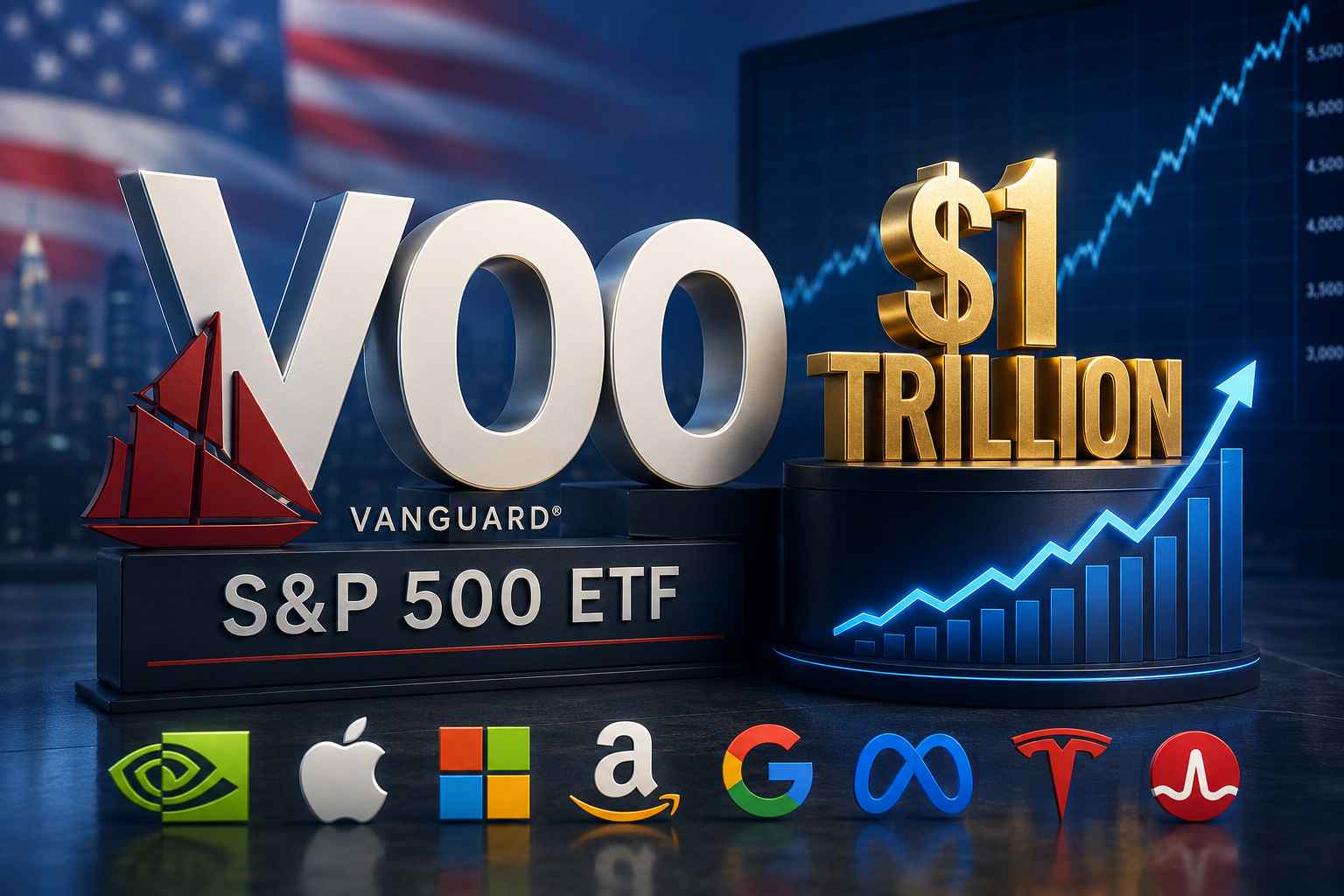
In early June 2026, Vanguard’s S&P 500 ETF (VOO) crossed $1 trillion in assets under management, becoming the first exchange-traded fund in history to reach that figure. The final push reportedly came from a single-day inflow of roughly $1.7 billion.
No ETF had ever touched the threshold before, not even SPY, the first U.S.-listed ETF, launched in 1993.
The headline is the number. The more useful story is what it represents. VOO is not an exotic product. It tracks the S&P 500 and nothing else. Its rise to $1 trillion is really a story about how passive money, ultra-low fees, and an AI-heavy index have started reinforcing one another.
VOO crossed $1 trillion in assets in early June 2026, the first ETF ever to do so, after a reported single-day inflow of about $1.7 billion.
It overtook SPY as the world’s largest ETF in early 2025 and has widened the gap since.
IVV holds roughly $860 billion and SPY roughly $786 billion, both within eventual reach of the milestone.
VOO and IVV charge 0.03%; SPY charges 0.0945%, a gap that has steadily redirected long-term flows.
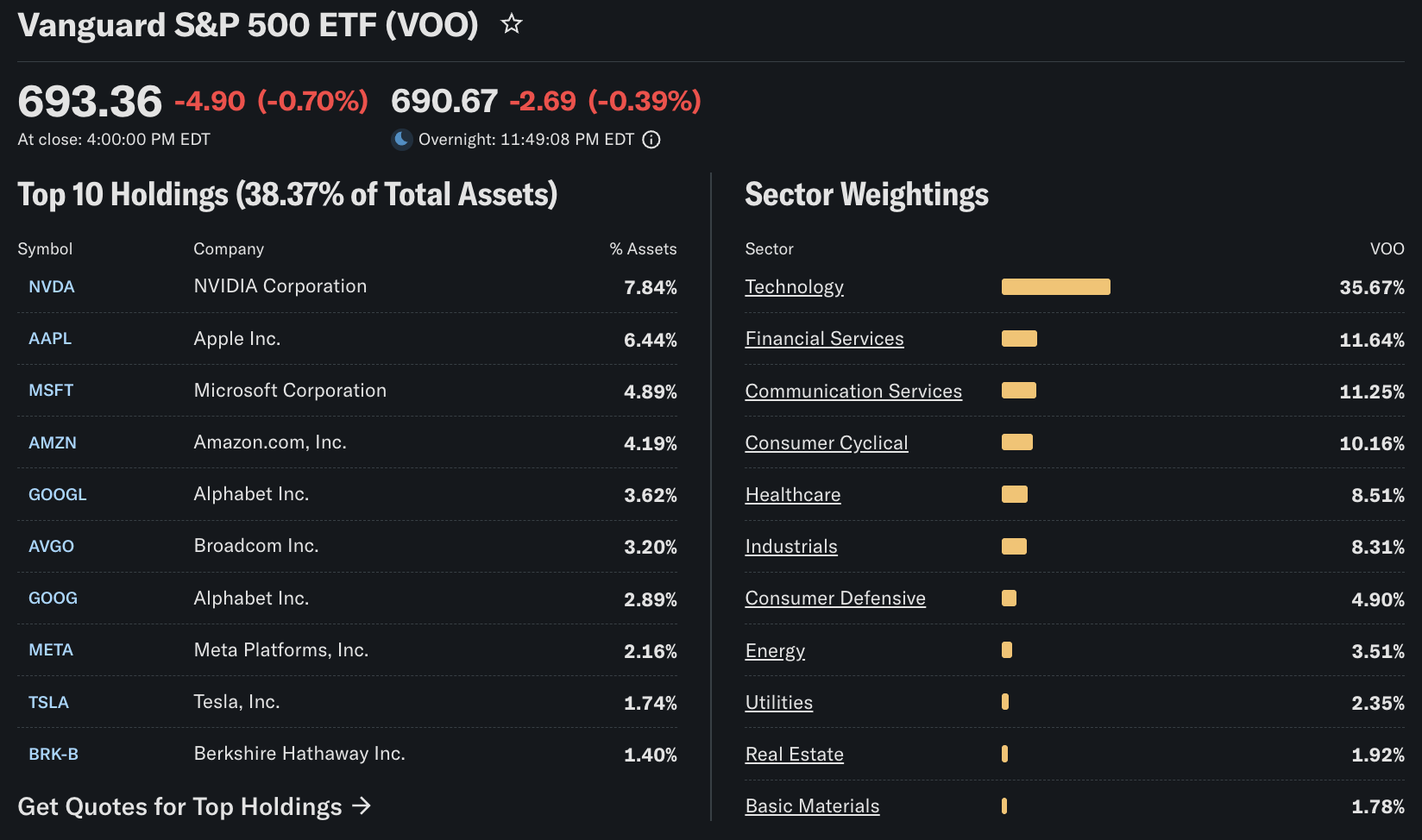
The top 10 S&P 500 companies now make up close to 40% of the index, many of them AI-linked mega-caps.
VOO’s scale makes it a cleaner proxy than ever for concentrated exposure to a small group of dominant stocks.
VOO launched in 2010, late to a market SPY had owned for nearly two decades. It closed the gap through persistent, low-cost accumulation rather than a single catalyst. Vanguard says VOO seeks to track the S&P 500 through full replication, holding the index’s stocks in roughly the same capitalization weights.
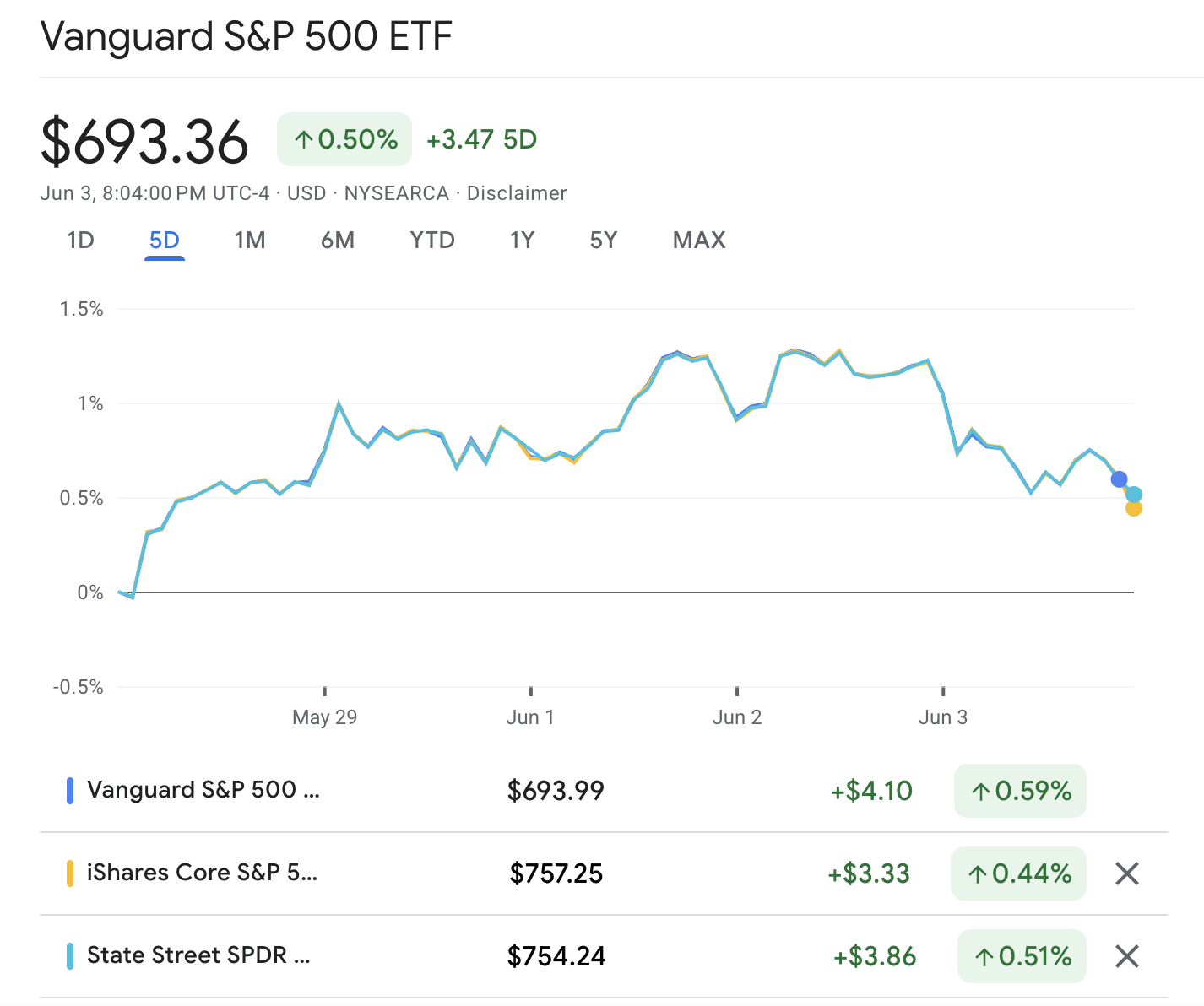
The fund added roughly $250 billion in assets during 2025 and has pulled in about $69 billion in net inflows so far in 2026. That pace let VOO overtake SPY as the world’s largest ETF in early 2025 and keep widening the lead. As of the milestone, IVV held around $860 billion and SPY around $786 billion.
The momentum extends to the issuer level. Vanguard has narrowed BlackRock’s lead in the ETF issuer race, helped by persistent inflows into its low-cost index products. That is a notable turn for a firm whose founder, Jack Bogle, was long skeptical of ETFs as a trading wrapper.
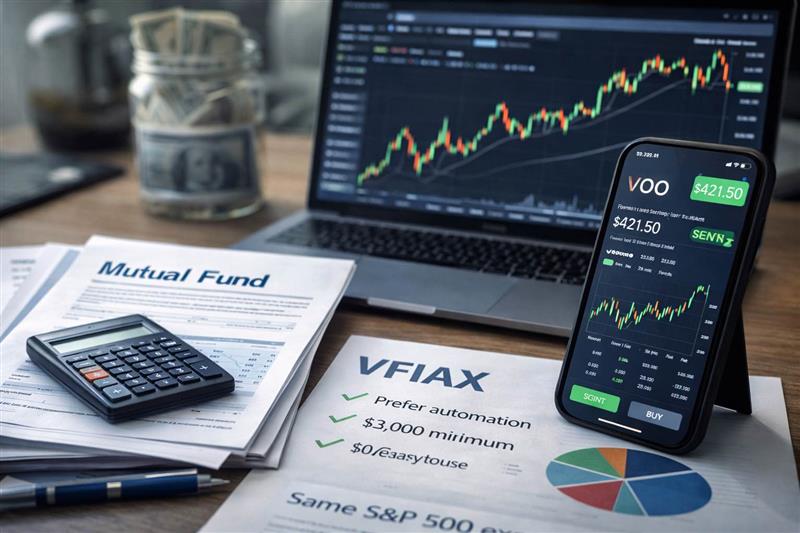
The three large S&P 500 ETFs hold the same stocks in the same weights. What separates them is cost and use case.
| ETF | Provider | Expense ratio | Primary use |
|---|---|---|---|
| VOO | Vanguard | 0.03% | Long-term buy-and-hold |
| IVV | BlackRock / iShares | 0.03% | Core allocation, model portfolios |
| SPY | State Street | 0.0945% | Trading, options, liquidity |
For a long-term holder, SPY’s deep liquidity and options market matter less than the annual cost drag. Over decades, a difference of more than six basis points compounds into a meaningful figure on a large balance. VOO and IVV both list 0.03% expense ratios, while State Street lists SPY’s gross expense ratio at 0.0945%.
SPY remains essential for trading, hedging, and options liquidity. VOO, however, has become the default S&P 500 vehicle for investors who want broad U.S. equity exposure at minimal annual cost.
The takeaway is not that one fund is better in every setting. It is that the default destination for passive U.S. equity money has shifted, and VOO is now sitting at the end of that pipe.
The mechanics underneath the milestone are worth examining. When a dollar flows into VOO, it does not weigh Nvidia against Apple or Microsoft against JPMorgan. It buys all 500 names in proportion to their market value, so the biggest companies automatically receive the biggest allocation.
That creates a feedback loop. Mega-cap stocks rise, their index weight increases, and the next wave of passive inflows buys more of them by design. The flows do not cause the concentration on their own, but they reinforce it. A $1 trillion fund running on that logic is no longer a passive bystander in the market. It is a structural source of demand pointed at whatever is already winning.
This is why VOO’s milestone reads better as a market-structure signal than a fund-marketing achievement. It marks the point at which a single index product became large enough to influence how broad-market capital is allocated.
VOO carries no AI branding. It does not have to. Because the S&P 500 is market-cap weighted, the AI winners already dominate it.
The top 10 companies in the S&P 500 index now account for close to 40% of its total weight, a level that has roughly doubled over the past decade and is driven largely by mega-cap technology and AI-related names.
Nvidia, Apple, Microsoft, Amazon, Broadcom, Alphabet, Meta, and Tesla sit near the top of many S&P 500 ETF holdings, showing how much index leadership now overlaps with semiconductors, cloud computing, digital platforms, and AI infrastructure.
The result is visible in performance. Since the start of 2023, the standard cap-weighted S&P 500 has outperformed its equal-weight counterpart by roughly 30 percentage points, one of the widest multi-year gaps on record. An investor buying VOO for broad-market exposure is, in practice, taking a concentrated position in a handful of AI-adjacent giants, whether or not that was the intention.
The sharper framing is this: VOO’s $1 trillion milestone is not only a story about cheap investing. It is a story about how passive money amplifies the names already leading the index.
The “500 stocks” label suggests automatic diversification. The weighting tells a different story.
When a small group of names drives close to 40% of the index, the fund’s returns depend heavily on a cluster of companies trading at elevated valuations. If those mega-caps perform, VOO captures most of the upside. If sentiment around AI monetization cools, the same concentration works in reverse, and the broad-market label offers less protection than the holder might assume.
This is the risk worth naming for both retail and institutional readers. VOO is cheap, efficient, and tax-friendly. It is not insulated from valuation risk in the names that now anchor it. Diversification by stock count is not the same as diversification by exposure.
None of this is a verdict against owning VOO. It is a reminder that the product has changed character as the index has narrowed, even though the ticker and the strategy have stayed the same.
VOO crossing $1 trillion did not diminish its rivals. It clarified their roles.
SPY remains the trader’s instrument. Its liquidity and options ecosystem make it the preferred vehicle for hedging, short-term positioning, and institutional trading desks, regardless of its higher fee. State Street describes SPY as one of the most liquid and heavily traded ETFs in the world, while also noting its 1993 debut as the first U.S.-listed ETF.
IVV is the quiet competitor. It matches VOO’s 0.03% fee and serves as a low-cost core building block, particularly inside advisor model portfolios. At roughly $860 billion, it is the closest pursuer and a plausible candidate to reach $1 trillion itself in time. The point is not that IVV is inferior. It is that VOO crossed the line first and took the symbolic title with it.
VOO’s $1 trillion milestone confirms how thoroughly low-cost passive investing has reshaped how people own U.S. stocks. A single fund now manages more than the annual economic output of most countries, built almost entirely on the appeal of broad exposure at three basis points.
The same milestone exposes the trade-off. The biggest ETF in history is also one of the most concentrated broad-market vehicles investors have ever held, with its fortunes increasingly tied to a small cluster of AI-driven mega-caps. That is a strength while those companies lead and a vulnerability if they stumble.
The trillion-dollar headline is about scale. The story underneath it is about dependence. VOO has become the clearest single expression of an era in which passive flows and market concentration now feed each other.