Published on: 2026-04-21
Updated on: 2026-04-21
Money market funds have become one of the most important cash-management vehicles in modern finance. In the United States, they held about $7.64 trillion in assets for the week ended April 15, 2026.
Globally, money market fund assets reached $13.28 trillion at the end of the fourth quarter of 2025 across 43 jurisdictions, equal to 15% of worldwide regulated open-end fund assets. Those figures show how far the category has moved beyond its old reputation as a quiet parking place for spare cash. Money market funds now sit at the center of how households, corporations, and institutions manage liquidity.
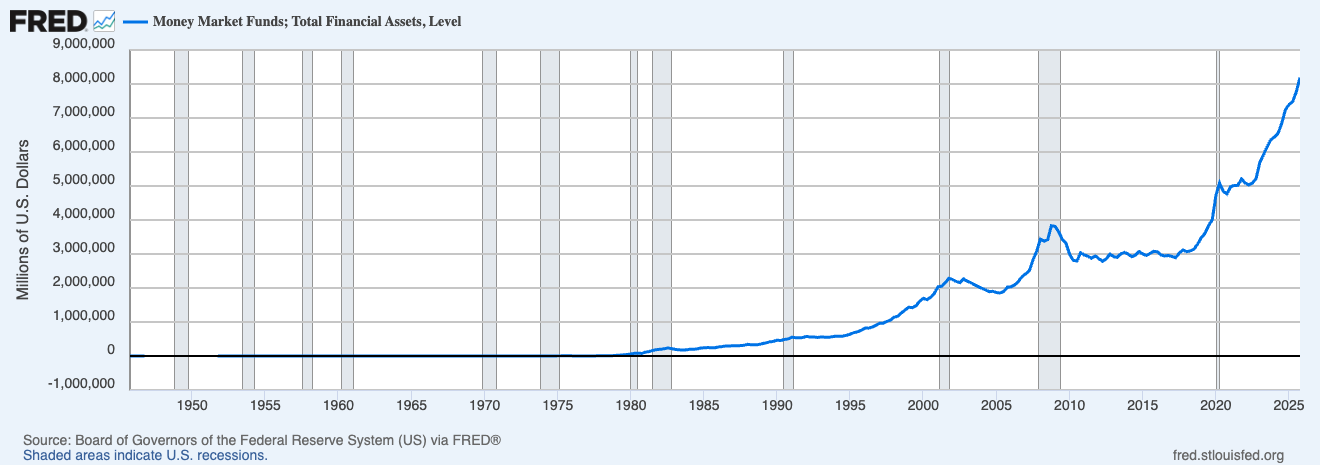
Their appeal rests on a combination that remains unusually powerful in 2026: short-term income, daily liquidity, and limited duration risk. The 6-month Treasury yield stood at 3.69 % in mid-April, which means investors can still earn meaningful income without extending too far into longer-dated bonds.
The demand is also broad. U.S. retail money market fund assets stood at $3.07 trillion, while institutional assets stood at $4.57 trillion, making clear that this is not simply a retail holding pen for cautious savers. It is also a core operating tool for professional cash managers.
A money market fund is a mutual fund designed for capital preservation, daily liquidity, and short-term income. Instead of buying long-dated bonds or equities, it invests in very short-term instruments such as government securities, repurchase agreements, commercial paper, certificates of deposit, and municipal securities, depending on the fund’s mandate.

The purpose is not long-term capital appreciation. It is to keep cash accessible while earning a return that moves closely with short-term interest rates.
The category is usually divided into three main groups. Government money market funds invest 99.5% or more of total assets in cash, government securities, and repurchase agreements backed by cash or government securities.
Prime money market funds invest mainly in taxable short-term corporate and bank debt, including commercial paper and certificates of deposit.
Tax-exempt money market funds generally invest 80 % or more of assets in municipal securities whose income may be exempt from federal tax and, in some cases, state tax as well.
That mix tells readers a great deal about investor preferences in 2026. The latest U.S. data show government funds at about $6.27 trillion, prime funds at about $1.23 trillion, and tax-exempt funds at about $141.09 billion. In practice, investors are choosing among three priorities: safety, tax treatment, and incremental yield. The market’s current shape shows that safety and liquidity still dominate.
Most retail money market funds, along with most government money market funds, seek to maintain a stable $1.00 net asset value, or NAV. That is why many investors experience them as cash-like.
The structure is not universal, however. Institutional prime and institutional tax-exempt money market funds use a floating NAV, which means their share price can move above or below $1 as market values change. Stability is therefore an objective of many money market funds, but not a legal guarantee.
The distinction between a money market fund and a money market deposit account is equally important. A money market fund is a mutual fund, while a bank money market account is a deposit product. FDIC insurance covers eligible bank deposits up to the applicable limits, but it does not insure mutual funds or other non-deposit investment products, even when they are sold through a bank. Traders often blur the two because the names sound similar, but the legal protections are fundamentally different.
One reason money market funds continue to attract cash is that short-term yields remain high enough to make staying liquid financially worthwhile. With the 6-month Treasury at 3.69 %, investors can still earn meaningful income without taking on the interest-rate sensitivity that comes with longer-duration bonds.
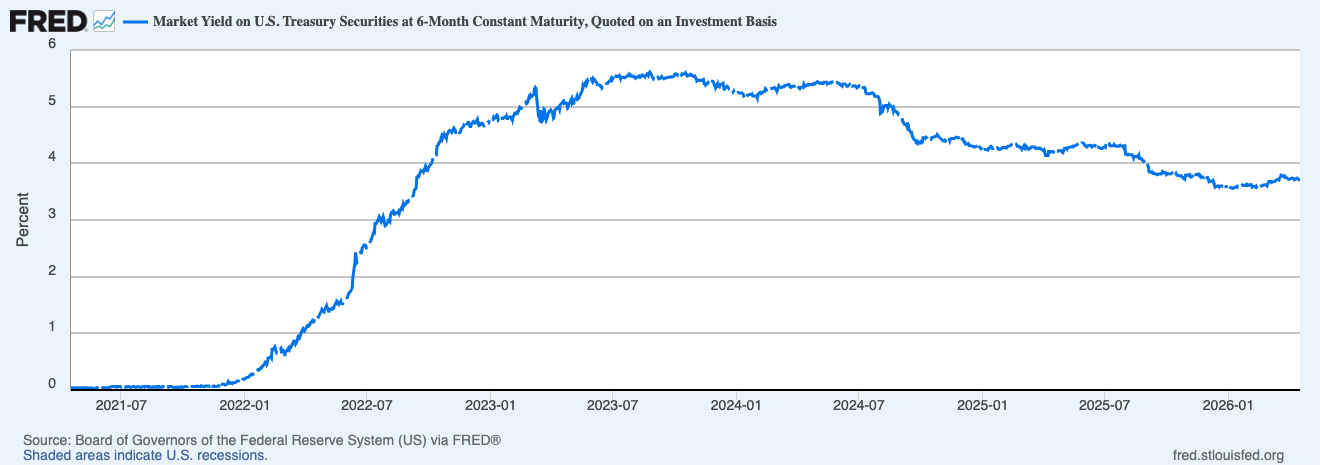
For investors unwilling to commit capital too early while the rate path remains unsettled, money market funds offer a practical compromise between return and flexibility.
The appeal of money market funds goes well beyond yield. Their structure gives investors immediate access to capital, which makes them useful not only as a defensive shelter but also as a reserve for future deployment.
In a market where equities, longer-dated bonds, and credit all react quickly to inflation surprises and shifting rate expectations, keeping capital close to cash still has obvious value. The persistence of about $7.64 trillion in U.S. assets shows how durable that preference remains.
Another reason balances remain so large is that money market funds play an operational role for institutions. Corporate treasurers, pension plans, fiduciaries, and other large cash managers use them as part of day-to-day liquidity management rather than as a simple tactical trade.
The asset split makes that clear: institutional funds hold about $4.57 trillion, versus $3.07 trillion in retail funds. A substantial share of this money is functional liquidity, held to meet obligations while still earning a short-term return.
The same pattern extends well beyond the United States. Worldwide money market fund assets rose 4.2% in the fourth quarter of 2025 to $13.28 trillion, while global net sales into money market funds reached $467 billion in that quarter alone.
By region, 56% of worldwide regulated open-end fund assets were in the Americas, 32% in Europe, and 12% across Africa and the Asia-Pacific regions. The search for short-term liquidity is therefore not simply a local response to U.S. monetary policy. It has become a global preference for flexibility and balance-sheet caution.
Modern money market funds are much more tightly regulated than many investors realize. The SEC’s 2023 reforms raised minimum liquidity requirements to 25% daily liquid assets and 50% weekly liquid assets. The rules also removed the old link between liquidity thresholds and redemption gates, while introducing a liquidity-fee framework for certain funds so that redemption costs fall more directly on redeeming investors during periods of stress.
The operational details matter most for non-government funds. Institutional prime and institutional tax-exemptmoney market funds must generally impose liquidity fees when daily net redemptions exceed 5% of net assets, unless liquidity costs are minimal.
The purpose is to reduce the first-mover advantage that can emerge in a stressed market and make the category more resilient when redemptions accelerate.
Money market funds are conservative, but they are not risk-free. The core risks are straightforward:
Stable NAV is not guaranteed NAV. A stable-NAV fund can still “break the buck” if its NAV falls far enough that the fund must reprice.
Floating-NAV funds can lose value. Institutional prime and institutional tax-exempt funds move with market conditions like other mutual funds.
Very low rates can create fee pressure. When short-term rates are extremely low, fees can exceed portfolio income, leaving investors with very little return or even a small loss.
Inflation can erode real value. Even when nominal capital appears stable, purchasing power can fall if inflation runs above the yield.
Money market funds are best understood as a cash-management instrument, not a substitute for long-term investing. They solve for liquidity and short-duration income. Growth still has to come from elsewhere in a portfolio.
They serve different purposes. Money market funds can offer competitive short-term yields and daily liquidity, but they are investment products rather than insured deposits. Savings accounts usually provide FDIC insurance up to the applicable limits, though they often offer lower yields.
The latest U.S. data show that investors overwhelmingly prefer maximum liquidity and high-quality collateral. Government funds hold far more assets than prime funds, which suggests that many investors still value safety over a modest pickup in yield.
Yes. Stable-NAV funds can break the buck, floating-NAV funds can decline in value, and inflation can quietly erode purchasing power even when a fund appears stable on the surface.
Money market funds continue to attract cash in 2026 because they occupy a rare middle ground between yield, liquidity, and caution. They allow investors to earn short-term income without taking large duration bets, they help institutions manage operating liquidity efficiently, and they provide a disciplined holding place for capital that is not yet ready to move back into riskier assets.
With about $7.64 trillion in U.S. assets and $13.28 trillion globally, money market funds are not simply benefiting from inertia. They are filling a central role in a financial system that still places a high value on optionality.