Published on: 2026-09-02
Updated on: 2026-09-02
Dell stock fell 6.8% on Tuesday, then reversed after hours as the results forced a sharp reset in forward expectations. Dell lifted FY2027 revenue guidance by $25 billion to $192 billion and ended the quarter with $95 billion of AI-server backlog. The debate has moved from whether AI demand exists to how much of that backlog Dell can convert into profitable, cash-generative growth.
Dell booked $60.9 billion of AI-server orders in Q2, roughly 3.7 times the AI-server revenue recognized during the quarter, leaving order intake far ahead of reported revenue.
Dell’s $95 billion AI backlog covers roughly 2.3 times the AI-server revenue still needed to reach its $74 billion FY2027 target.
Infrastructure operating margin rose 620 basis points to 15.0%, showing strong operating leverage across Dell's infrastructure business even while the AI-heavy product mix pressures gross margins.
Inventory doubled from January to July while Q2 free cash flow fell 47% to $986 million, making efficient backlog conversion the clearest risk to the next stage of growth.
Dell stock reversed after earnings because management raised both near-term and full-year expectations far beyond what the market had priced in. Q3 revenue guidance reached $49 billion versus roughly $41.4 billion expected before the report, while adjusted EPS guidance of $6.50 compared with expectations near $4.46.
The annual outlook widened the gap further. Dell raised FY2027 revenue guidance from $167 billion to $192 billion, lifted non-GAAP EPS guidance from $17.90 to $25.50 and increased its AI-server revenue target from $60 billion to $74 billion. The surprise therefore extended well beyond Q2, forcing a much higher revenue and earnings path into second-half expectations.
Dell’s 6.8% pre-earnings decline reflected a weak technology session and an unusually high bar for the results. Technology shares were already under pressure as Treasury yields approached 4.8% and rising oil prices revived inflation and interest-rate concerns.
Dell had also risen roughly 248% in 2026 before the report, leaving little room for disappointing guidance or evidence that AI demand was slowing. Broader market weakness and elevated expectations made the stock particularly sensitive before the results arrived.
Dell generated $32.5 billion of AI-server revenue during the first half of FY2027. Reaching the new $74 billion full-year target therefore requires another $41.5 billion in H2. Against that requirement, Dell’s $95 billion backlog provides 2.29 times coverage.
| AI revenue math | Value |
|---|---|
| H1 AI revenue | $32.5B |
| FY2027 target | $74.0B |
| H2 required | $41.5B |
| Q2 backlog | $95.0B |
| Backlog coverage | 2.29x |
Dell expects roughly $19 billion in AI-server revenue in Q3, leaving about $22.5 billion for Q4 if it reaches the annual target. The $41.5 billion H2 revenue requirement equals less than 44% of Dell's current backlog, even before considering additional orders booked during the second half.
New orders are growing much faster than recognized revenue. Dell booked $60.9 billion of AI-server orders in Q2 against $16.4 billion of AI-server revenue, producing a quarterly book-to-bill ratio of about 3.7 times. Backlog also climbed from $51.3 billion in Q1 to $95 billion in Q2, an increase of roughly 85% in three months.
Dell’s $95 billion backlog should not be treated as guaranteed future revenue. Dell defines product backlog as unfulfilled manufacturing orders, and includes only orders it considers non-cancelable in remaining performance obligations.
Conversion timing still depends on component availability, platform transitions and customer data-center readiness. A simple bridge from the disclosed figures gives $95.8 billion after adding $60.9 billion of Q2 orders to the $51.3 billion Q1 backlog and subtracting $16.4 billion of Q2 AI-server revenue, close to the reported $95 billion balance. The comparison supports the reported backlog trajectory, but it is not a formal backlog roll-forward.
Dell’s AI-server mix still pressures gross margins, but the wider infrastructure business is producing much stronger operating leverage as volume expands. Infrastructure revenue rose 89% year over year in Q2, while operating income increased 225%. Operating margin climbed from 8.8% to 15.0%.
Scale contributed more than 400 basis points to that margin improvement. Dell therefore does not need AI servers to become high-margin hardware for them to lift operating profit. Much larger volumes spread infrastructure costs across a broader revenue base even while the AI-heavy product mix weighs on gross-margin percentage.
Storage provides another source of support. Revenue increased 26% to $4.9 billion as improving storage profitability and product mix strengthened infrastructure margins. AI servers can therefore dilute Dell’s gross-margin rate while still supporting higher operating profit when volume grows quickly, and customers also buy more profitable infrastructure around the compute systems.
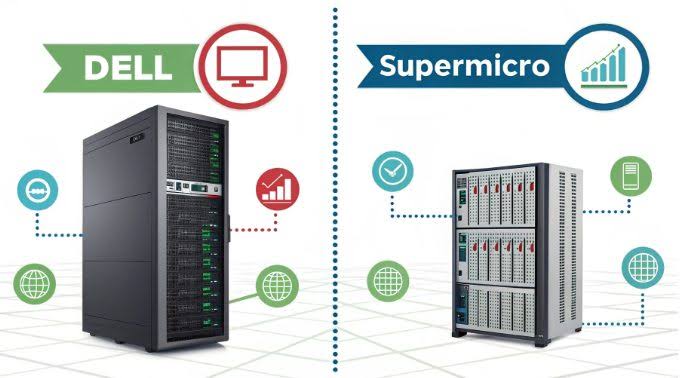
Image Source: Varidata
Dell is gaining server share, but public data does not prove that its AI gains are coming directly from Super Micro. Dell says it gained more than 10 percentage points of traditional-server share over the past two quarters, although that measure does not isolate AI systems.
Super Micro is also reporting rapid growth and strong order demand, although recent execution and inventory pressures at Super Micro show why competitive comparisons require more than revenue growth alone. Dell’s expanding AI-server revenue, backlog and customer base show rising competitive scale, but they do not identify which rival supplied any displaced share.
The defensible conclusion is narrower. Dell is strengthening its position in servers and AI infrastructure, while available data does not prove that Super Micro is losing the same revenue dollar for dollar.
Dell’s rapid infrastructure expansion is being accompanied by a much larger working-capital requirement. Inventory rose from $10.4 billion at the end of January to $21.3 billion at the end of July, more than doubling in six months. Short-term financing receivables also increased 51% to $12.8 billion.
Cash generation lagged the earnings surge. Q2 operating cash flow fell 13% year over year to $2.2 billion, while Dell's free cash flow declined 47% to $986 million. Dell’s adjusted free cash flow was much higher at $8.1 billion, largely because the measure adds back changes associated with financing receivables and equipment under operating leases.
With demand already running far ahead of recognized revenue, the quality of Dell’s AI growth increasingly depends on how efficiently that backlog moves through inventory and into cash.
Dell expects $74 billion of AI-server revenue in FY2027, up from its previous $60 billion forecast. With $32.5 billion already recognized in the first half, Dell needs roughly $41.5 billion of AI-server revenue in H2 to reach the full-year target.
Not necessarily. Dell’s product backlog includes unfulfilled manufacturing orders, while only orders it considers non-cancelable are included in remaining performance obligations. Conversion timing can also change with component availability, platform transitions and customer data-center readiness.
Dell would need roughly $22.5 billion of AI-server revenue in Q4 if it delivers about $19 billion in Q3 and reaches its $74 billion FY2027 target. That would represent another sequential increase from the $16.4 billion recognized in Q2.
Dell has guided to roughly $19 billion of AI-server revenue in Q3. The stronger signal will be whether that growth arrives with resilient infrastructure margins, better cash conversion and less pressure on working capital.
Dell no longer needs to prove that AI demand exists. It needs to prove that a $95 billion backlog can become profitable cash flow.
The defensible conclusion is narrower. Dell is strengthening its position in servers and AI infrastructure, while available data does not prove that Super Micro is losing the same revenue dollar for dollar.