Published on: 2026-04-09
Updated on: 2026-04-09
France did not reduce its gold reserves. The stock remained unchanged at 2,437 tonnes, preserving the country's position as the world's fourth-largest official gold holder.
The 129-tonne tranche accounted for approximately 5.3% of France’s reserves and consisted of the remaining New York-held gold that did not meet Banque de France’s preferred technical standard.
Between July 2025 and January 2026, Banque de France completed 26 transactions, generating a €12.8 billion gain. €11 billion was recognized in 2025 and €1.8 billion in 2026.(~$15B in Total)
This was not a geopolitical shift but a liquidity and custody upgrade. France sold non-standard bars in New York and replaced them with LBMA 99.99% standard bars in Europe, now stored in Paris.
The direct impact on the New York Fed was limited. Its vault held 6,331 metric tons as of 2024, making France’s 129 tonnes only about 2% of that inventory. The move was symbolic and operational, not disruptive.
| Metric | Official Data | Market Meaning |
|---|---|---|
| Total French Gold Reserves | 2,437 tonnes | No reduction in strategic bullion holdings |
| New York-Held Residual Stock | 129 tonnes | Roughly 5.3% of total reserves |
| Execution Window | July 2025 to January 2026 | Timed into a strong gold-price environment |
| Number Of Transactions | 26 | Indicates staged execution, not a one-off transfer |
| Exceptional Gain | €12.8 billion | €11 billion booked in 2025, €1.8 billion in 2026 |
| Remaining Non-Standard Stock In Paris | 134 tonnes | Standardization program continues through 2028 |
| New York Fed Vault Holdings | 6,331 tonnes in 2024 | France’s move equaled only about 2.0% of vault inventory |
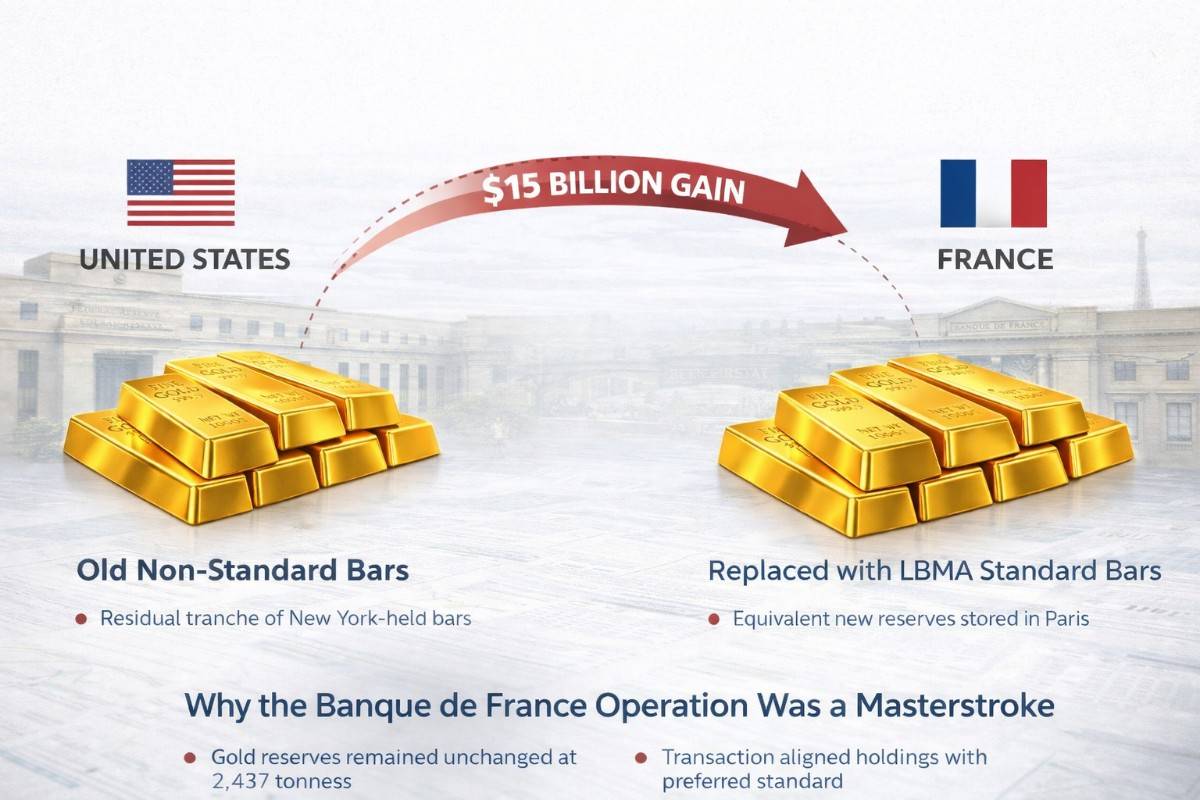
Banque de France stated that the 129 tonnes held in New York were the remaining portion of its reserves not yet aligned with its preferred standard.
Instead of a lengthy and risky transfer and refining process, it sold those bars and repurchased equivalent gold in Europe at the highest international standard, storing the replacement bars in Paris. The reserve volume remained unchanged; only the form and location were updated.
This distinction is significant. Reducing gold reserves is an asset-allocation decision, while exchanging non-standard foreign-held bars for standard domestically held bars is an operational and strategic action. France chose the latter, enhancing the fungibility and usability of its gold while maintaining bullion on its balance sheet.
An additional detail is that while the New York operation is complete, a separate residual stock in Paris remains to be standardized: 134 tonnes, including 85 tonnes in bars and 49 tonnes in coins.
The broader modernization program is scheduled for completion in 2028. This demonstrates that the initiative is part of a long-term reserve-quality program begun in 2005, not a reactionary policy in 2026.
The €12.8 billion gain is often described as an "arbitrage," though this term is only directionally accurate. This was not a textbook risk-free location spread, but rather a reserve-management arbitrage involving legacy bar form, location, accounting history, and a period of highly favorable gold prices.
Gold has been in a structural bull market for years. Banque de France noted in 2024 that the gold price had doubled since 2019, driven in part by central bank demand and geopolitical tensions, even though higher real rates and a strong dollar would normally have been headwinds.
By April 8, 2026, Comex gold was trading near $4,750 an ounce. Selling the older New York-held bars at these prices and replacing them with high-standard bars in Europe enabled France to realize accumulated gains while improving the quality of its reserve assets.
The result significantly improved Banque de France’s earnings profile. After a €7.7 billion loss in 2024, it reported €8.1 billion in net income for 2025, largely due to the gold operation. This was a balance-sheet repair achieved through reserve optimization.
The main takeaway from this episode is that custody is no longer a passive administrative decision. It is now an integral part of active reserve management.
The World Gold Council’s 2025 survey found that domestic storage is increasingly common, active gold management is at a record high, and return enhancement is now the primary driver of this trend. France’s transaction aligns closely with this pattern.
However, that does not mean New York or London are suddenly obsolete. In fact, the same survey showed that the Bank of England remained the most popular vaulting location, and that most respondents reported no change in custody.
The New York Fed remains the world’s largest known depository of monetary gold. However, the focus is shifting from reliance on legacy custodians to a more deliberate balance of safety, domestic control, and market utility.
Claims that France is abandoning the dollar are exaggerated. Banque de France described the operation as a technical standardization program. The dollar remains the majority of disclosed global foreign exchange reserves, and the New York Fed continues to provide custody for central banks and official institutions.
However, the argument still contains some accurate points. Gold is becoming increasingly important as reserve managers look for assets with no issuer risk when held physically, greater crisis resilience, and improved diversification properties. Those are precisely the qualities central banks themselves cited in the World Gold Council survey.
While France did not explicitly move against the dollar, it recognized that legal reach, sanctions risk, collateral quality, and storage jurisdiction now play a greater role in reserve management decisions.
For investors, the market implication is clear. France’s transaction does not create immediate new gold demand, as the reserve tonnage remained unchanged and the program is complete. However, it reinforces the structural support for bullion by reflecting current official institution strategies. This is not speculative behavior, but strategic portfolio construction.
No. France sold a 129-tonne tranche of non-standard bars held in New York and repurchased equivalent high-standard bars in Europe. The national gold stock remained unchanged at 2,437 tonnes, making this a reserve upgrade rather than a reduction.
The gain resulted from realizing embedded appreciation during a strong gold market while replacing older bars with LBMA-standard bullion. Banque de France recorded €12.8 billion across 2025 and early 2026, with most recognized in 2025.
No. Banque de France described it as a technical operation focused on standards and logistics. However, in a broader reserve-management context, it reflects the increasing importance of jurisdiction, custody control, and gold’s crisis utility.
Banque de France did not reduce reserves or make an anti-dollar statement. Instead, it executed a strategic reserve-management maneuver: upgrading bar quality, eliminating foreign-held residual stock, securing a significant gain, and improving domestic control without reducing bullion exposure.
This is why the move is considered a masterstroke. In a fragmented monetary environment, the most valuable reserve asset is not only the one with the highest nominal return, but also the one that remains liquid, acceptable, and usable across legal regimes, market venues, and during crises. France recognized this early and capitalized on it.
Disclaimer: This material is for general information purposes only and is not intended as (and should not be considered to be) financial, investment or other advice on which reliance should be placed. No opinion given in the material constitutes a recommendation by EBC or the author that any particular investment, security, transaction or investment strategy is suitable for any specific person.