Published on: 2026-03-25
Updated on: 2026-03-25
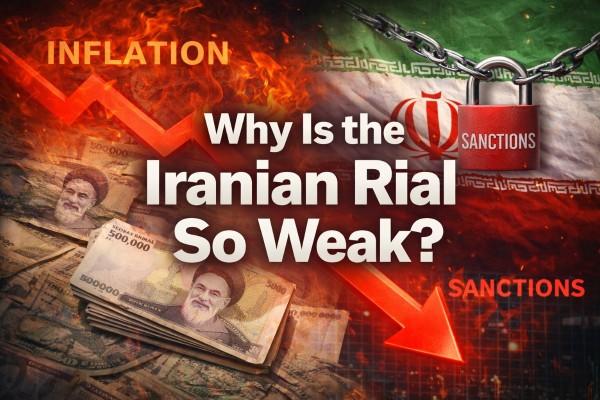
The Iranian rial is weak due to multiple concurrent issues rather than a single currency shock. Iran faces tighter sanctions, high inflation, a widening fiscal deficit, pressure on oil revenues, and deep political and military uncertainty.
Those forces have steadily eroded confidence in the rial and pushed people and businesses to prefer dollars and other hard assets whenever possible.
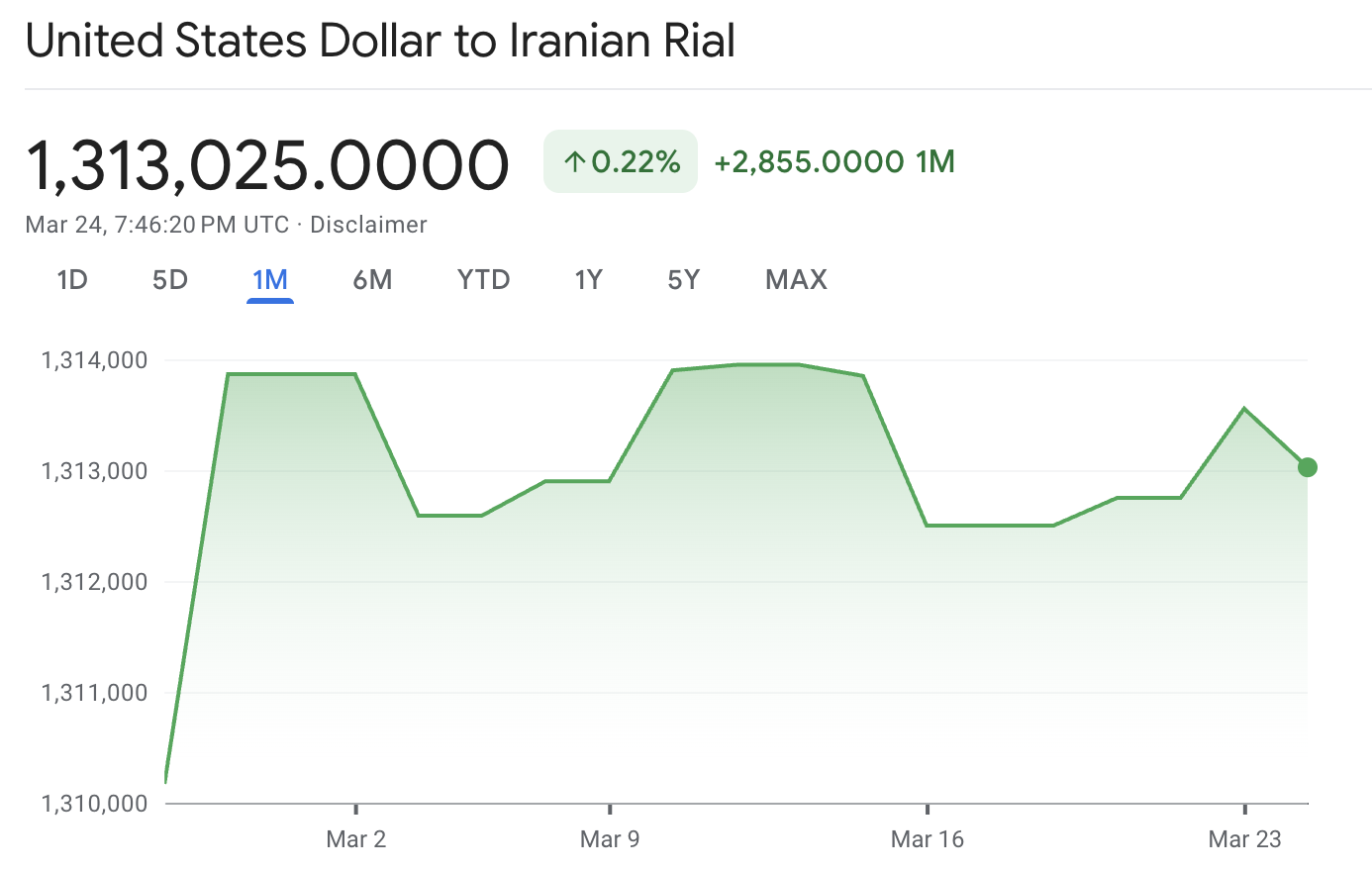
In late January 2026, the rial fell to around 1.6 million rials per U.S. dollar in the free market, a record low at the time. It later rebounded modestly to about 1.559 million per dollar on March 21 after the United States temporarily allowed some Iranian oil already in transit to be sold. However, even that bounce only highlighted how fragile the currency had become.
| Indicator | Latest / recent signal | Why it matters |
|---|---|---|
| Free-market rial | Around 1.559 million per dollar on March 21, 2026 | Shows the currency remains near crisis levels even after a bounce |
| Record low area | Around 1.6 million per dollar in late January 2026 | Shows how far confidence had already fallen |
| Inflation | 40.1% year over year in the first five months of 2025/26 | High inflation weakens the rial’s purchasing power |
| World Bank inflation forecast | 49.0% in 2025/26 and 56.0% in 2026/27 | Suggests the pressure is not yet over |
| GDP growth forecast | -1.7% in 2025/26 and -2.8% in 2026/27 | Weak growth reduces confidence in the currency |
| Iran oil exports to China in 2024 | 1.444 million barrels per day | Shows how dependent export earnings are on a narrow channel |
This is the most important reason. Iran requires foreign currency, particularly the U.S. dollar, to pay for imports, boost confidence, and stabilize its exchange market. But sanctions have restricted oil sales, banking links, and broader access to international finance for years.
The World Bank reports that heightened sanctions have significantly hindered growth and led to currency depreciation. The EIA also says petroleum exports remain a significant source of government revenue, which means any disruption to oil income quickly feeds into currency weakness.
Iran has managed to keep exporting oil, but the structure is fragile. The EIA's 2025 SHIP Act report indicated that Iran's crude and condensate exports to China averaged 1.444 million barrels per day in 2024, while exports to destinations outside China totaled only about 40,000 barrels per day. That is a highly concentrated export base.
When one country, one trade channel, or one sanctions waiver matters that much, the currency becomes more vulnerable to sudden swings in policy and geopolitics.
The World Bank stated inflation in Iran reached 40.1% YoY in the first five months of 2025/26, with food inflation at 44.5%. It also forecasts inflation of 49.0% in 2025/26 and 56.0% in 2026/27. The IMF's October 2025 World Economic Outlook also shows Iran's average consumer-price inflation at 41.6% in 2026.
That matters because high inflation changes behavior. Households try to spend money faster before it loses value. Companies seek to safeguard their interests by increasing prices or converting their transactions into foreign currencies. Savers look for dollars, gold, property, or anything else they believe will hold value better than the rial.
Once that cycle takes hold, the currency weakens not only because of policy but because people stop trusting it as a store of value.
Iran's currency weakness is also closely linked to its fiscal management. The World Bank estimates a fiscal deficit of 3.2% of GDP in 2024/25, averaging 4.2% over the forecast period.
Public spending exceeded targets by over 40%, with the government covering the shortfall through increased bond issuance, withdrawals from the National Development Fund, and reliance on the banking system.
The World Bank warns that inflationary expectations and monetary financing of the deficit could drive inflation above 50% in 2026–27.
This dynamic puts direct pressure on the rial. When investors and households anticipate inflationary financing of deficits, they expect the currency to depreciate, which can reinforce itself. As a result, the market demands more rials per dollar today in anticipation of further currency issuance.
The rial is not falling in a vacuum. When the Middle East conflict escalated in June and sanctions tightened, the currency swiftly depreciated, and inflation expectations spiked.
For example, the Tehran stock market had fallen 26% from its May 2025 peak. In other words, the currency is trading inside a broad confidence crisis, not a narrow foreign-exchange event.
Recent market moves underline that point. The rial's rebound on March 21 came only after the United States allowed some Iranian oil already in transit to be sold. Traders interpreted that decision as a potential source of new foreign-currency inflows.
This indicates that the currency reacts not only to economic factors but also to daily fluctuations in conflict risk, sanctions enforcement, and expectations regarding oil shipments.
Iran maintains an opaque, fragmented currency regime. Central Bank tables reveal both official and open-market rates, proof that a unified foreign exchange system remains absent. This arrangement may briefly manage pressure in isolated areas, but it blatantly invites arbitrage, erodes transparency, and undermines trust in the rial's actual value.
This type of arrangement can temporarily alleviate pressure in specific areas. Still, it also encourages arbitrage, weakens transparency, and makes it harder for businesses and households to trust the currency's true value.
The difference between official channels and the free market indicates something significant: the state itself does not depend exclusively on a single market-clearing price.
When that happens, the open market is often where real stress first shows up. The repeated slide of the free-market rate to 1.5 million and then 1.6 million per dollar is a sign that the unofficial price has become a clearer measure of confidence.
Beyond currency dynamics, the rial is also grappling with deeper economic issues that extend past sanctions and inflation. For example, Iran faces energy and water shortages, weak investment, and undercapitalised banks.
With nearly 90% of financing dependent on banks, existing vulnerabilities are likely to increase, especially amid weak growth. The World Bank forecasts GDP growth of -1.7% in 2025/26 and -2.8% in 2026/27 under its current scenario.
Over many years, the rial has depreciated due to high inflation, sanctions-related restrictions on foreign currency inflows, and a decline in confidence in economic policy.
No. Sanctions are a major reason, but not the only one. High inflation, fiscal deficits, conflict risk, structural shortages, and a fragmented exchange-rate system also play important roles.
Yes, but probably only temporarily unless broader conditions also improve. The recent rebound after a limited oil sales waiver has shown that additional foreign-currency inflows can be beneficial. However, the long-term direction still relies on inflation, sanctions, and overall confidence.
In conclusion, the Iranian rial remains weak due to pressure on Iran's economy from both external and internal factors. That is why the rial's weakness should be seen as a structural problem, not a one-day market panic.
Until Iran can lower inflation, restore confidence, and secure more stable access to foreign currency, the rial is likely to remain vulnerable.
Disclaimer: This material is for general information purposes only and is not intended as (and should not be considered to be) financial, investment, or other advice on which reliance should be placed. No opinion given in the material constitutes a recommendation by EBC or the author that any particular investment, security, transaction, or investment strategy is suitable for any specific person.