Published on: 2026-05-07
Updated on: 2026-05-07
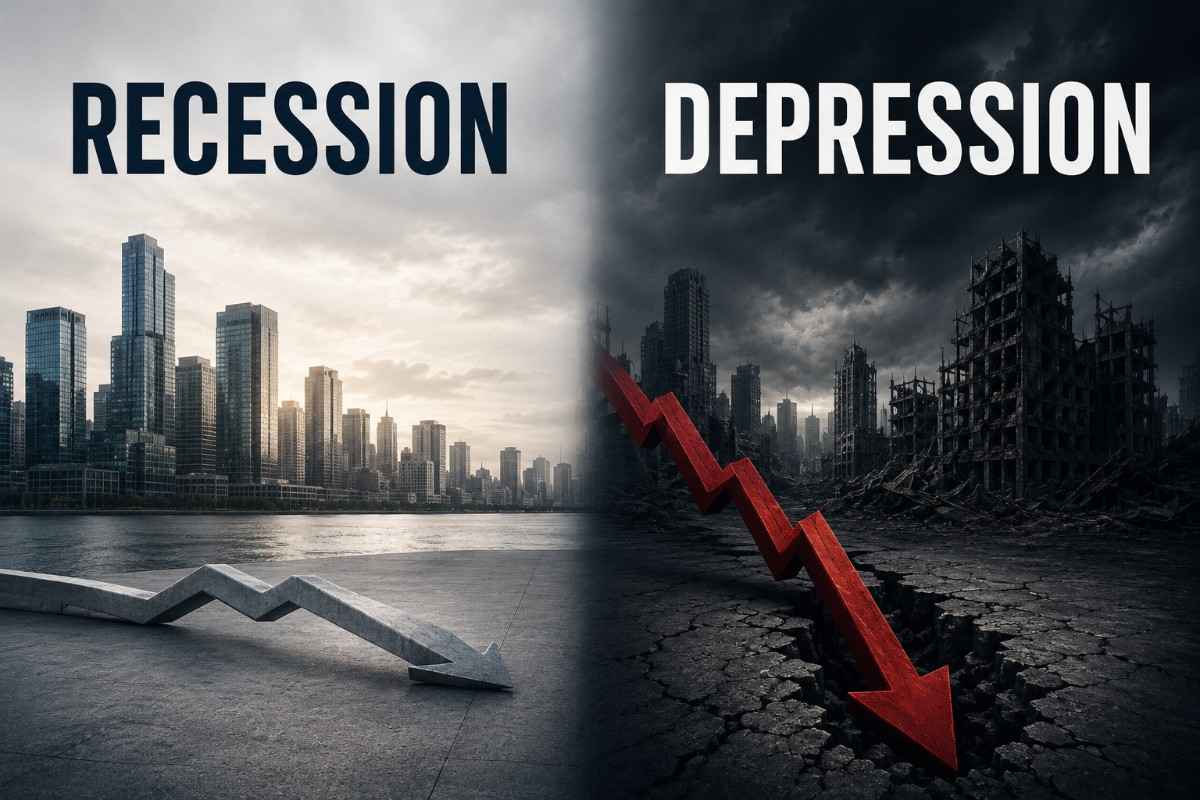
A recession is a broad contraction that usually lasts months, while a depression is a rare, prolonged breakdown marked by severe GDP decline, mass unemployment, credit stress, deflation risk, and lasting damage to confidence. A recession weakens the business cycle. A depression damages the system that allows the economy to recover.
The line is not defined by a single data point. The US business-cycle framework defines recession through depth, diffusion, and duration: how severe the decline is, how widely it spreads, and how long it lasts. Depression has no official global definition. A GDP decline of 10% or more is best treated as an analytical benchmark, not a formal classification rule. (1)
The turning point is credit. A recession becomes more dangerous when weak demand creates defaults, bank stress, tighter lending, and balance-sheet damage.
The Great Depression remains the benchmark: US real GDP fell 29% from 1929 to 1933, unemployment reached 25%, and consumer prices fell 25%. (2)
The Great Recession was severe but not depression-scale: real GDP fell 4.3%, unemployment peaked at 10%, and the S&P 500 fell 57% from peak to trough. (3)
Markets price recessions through earnings, rates, and risk appetite. They price depressions through solvency, liquidity, credit availability, and trust in institutions.
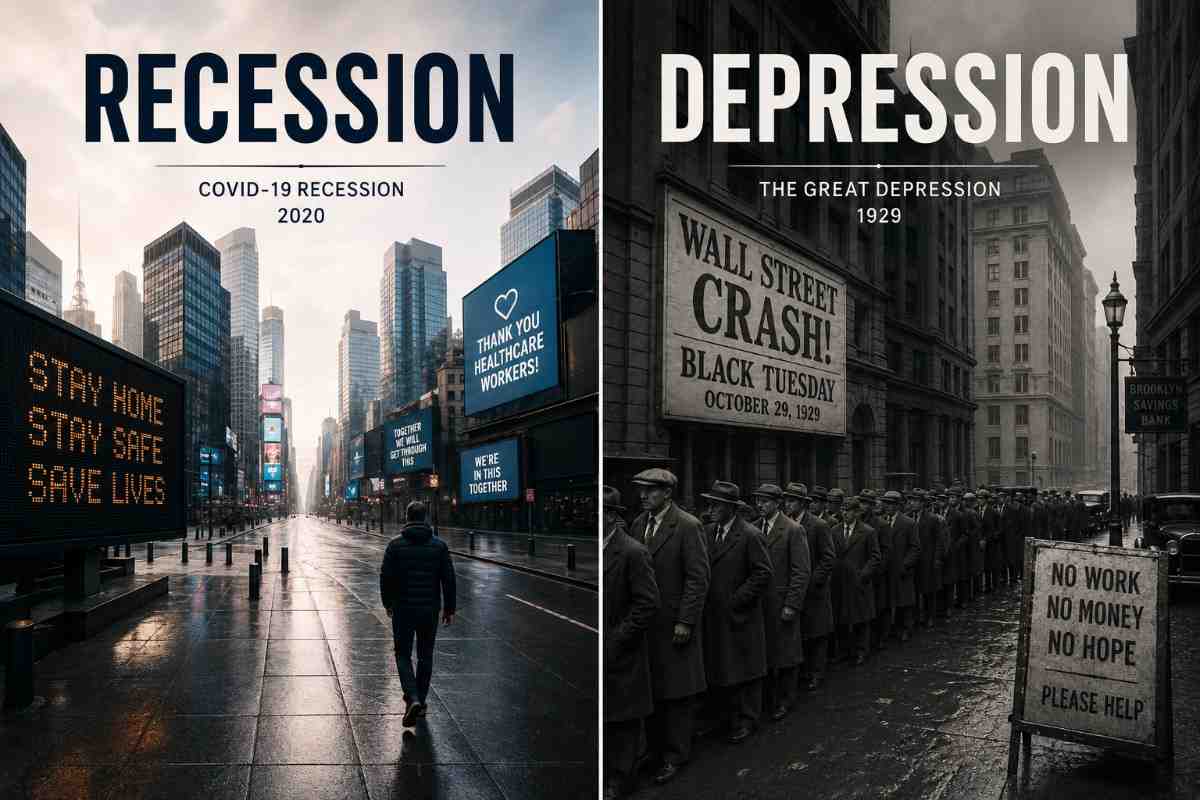
A recession is a significant, widespread, and sustained decline in economic activity. The most useful signals include real income, employment, industrial production, wholesale and retail sales, and GDP. The two-quarter GDP rule is a shortcut, not the full test.
Recessions often follow monetary tightening, energy shocks, financial stress, inventory corrections, external crises, or a sudden fall in private demand. Companies protect margins by delaying hiring and cutting discretionary spending. Households postpone large purchases. Banks raise lending standards. Earnings forecasts fall.
Market impact: Markets usually price recessions through earnings, interest-rate expectations, and risk appetite. Equities tend to weaken as profit forecasts fall, especially in cyclical sectors such as consumer discretionary, industrials, materials, and financials. Credit spreads widen as default risk rises, while government bonds may benefit if inflation falls enough for central banks to cut rates.
An economic depression is an extreme contraction that overwhelms the normal stabilisers of the business cycle. It is deeper, longer, and more destructive because it damages the mechanisms that normally create recovery.
The 10% GDP threshold is a market convention and analytical benchmark. It is not an official global test. The IMF describes depression as an extremely severe recession and notes that only a handful of advanced-economy depression episodes have occurred since 1960. Finland’s contraction in the early 1990s, when GDP fell about 14%, is one example. (4)
The Great Depression shows the full mechanism at work. US real GDP fell 29% from 1929 to 1933. The unemployment rate reached 25%. Consumer prices fell 25%, while wholesale prices fell 32%. About 7,000 banks failed between 1930 and 1933, nearly one-third of the US banking system.
Market impact: Market price declines driven by solvency, liquidity, credit availability, and trust in institutions. Equities face deeper valuation pressure because investors are no longer pricing a normal earnings recession. Credit markets become the central warning signal as defaults accelerate, lending tightens, and funding stress spreads. Gold and reserve currencies may respond less to ordinary risk aversion and more to confidence in money, banks, and purchasing power.
| Factor | Recession | Depression |
|---|---|---|
| Economic character | Cyclical downturn | Systemic breakdown |
| GDP impact | Moderate to severe contraction | Extreme cumulative decline, often above 10% |
| Duration | Months to several quarters | Years |
| Labour market | Rising unemployment | Mass and persistent unemployment |
| Credit conditions | Lending standards tighten | Credit freezes or bank stress emerges |
| Consumer behaviour | Spending weakens | Spending collapses as confidence breaks |
| Corporate response | Cost control and hiring freezes | Defaults, bankruptcies, and investment collapse |
| Market pricing | Earnings recession and valuation reset | Solvency, liquidity, and institutional trust repricing |
| Policy response | Rate cuts, liquidity support, fiscal stimulus | Emergency intervention and financial-system repair |
| Recovery path | V, U, or W-shaped | Often slow, uneven, or L-shaped |
The distinction is about transmission. A recession mainly reflects falling activity. A depression reflects impaired recovery channels: credit, confidence, employment, investment, and banking stability stop supporting the economy and begin reinforcing contraction.
| Episode | Duration | GDP Impact | Labour Market | Financial Character |
|---|---|---|---|---|
| Great Depression | 1929 to about 1939 | US real GDP fell 29% from 1929 to 1933 | Unemployment reached 25% in 1933 | Bank failures, deflation, money-supply collapse |
| Great Recession | Dec 2007 to Jun 2009 | US real GDP fell 4.3% peak to trough | Unemployment peaked at 10% in Oct 2009 | Housing crash, bank stress, credit-market seizure |
| COVID-19 recession | Feb 2020 to Apr 2020 | Historic but brief output shock | Payrolls fell 20.5 million in Apr 2020 | Liquidity shock followed by rapid policy support |
| Finland early 1990s | Early 1990s | GDP fell about 14% | Severe domestic adjustment | Advanced-economy depression example |
The table separates intensity from persistence. COVID-19 produced a labour shock that looked depression-like in speed: US payroll employment fell by 20.5 million in April 2020, while unemployment reached 14.7%. Yet the downturn did not become a depression because the collapse was brief and policy support arrived rapidly.
The Great Recession sits between the two extremes. It was the longest US recession since World War II and the deepest post-war GDP decline at that point, but it stopped short of depression because policy stabilised the banking system before monetary contraction became uncontrollable.
A recession begins to resemble a depression when cyclical weakness becomes a balance-sheet crisis.
The turning point is usually credit. Weak GDP alone does not create a depression. Rising unemployment alone does not always create one either. The danger rises when unemployment, defaults, bank stress, falling collateral values, and deflation begin feeding on each other. Once credit stops flowing, the economy loses its main recovery channel.
In a normal recession, spreads widen and lenders become more selective. In a depression-risk scenario, defaults accelerate, banks pull back on lending, collateral values fall, and funding markets begin to seize up. At that stage, markets stop pricing a temporary earnings decline and begin pricing solvency risk.
The warning signs are clustering: rising unemployment, wider credit spreads, tighter bank lending, weaker earnings revisions, higher defaults, deflationary pressure, and delayed policy response. One weak indicator signals a slowdown. Several moving together signal transmission risk.
The clearest warning sign is clustering, not one weak GDP print.
A downturn becomes more dangerous when labour, credit, banks, profits, prices, and policy signals deteriorate together.
Rising unemployment points to weaker income. Wider credit spreads show higher default risk. Tighter bank lending restricts the flow of capital. Falling earnings revisions weaken equity valuations. Deflation raises real debt burdens. Policy delay allows those pressures to compound.
Credit stress, bank funding pressure, and earnings downgrades often move before official recession labels. The NBER dates cycles after reviewing the full pattern of activity, while markets continuously reprice risk. That timing gap explains why financial signals often turn before the macro label arrives.
A depression remains possible, but the institutional setup is stronger than it was in the early 1930s. Deposit insurance, central bank liquidity facilities, automatic fiscal stabilisers, bank supervision, stress testing, and emergency fiscal tools reduce the risk that a recession becomes a banking collapse.
Those protections change the risk rather than removing it. Aggressive stimulus can prevent depression but leave inflation, debt, or asset bubbles behind. Low interest rates can stabilise markets but encourage leverage. Public-sector intervention can protect private balance sheets while expanding sovereign balance sheets.
The modern depression risk is less likely to be a direct replay of 1929. The more plausible threat is a balance-sheet crisis driven by leverage, asset-price deflation, banking stress, policy delay, or a shock that simultaneously impairs supply and demand. Recessions are common because business cycles still turn. Depressions are rare because they require multiple failures to align.
Recession vs depression is ultimately a question of economic transmission. A recession is a broad economic contraction. A depression begins when that contraction damages the channels that normally support recovery.
The practical test is whether the economy can still lend, hire, invest, spend, and repair balance sheets. GDP is part of the answer, but not the whole answer. Credit availability, bank stability, employment persistence, inflation dynamics, and policy credibility decide whether a downturn remains cyclical or becomes systemic.
(1) https://www.nber.org/research/business-cycle-dating
(3) https://www.federalreservehistory.org/essays/great-recession-of-200709
(4) https://www.imf.org/external/pubs/ft/fandd/basics/recess.htm