Published on: 2026-05-08
Updated on: 2026-05-08
Smart beta ETFs are not magic index funds. They are rules-based ETFs that tilt toward factors such as value, quality, momentum, dividends, low volatility, size, or equal weighting.
That can make them useful, but it also makes them riskier than the word “smart” suggests. A smart beta ETF may track an index, but the index itself reflects active choices about what to own, how to weight it, and when to rebalance.
For most retail investors, smart beta works best as a targeted portfolio tilt rather than a full replacement for broad index exposure. The strategy only makes sense when the investor understands the factor, accepts benchmark lag, and knows why that exposure belongs in the portfolio.
A smart beta ETF tracks a rules-based index built around factors such as value, quality, momentum, dividends, low volatility, size, or equal weighting.
It is passive in execution but active in design.
Smart beta can target a specific exposure, but it does not guarantee better returns.
The main risks are tracking error, factor underperformance, crowding, turnover, fees, liquidity gaps, and hidden sector concentration.
Most retail investors should use smart beta as a satellite allocation, not as their entire equity core.

A smart beta ETF is an exchange-traded fund that tracks a custom index using rules other than standard market-cap weighting.
A traditional market-cap ETF gives larger companies larger weights. If a company’s value rises, its weight in the index usually increases too.
A smart beta ETF changes that structure. For example:
A value ETF may hold companies trading at lower valuation multiples.
A quality ETF may prefer profitable companies with lower debt and steadier earnings.
A momentum ETF may hold stocks with stronger recent price trends.
A low-volatility ETF may hold stocks with smaller historical price swings.
A dividend ETF may favor companies with higher or more consistent payouts.
An equal-weight ETF may give every stock equal weight rather than letting mega-cap stocks dominate.
Investor.gov describes smart beta funds as non-traditional index funds because they use custom-built indexes and may behave differently from traditional index funds. (1)
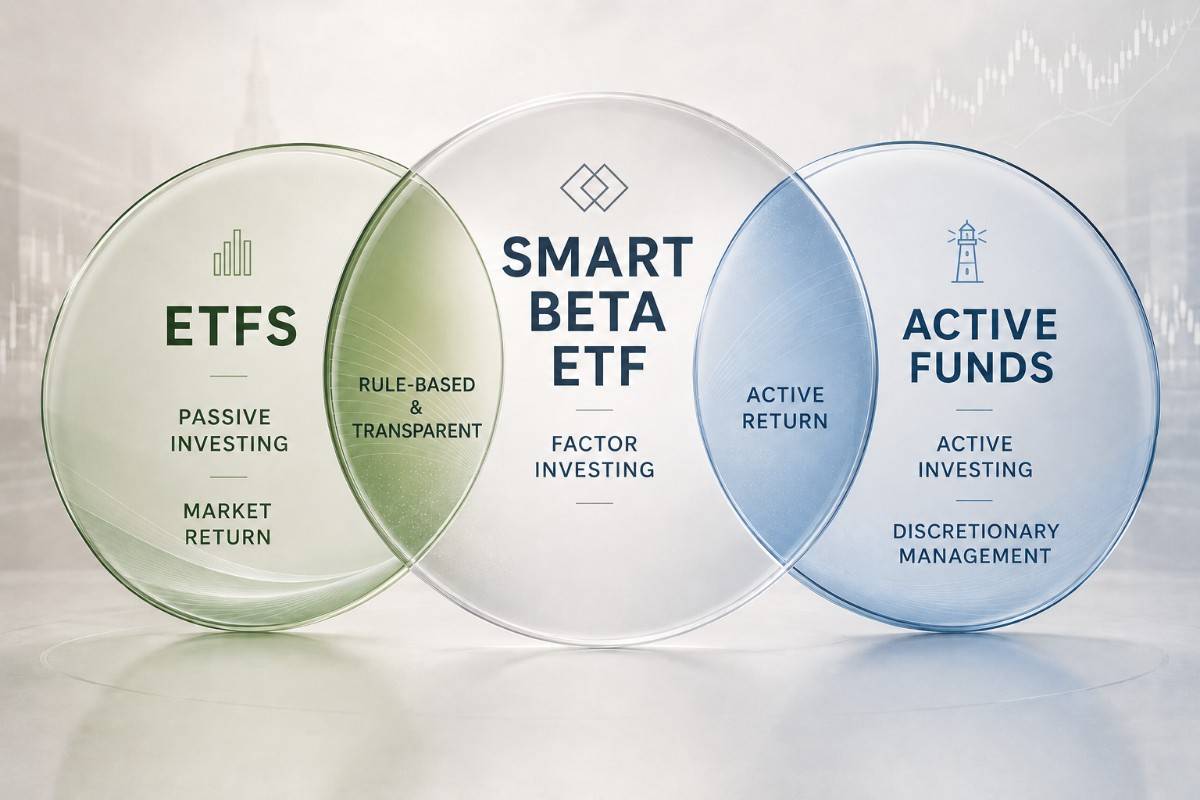
Smart beta sits between passive indexing and active management.
The ETF itself usually tracks an index passively. But the index is not neutral. Someone designed the rules. Those rules decide which stocks qualify, how much each stock receives, when the fund rebalances, and how far the fund can drift from the broad market.
That is why smart beta can look passive on a trading platform while behaving like an active style bet in a portfolio.
A smart beta ETF is not stock-picking in the traditional sense. But it is still a choice to favor one type of stock over another.
| Feature | Traditional Index ETF | Smart Beta ETF | Active Fund |
|---|---|---|---|
| Main objective | Track the broad market | Tilt toward selected factors | Beat a benchmark |
| Weighting method | Usually market capitalization | Rules-based methodology | Manager discretion |
| Main decision | Own the market | Choose a factor rule | Choose a manager |
| Cost profile | Usually lowest | Usually higher than plain index ETFs | Usually higher |
| Main risk | Market risk | Factor and tracking risk | Manager and style risk |
| Best role | Core exposure | Satellite tilt | Specialist exposure |
Cost is one clear difference. Vanguard’s S&P 500 ETF had an expense ratio of 0.03% as of April 28, 2026, while Invesco’s S&P 500 Equal Weight ETF listed a 0.20% expense ratio, and iShares MSCI USA Quality Factor ETF listed a 0.15% expense ratio.
Those fee differences may look small, but they still matter. A smart beta fund must overcome both its higher cost and the risk that its factor is out of favor.
Smart beta risk typically appears in four areas.
Tracking error refers to how far a fund’s performance differs from a broad benchmark.
That difference is not always a failure. A low-volatility ETF, for example, is supposed to behave differently from the broad market. But if the broad market is led by fast-rising mega-cap growth stocks, a defensive fund may lag badly.
The iShares MSCI USA Min Vol Factor ETF is a useful example. As of April 30, 2026, its 10-year annualized total return was 9.73%, while the MSCI USA Index returned 14.16%. The fund followed its lower-volatility objective, but investors still gave up significant upside during that period.
This is a historical example, not a forecast. Past performance does not guarantee future results, and factor performance can change across market cycles.
Factors can underperform for years.
Value can lag when investors reward growth. Momentum can reverse quickly when market leadership changes. Low-volatility stocks can trail during strong rallies. Dividend strategies can struggle when interest-rate-sensitive sectors are under pressure.
A factor ETF can be working exactly as designed and still disappoint investors.
Smart beta funds can look diversified because they own many stocks. But the factor screen may create concentration in certain sectors, industries, valuation profiles, or interest-rate exposures.
A dividend ETF may become heavily weighted toward financials, utilities, energy, or real estate. A quality ETF may cluster in highly profitable companies that already trade at expensive valuations. A momentum ETF may become concentrated in the latest market winners.
The ETF name rarely tells the full story. The holdings do.
Smart beta indexes must rebalance to maintain their factor exposure. Rebalancing can increase turnover, trading costs, and taxable distributions.
The expense ratio is only the visible cost. Retail investors should also check the bid-ask spread, trading volume, premium or discount to net asset value, and rebalance schedule.
The important point is that every smart beta strategy solves one problem by accepting another risk.
| Strategy | What It Targets | When It May Help | Main Risk |
|---|---|---|---|
| Value | Cheaper stocks relative to fundamentals | When valuation gaps narrow | Can lag growth stocks for years |
| Quality | Profitable, lower-leverage companies | When earnings durability is rewarded | Can become expensive |
| Momentum | Stocks with strong recent trends | When leadership persists | Sharp reversals |
| Low volatility | Stocks with lower historical volatility | When defensive exposure is rewarded | Can lag in strong rallies |
| Dividend | Income-paying companies | When income stocks are favored | Sector and rate sensitivity |
| Equal weight | Broader stock participation | When market breadth improves | More mid-cap and cyclical exposure |
Every smart beta strategy trades one risk for another.
Smart beta ETFs can be worth it when an investor wants a specific factor tilt and understands the risk of underperforming a broad index.
They are less suitable as a full replacement for a low-cost market-cap-weighted ETF. For most retail investors, smart beta works best as a smaller satellite allocation around a diversified core.
Smart beta can make sense when it solves a specific portfolio problem.
A quality ETF may help an investor tilt toward profitable, lower-leverage companies. A dividend ETF may support an income-oriented equity sleeve. A low-volatility ETF may reduce exposure to higher-beta stocks. An equal-weight ETF may reduce dependence on a few mega-cap companies.
But smart beta is weaker as a total replacement for broad-market exposure.
For many retail investors, the more sensible structure is:
Use a broad, low-cost, market-cap-weighted ETF as the core.
Add smart beta only as a smaller satellite tilt.
Keep the tilt small enough that several years of underperformance would not force an emotional exit.
For example, an investor who already owns a broad U.S. equity ETF might allocate to a smaller, high-quality ETF to tilt toward profitable, lower-leverage companies. Another investor concerned about mega-cap concentration might use a small equal-weight allocation. In both cases, the smart beta ETF is a targeted tilt, not the whole portfolio.
A smart beta ETF should not be bought because it has recently outperformed. That is often when factor risk is most crowded.
Smart beta may be a poor fit for investors who:
Do not understand the fund’s index methodology.
Expect it to outperform every year.
Cannot tolerate lagging a broad benchmark.
Are buying only because of recent returns.
Want a simple one-fund equity core.
Do not check holdings, sector exposure, fees, or liquidity.
Believe “low volatility” means low risk of loss.
Beginners are usually better served by understanding broad index funds first. Smart beta can come later, after the investor understands what risk they are adding.
Before buying, ask yourself seven questions.
| Checkpoint | What to Review |
|---|---|
| Factor | What exposure is the fund targeting? |
| Methodology | How are stocks selected and weighted? |
| Rebalance rules | How often does the index refresh? |
| Holdings | What are the top stocks and sectors? |
| Cost | How does the fee compare with broad index ETFs? |
| Liquidity | What are the volume, spread, and premium/discount? |
| Performance | How did the fund behave across different market regimes? |
The most important step is reading the methodology.
Two quality ETFs can perform differently if one emphasizes return on equity while another emphasizes earnings stability or leverage. Two value ETFs can diverge if one uses book value and another uses earnings, cash flow, or sales.
Do not buy the label. Read the rulebook.
Smart beta ETFs can be useful, but they are not neutral market exposure. They are rules-based factor strategies wrapped in an ETF.
Used carefully, they can help investors target value, quality, income, momentum, lower volatility, or broader market participation. Used blindly, they can create hidden active risk through tracking error, sector concentration, higher costs, and long periods of underperformance.
A smart beta ETF belongs in a portfolio only when the investor understands the rule, accepts the risk of lagging the benchmark, and uses it for a clear purpose. Otherwise, the “smarter index” is just a disguised style bet.