Published on: 2026-08-24
Updated on: 2026-08-24
Nvidia has beaten Wall Street expectations for four straight quarters, yet its shares fell after every report, including a 5.5% drop after February’s results. Consensus now points to roughly $92B of Q2 revenue, while options price about a 6% move after Wednesday’s report. Breaking the streak will likely require more than another beat, with Q3 guidance and margins determining whether expectations finally move higher.
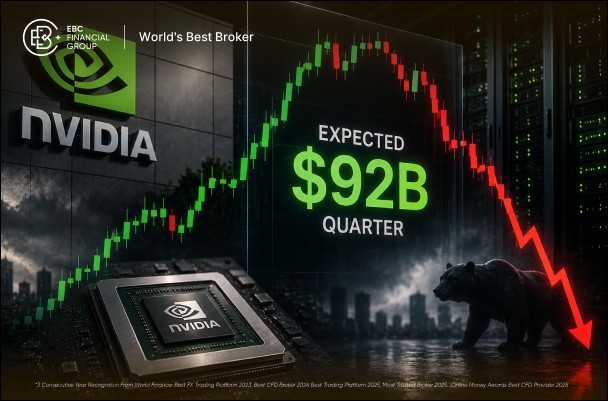
The four post-earnings declines came from different pressures. Moves ranged from 0.8% to 5.5%, spanning Nvidia-specific concerns and broader market selling.
A small Q2 beat may not be enough. Published revenue consensus is near $92B, while some high-side institutional forecasts point materially higher.
Q3 guidance is the cleaner test of upside surprise. Blackwell Ultra and early Vera Rubin demand are moving further into the forward outlook.
Gross margin near 75% remains the quality test. Faster revenue growth loses force if profitability slips materially below Nvidia’s guided range.
Options are pricing unusually high event risk. The implied post-earnings move is substantially larger than Nvidia’s recent reactions.
Published Q2 revenue consensus sits near $92B, with adjusted EPS expected around $2.08–$2.09. Nvidia’s own revenue outlook is $91B ±2%, so a result around consensus would clear the company’s midpoint without producing a particularly large surprise.
Bank of America represents the more demanding end of the forecast range, with Q2 revenue estimated at $94B–$95B. That would put the quarter roughly $2B–$3B above published consensus and $3B–$4B above Nvidia’s guidance midpoint. The $94B–$95B range is a high-side institutional forecast, not the broad Wall Street consensus.
The forward numbers raise the bar again. Q3 consensus sits around $103.7B–$104B, while BofA sees potential guidance of $107B–$108B as Vera Rubin shipments begin and cloud capital spending remains firm. A guide near consensus would preserve the current growth path. A move toward the high end of the range would push forward estimates materially higher.
Gross margin determines the quality of that upside. Nvidia guided non-GAAP Q2 gross margin to 75.0% ±50 basis points, leaving little room for a major profitability setback to hide behind faster sales.
Assuming gross margin stays near Nvidia’s 75% target, the central earnings scenarios come down to how much current revenue and the next-quarter outlook exceed the numbers already published.
| Q2 revenue | Q3 guide | Read-through |
|---|---|---|
| ~$92B | ~$103B–$104B | Beat, little reset |
| ~$94B–$95B | ~$103B–$104B | Strong Q2, softer outlook |
| ~$94B–$95B | ~$107B–$108B | Strongest upside case |
| Below consensus | Below ~$103B | Clear disappointment |
The third scenario clears both the high-side Q2 forecast and the more aggressive forward benchmark. The first two leave either the current-quarter surprise or the next-quarter outlook too close to numbers already circulating before the release.
A $107B–$108B Q3 outlook would look stronger if growth remains broad across hyperscalers, AI labs, neocloud providers and sovereign customers. Heavy dependence on a smaller group of buyers would make the same revenue number less convincing as evidence that the AI infrastructure cycle is widening.
Nvidia is also working with Apollo, BlackRock, Blackstone, Brookfield, Goldman Sachs and KKR on platforms intended to mobilize more than $500B of third-party capital for AI infrastructure. The initiative expands access to capital while putting the funding structure behind the next wave of AI infrastructure under greater scrutiny.
A bigger revenue number carries more weight when more customers are willing and able to fund it.
The previous four reactions did not follow one recurring earnings flaw. February showed how a substantial beat could still fail when the priced-in bar moved higher, while November initially produced a roughly 5% rally before a broad technology reversal erased the gain.
| Report | Move | Main pressure |
|---|---|---|
| Aug. 2025 | -0.8% | Data Center and China |
| Nov. 2025 | -3.2% | Broad tech reversal |
| Feb. 2026 | -5.5% | AI returns and growth |
| May 2026 | -1.8% | Expectations and competition |
May reinforced the pattern from another angle. Nvidia reported $81.6B in revenue, up 85% year over year, and guided the following quarter to $91B, yet the shares still fell 1.8% after the report. The four-report sequence therefore captures several different failure points rather than one repeatable earnings problem.
The streak does not establish that a fifth decline is inevitable, particularly when broader market conditions helped drive at least one of the previous reversals.
Options imply roughly a 6% move after Wednesday’s results. From Nvidia’s August 21 close of $214.72, that points to an approximate post-earnings range of $202 to $228. Live estimates vary with volatility and spot price, with recent readings around 6.0%–6.4%.
The previous four next-day reactions averaged about 2.8% in absolute terms. Current pricing therefore assumes more than twice the movement Nvidia delivered on average across the latest four-report streak.
Nvidia’s roughly 7.6% weight in the S&P 500 raises the stakes beyond the stock itself. A 6% Nvidia move would mechanically contribute about 46 basis points to the index before any reaction across semiconductors, cloud platforms or other AI-linked shares.
Options are pricing magnitude, not direction.
EBC is waiving commission and swap fees on eligible US stock CFDs until 11 September 2026. Terms and conditions apply.
Explore US Stock CFDs
Nvidia reports fiscal Q2 2027 results on Wednesday, August 26, after the US market closes. The earnings call begins at 5:00 p.m. ET shortly after the results are released.
No. Since 2016, Nvidia’s median one-day return following earnings has been positive at about 0.3%, rising to 3.3% after one week. The latest four-report losing streak is therefore considerably more negative than the longer-run pattern.
Yes. A headline beat can still disappoint if Q3 guidance, gross margin or demand quality falls short of assumptions already reflected in the stock. The latest four reports show that clearing revenue and EPS estimates alone has not guaranteed a positive next-day close.
No. Nvidia’s $91B ±2% Q2 outlook excludes Data Center compute revenue from China. Any renewed contribution would sit outside the company’s original baseline rather than being required to meet its published guidance.
Nvidia enters the August 26 report with a market value around $5.2T, so another record quarter alone would add little that the current narrative does not already assume. At this scale, extraordinary growth is already the price of admission.
Nvidia no longer needs to prove the AI boom is real. It needs to prove the market is still underestimating how large it can become.