Published on: 2026-05-14
Updated on: 2026-05-14
Nvidia stock now depends on whether Big Tech can keep funding AI infrastructure without weakening cash flow, buybacks, or future AI budgets.
Data Center revenue reached $193.7 billion in fiscal 2026, making AI infrastructure the core driver of Nvidia’s valuation. (Nvidia Newsroom)
Gross margin fell from 75.0% to 71.1%, making Blackwell profitability a bigger test than headline revenue growth.
Two direct customers represented 36% of fiscal 2026 revenue, making large-buyer order timing a stock-level risk.
Nvidia has $17.5 billion invested in private companies and infrastructure funds, showing deeper exposure to the ecosystem buying its chips.
The next test is demand quality: broad customers, stable margins, rising inference use, and guidance strong enough to support the premium.
Nvidia stock is at record highs, but the more important signal sits below the share price. The stock is priced as if the AI buildout can keep expanding without weakening the companies paying for it. Its largest customers are still buying GPUs, networking systems, and data-center capacity at historic scale, but that same spending is absorbing cash flow across Big Tech.
The risk is not weak AI demand. The risk is that AI demand becomes more expensive before customers fully prove the return.
Fiscal 2026 revenue rose 65% to $215.9 billion, while Data Center revenue reached $193.7 billion. The harder question is whether earnings can keep growing fast enough to defend a roughly $5.53 trillion valuation and a premium multiple.
At that valuation, Nvidia does not need merely strong results. It needs results that keep future earnings estimates rising faster than investors lower the multiple.

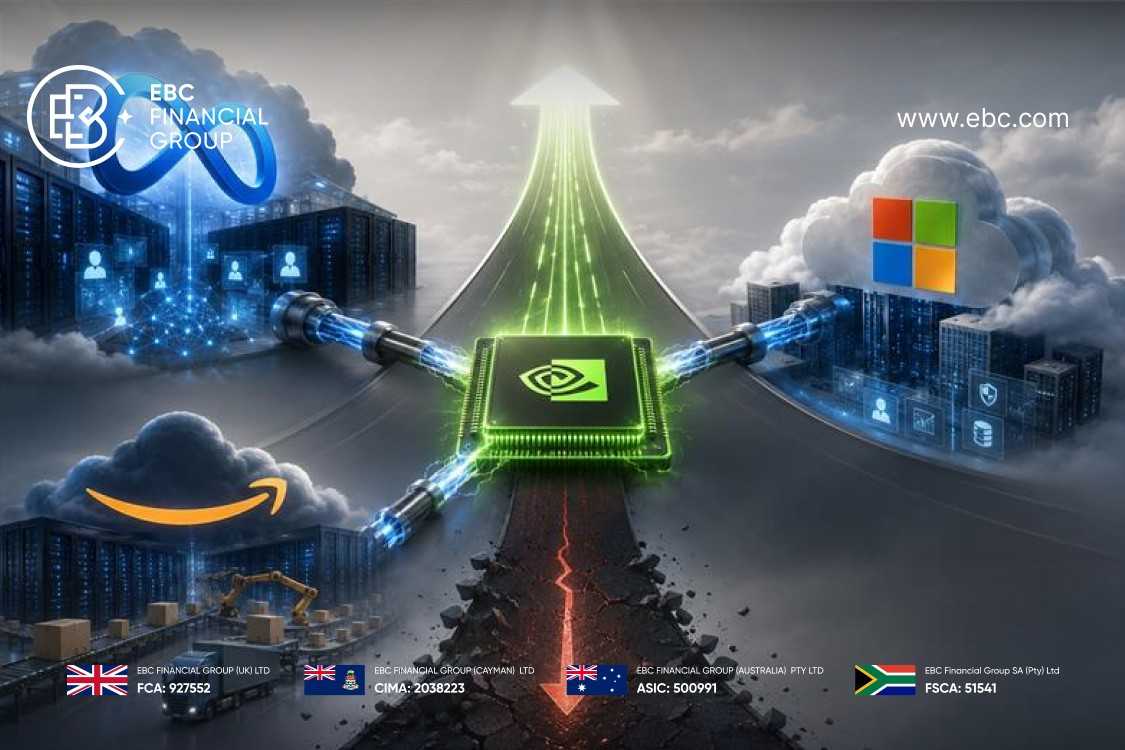
Nvidia’s revenue starts with customer budgets. Microsoft, Amazon, Meta, Alphabet, Oracle, AI model developers, and cloud infrastructure firms fund the demand that appears as Nvidia Data Center sales. The stock’s next test is whether those customers can turn AI spending into revenue fast enough to keep expanding orders.
| Company | Latest AI Spending Signal | What It Means for Nvidia Stock |
|---|---|---|
| Microsoft | AI business above $37 billion annual revenue run rate; Azure and cloud services up 40% | Strongest demand signal because AI infrastructure is already converting into cloud revenue. |
| Amazon | Free cash flow fell to $1.2 billion from $25.9 billion as property and equipment purchases rose $59.3 billion | Nvidia benefits from the spending, but customer cash-flow pressure raises the risk of slower capex later. |
| Meta | 2026 capex guidance raised to $125 billion to $145 billion | AI budgets are still expanding, but the market will demand evidence that spending produces returns. |
The table separates the Nvidia debate into three parts. Microsoft shows AI spending already turning into cloud revenue. Amazon shows the cash-flow cost. Meta shows the scale of the budget expansion. Nvidia can defend its premium if more customers look like Microsoft. It becomes more vulnerable if more customers keep spending like Amazon, with less free cash flow to show for it.
The AI trade has moved from a demand story to a return test. Nvidia’s customers are not speculative buyers. They are some of the world’s largest cash generators. If even these companies need to slow buybacks, borrow more, or accept weaker free cash flow to fund AI infrastructure, Nvidia becomes more exposed to budget decisions outside its control.
That does not weaken Nvidia’s current franchise. It changes the test. A normal chip cycle depends on inventories, pricing, and end-market demand. Nvidia’s current cycle depends on whether customers keep finding profitable uses for massive amounts of compute.
Training builds AI models. Inference runs those models on real products. Nvidia needs both, but inference is the stronger long-term signal because it shows AI is being used repeatedly, not just built once.
If inference expands across search, software, advertising, enterprise automation, and consumer products, hyperscaler spending can stay aggressive.
If usage grows more slowly than capacity, the market will start questioning how much infrastructure is being built ahead of revenue.
Nvidia has $17.5 billion invested in private companies that buy its chips. If those companies slow their orders, Nvidia loses a customer and an investment simultaneously
Nvidia disclosed $17.5 billion of investments in private companies and infrastructure funds, including AI model makers that purchase its products directly or through cloud service providers. It also disclosed $3.5 billion of land, power, and shell guarantees for partner facilities. Traditional chipmakers usually sell into a cycle. Nvidia is helping finance and support parts of the cycle itself.
The company also expects to begin leases with $22.7 billion of future obligations from fiscal 2027 through fiscal 2030, mainly data-center leases supporting research and development. For shareholders, that means Nvidia is taking on more infrastructure exposure even as it profits from infrastructure demand.
If these investments make customers more tied to Nvidia’s platform, the moat widens. If investors start seeing them as support needed to keep the AI buildout moving, the market may value the same revenue less generously.
Nvidia’s fiscal 2026 gross margin fell to 71.1% from 75.0%. The decline reflected the shift from Hopper HGX systems to Blackwell full-scale data-center solutions and a $4.5 billion charge tied to H20 excess inventory and purchase obligations. (Nvidia SEC)
That margin shift is the cleanest way to test Nvidia stock from here. A stronger product cycle does not automatically produce higher profitability. Rack-scale AI systems require networking, power, cooling, supply-chain coordination, system integration, and deployment timing. Nvidia is moving from selling accelerators to supplying full AI factories.
| Margin Signal | Latest Reading | What Retail Investors Should Watch |
|---|---|---|
| FY2026 gross margin | 71.1%, down from 75.0% | Profitability weakened even as revenue surged, so sales growth alone is not the full story. |
| Q1 FY2027 revenue guide | $78.0 billion, plus or minus 2% | The market expects another major revenue step-up. |
| Q1 FY2027 gross margin guide | Around 75% | A margin recovery would support the premium valuation. |
| Blackwell transition | Full-scale data-center systems | Higher complexity can lift revenue but also pressure costs, timing, and execution. |
| H20-related charge | $4.5 billion | Export controls and product restrictions can still hit profitability. |
Nvidia’s next test is not only whether demand remains strong. The question is whether Blackwell's revenue can arrive with margins strong enough to support the stock’s premium.
If margins recover toward guidance, higher earnings estimates can help defend the valuation.
If system complexity pulls margins lower, investors may start valuing Nvidia more like a high-growth hardware company than a dominant AI platform.
Nvidia disclosed that one direct customer accounted for 22% of fiscal 2026 revenue, and another accounted for 14%, both primarily tied to Compute & Networking. These are direct customers, not necessarily the final users of Nvidia systems, but the concentration still changes how traders should read the stock.
That concentration is powerful while orders accelerate. It becomes risky when deployment schedules stretch or customers change procurement plans. A single hyperscaler pause can affect quarterly growth. A shift toward custom chips can reduce the scarcity premium attached to Nvidia’s platform. A broader slowdown in AI budgets can hit the same revenue base from several directions.
If the largest customers keep expanding across training, inference, networking, and full-stack systems, concentration reinforces Nvidia’s scale advantage. If procurement pauses or custom chips gain share, one customer’s timing issue can become Nvidia’s valuation problem.
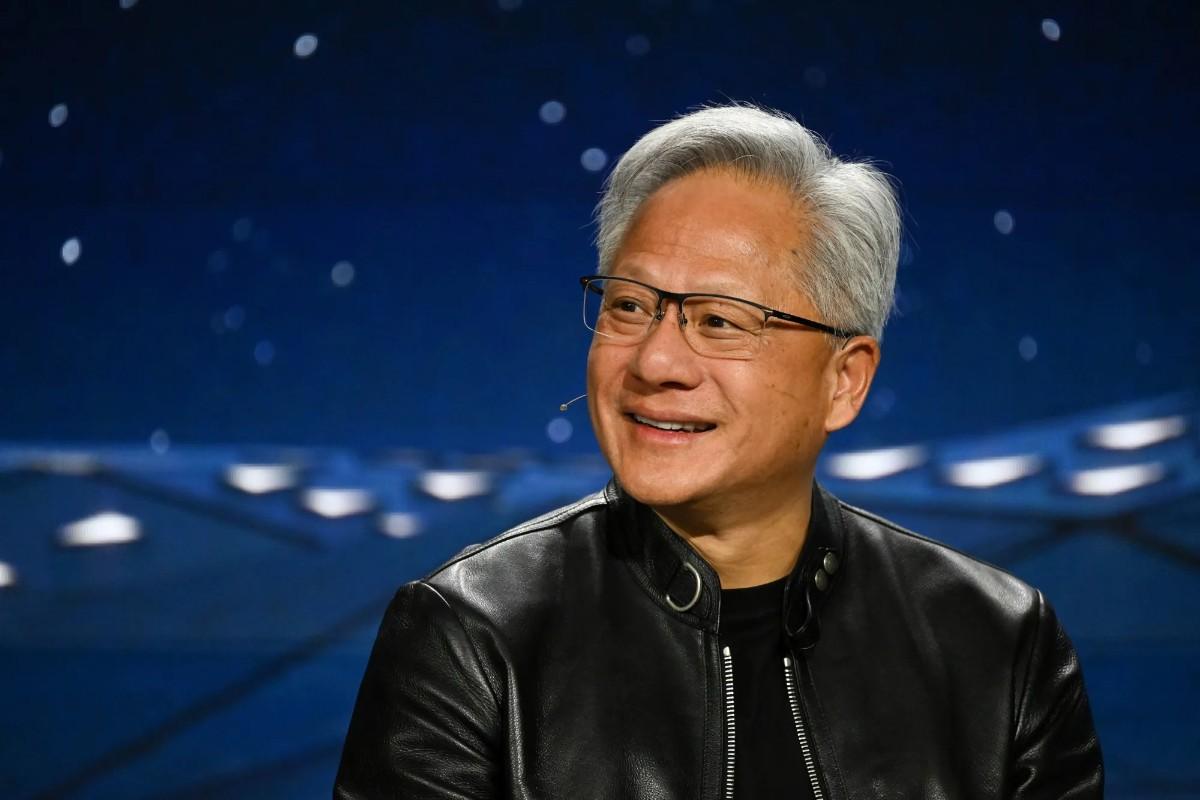
Nvidia stock has drawn fresh support from Jensen Huang’s presence on President Trump’s China trip, which revived hopes that chip restrictions could eventually ease. That optimism matters, but Nvidia’s own Q1 fiscal 2027 outlook still assumes no Data Center compute revenue from China. The current guide depends on strong demand outside China to carry the quarter.
Nvidia said it was effectively blocked from competing in China’s data-center computing market at the end of fiscal 2026. It also said restrictions helped local competitors build larger developer and customer ecosystems.
The stock can still rise without China. The weaker assumption is that China can be added back later as clean upside. While Nvidia is restricted, domestic alternatives keep gaining customers, developers, and procurement trust.
Nvidia does not need to prove that AI demand exists. The market has already accepted that. The next test is whether the demand supporting Nvidia’s valuation remains broad, profitable, and repeatable.
Watch four signals:
Revenue breadth: A strong quarter built on several customers, workloads, and regions is more durable than one driven by a narrow procurement wave.
Gross margin: Blackwell demand can lift revenue, but the stock needs evidence that full-scale AI systems are arriving with strong profitability.
Inference demand: Training builds AI models. Inference runs them in real products, services, and enterprise tools. Expanding inference would make AI infrastructure look more recurring.
Guidance quality: A headline beat may lift the stock briefly. Stable margins, broad demand, and confident forward commentary would do more to defend Nvidia’s premium valuation.
AI spending is the budget behind Nvidia’s Data Center revenue. When hyperscalers build more data centers, Nvidia sells more GPUs, networking systems, and full AI infrastructure. If that spending starts pressuring customer cash flow, investors may question how long the order cycle can continue.
Margin pressure, slower customer spending, competition from custom chips, or slower adoption of inference could hurt the stock even if AI demand remains high. At Nvidia’s valuation, the market will judge the quality of growth, not just the size of revenue.
Training builds AI models. Inference runs those models repeatedly in real products and services. Strong inference demand would make AI infrastructure spending appear more recurring, which would support Nvidia’s long-term revenue base.
China still matters for long-term competition, but Nvidia’s current outlook assumes no Data Center compute revenue from China. The near-term valuation depends on demand outside China, while the longer-term risk is that local competitors continue to build stronger ecosystems.
Nvidia remains the clearest winner from the AI infrastructure buildout, but the next phase of the stock will be harder than the last one. The market already knows companies want more AI compute.
The unresolved question is whether those companies can turn that compute into enough revenue, cash flow, and return on capital to keep funding Nvidia’s next leg.