Published on: 2026-02-11
Updated on: 2026-02-11
This jobs report is arriving with more emotional charge than usual because it is not only about January hiring. It questions whether the US labor market in 2025 was weaker than investors were led to believe at the time.
The US labor market has been cooling, as seen in hiring proxies and layoff data. Still, the market's real challenge is separating signal from noise when benchmark revisions, seasonal factor updates, and model changes can move the goalposts in a single release.
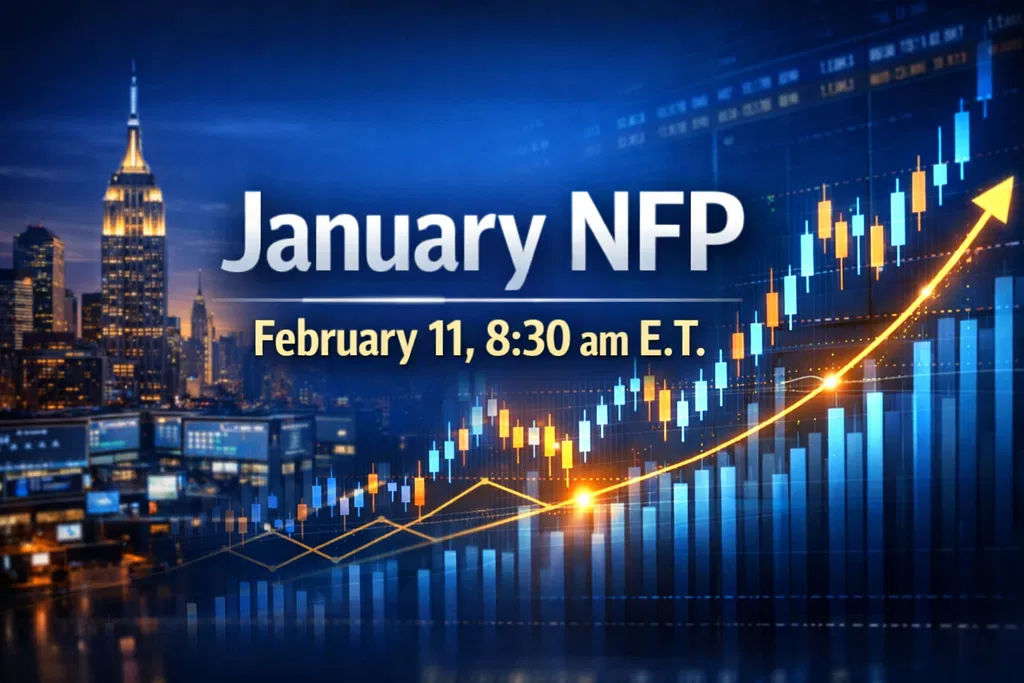
Today's Employment Situation report is scheduled for 8:30 a.m. Eastern Time on February 11, 2026. The timing has been reshuffled by the recent partial government shutdown, adding one more layer of uncertainty to a report that already carries unusually high "revision risk."
| City | Local release time |
|---|---|
| New York (ET) | 8:30 a.m. |
| London (GMT) | 1:30 p.m. |
As mentioned above, the January Employment Situation report will be released today at 8:30 a.m. ET.
The Three Numbers That Usually Move First
Average hourly earnings (m/m)
Unemployment rate
Payrolls headline, plus revisions to prior months
If wages surprise to the upside, the first move is often in 2-year yields and the US dollar, even if payrolls look mediocre.
| Metric | Latest official (Dec 2025) | Market expectation for Jan 2026 report |
|---|---|---|
| Nonfarm payrolls (m/m) | +50,000 | +70,000 to +80,000 |
| Unemployment rate | 4.4% | ~4.4% |
| Avg. hourly earnings (m/m) | +0.3% | ~+0.3% |
| Avg. hourly earnings (y/y) | +3.8% | Slightly below 4% |
The cleanest baseline is the last official read. In December 2025, total nonfarm payrolls increased by 50,000, the unemployment rate remained at 4.4 percent, and average hourly earnings rose by 0.3 percent to $37.02, marking a 3.8 percent year-over-year increase.
For today's January 2026 report, consensus clustering sits near the mid-double-digits thousands, but dispersion is unusually large because the release embeds multiple one-off technical forces.
Many previews place the headline around 70,000 to 80,000, with unemployment near 4.4 percent and earnings near 0.3 percent month over month, while prominent forecasts span from a small job loss to a six-figure gain.
Payrolls: Negative or above +150k would likely trigger a bigger repricing because the baseline is low.
Wages: 0.4% m/m would feel hot in a pause-and-watch Fed regime, while 0.1% m/m would revive the "cuts soon" narrative.

The headline payroll number is an average of wildly different labor-market realities. Job growth can still be positive even in a slowing cycle if several large sectors continue to hire while cyclical industries lay off workers. That is why markets increasingly focus on the industry mix, private versus government hiring, and hours worked.
Private payroll proxies point to narrow strength rather than broad expansion. ADP reported +22,000 private jobs in January, with +74,000 in education and health services offset by losses in professional and business services (-57,000), manufacturing (-8,000), and information (-5,000).
A BLS payroll number close to consensus would align with this trend if healthcare, social assistance, and leisure sectors account for most hiring, while rate-sensitive categories lag.
Investors should also watch the revision line items inside the release. In December's report, prior months were revised down, illustrating how late survey responses can reshape the near-term trend even before the benchmark process is applied.
Wages matter because the Fed can treat a softer payroll trend as noninflationary, but it cannot ignore a renewed acceleration in earnings growth. December's read of 0.3 percent month over month and 3.8 percent year over year was consistent with cooling wage inflation, but it was not weak enough to declare victory.
Private wage measures show stability rather than collapse. ADP's pay insights revealed that pay for job-stayers increased by 4.5% YoY, while pay for job-changers rose by 6.4%. This shows a slowdown in job-changer gains, which typically indicates a less competitive hiring market.
If today's BLS earnings print surprises to the upside, rate markets can still tighten even if payrolls are soft, because the policy reaction function is more sensitive to persistent wage inflation than to one month of hiring noise.
Hours are the quiet amplifier. In December, the average workweek fell to 34.2 hours, indicating that employers are retaining labor while decreasing utilization. A further decline in hours would strengthen the "slowdown" signal even if payrolls are positive.
| Sector | Benchmark revision (thousands) | Percent revision |
|---|---|---|
| Total nonfarm | -911 | -0.6% |
| Total private | -880 | -0.7% |
| Trade, transportation, and utilities | -226 | -0.8% |
| Leisure and hospitality | -176 | -1.1% |
| Professional and business services | -158 | -0.7% |
| Manufacturing | -95 | -0.8% |
| Information | -67 | -2.3% |
Today's NFP report presents a unique risk not seen in most months: the annual benchmark revision and related recalculations. The benchmark process re-anchors payroll employment to more comprehensive counts derived from unemployment insurance tax records via the QCEW.
The starting point is already known. The BLS preliminary benchmark estimate for March 2025 implied the payroll level was 911,000 lower than previously estimated, or -0.6 percent, with the largest percentage hit in information (-2.3 percent) and major downward revisions across trade, leisure and hospitality, and professional and business services.
The BLS also noted that benchmark revisions over the last decade averaged an absolute 0.2 percent of total nonfarm employment, which highlights how unusually large the preliminary estimate already looks.
First, the BLS has signaled that establishment survey data will be revised to reflect the annual benchmark and updated seasonal adjustment factors, affecting not seasonally adjusted data back to April 2024 and seasonally adjusted data back to January 2021.
Second, the establishment survey's birth-death model is being changed to incorporate current sample information each month, which can meaningfully alter month-to-month profiles at turning points.
Household survey comparability also deserves attention. The BLS announced that it will instead introduce population control adjustments with the February 2026 estimates in March.
Analysts may later revise the January estimates to include the new controls. That means the unemployment rate can be stable while the underlying population and participation assumptions shift later.
Price action surrounding the NFP report is typically influenced more by how the data affects the anticipated direction of monetary policy rather than by minor differences in payroll figures.
The table below presents a likely market interpretation, considering both payroll numbers and wage growth, with revisions serving as a multiplier effect.
| Scenario | Payrolls and unemployment | Wage signal | Likely market interpretation |
|---|---|---|---|
| Growth scare | Payrolls near zero or negative, unemployment drifts higher | Wages stay at or below 0.3% m/m | Rates price faster cuts, USD weakens, equities can rally if revisions are not worse than feared. |
| Soft landing | Payrolls roughly 50,000 to 100,000, unemployment near 4.4% | Wages near 0.3% m/m | The "cooling but not breaking" narrative holds, and risk assets stabilize with modest USD downside. |
| Reflation risk | Payrolls above 100,000 and revisions are not heavily negative | Wages 0.4% m/m or higher | Yields rise, USD firms, and equities can wobble as the market pushes cuts further out. |
| Revision shock | Headline is near consensus but benchmark wedging materially lowers prior levels | Wages are secondary | The trend narrative shifts toward weaker labor momentum, and the initial reaction can reverse as markets digest the revisions. |

Today's jobs report is not the only delayed domino.
The BLS schedule shift also pushed the January CPI release to February 13, which means traders will receive two major inflation and labour inputs inside one tight window.
That pairing matters because:
A soft NFP followed by a firm CPI can create a tug-of-war.
A firm NFP followed by a soft CPI can trigger a quick reversal in yields and the dollar.
The January 2026 Employment Situation report is at 8:30 a.m. ET on Wednesday, February 11, 2026.
It includes the annual benchmark revision and updated seasonal factors. The BLS has indicated that the payroll, hours, and earnings series will also be revised with this release.
A weak NFP increases the odds, but it does not guarantee them. The Fed has emphasized incoming data and risk balance, and wages and inflation trends can offset a softer jobs print.
In conclusion, today's NFP is a two-part event. The first part is the January headline for payrolls, unemployment, and wages.
The second part is the benchmark revision, which can alter the market's perception of job growth in 2025, potentially making the trend appear weaker than it initially did.
The clearest analysis will come from combining wages, hours, and the revision profile, as these elements determine whether a cooling labor market remains orderly or begins to appear structurally weaker in the Fed's 2026 policy considerations.
Disclaimer: This material is for general information purposes only and is not intended as (and should not be considered to be) financial, investment or other advice on which reliance should be placed. No opinion given in the material constitutes a recommendation by EBC or the author that any particular investment, security, transaction or investment strategy is suitable for any specific person.