Published on: 2026-02-11
Updated on: 2026-02-11
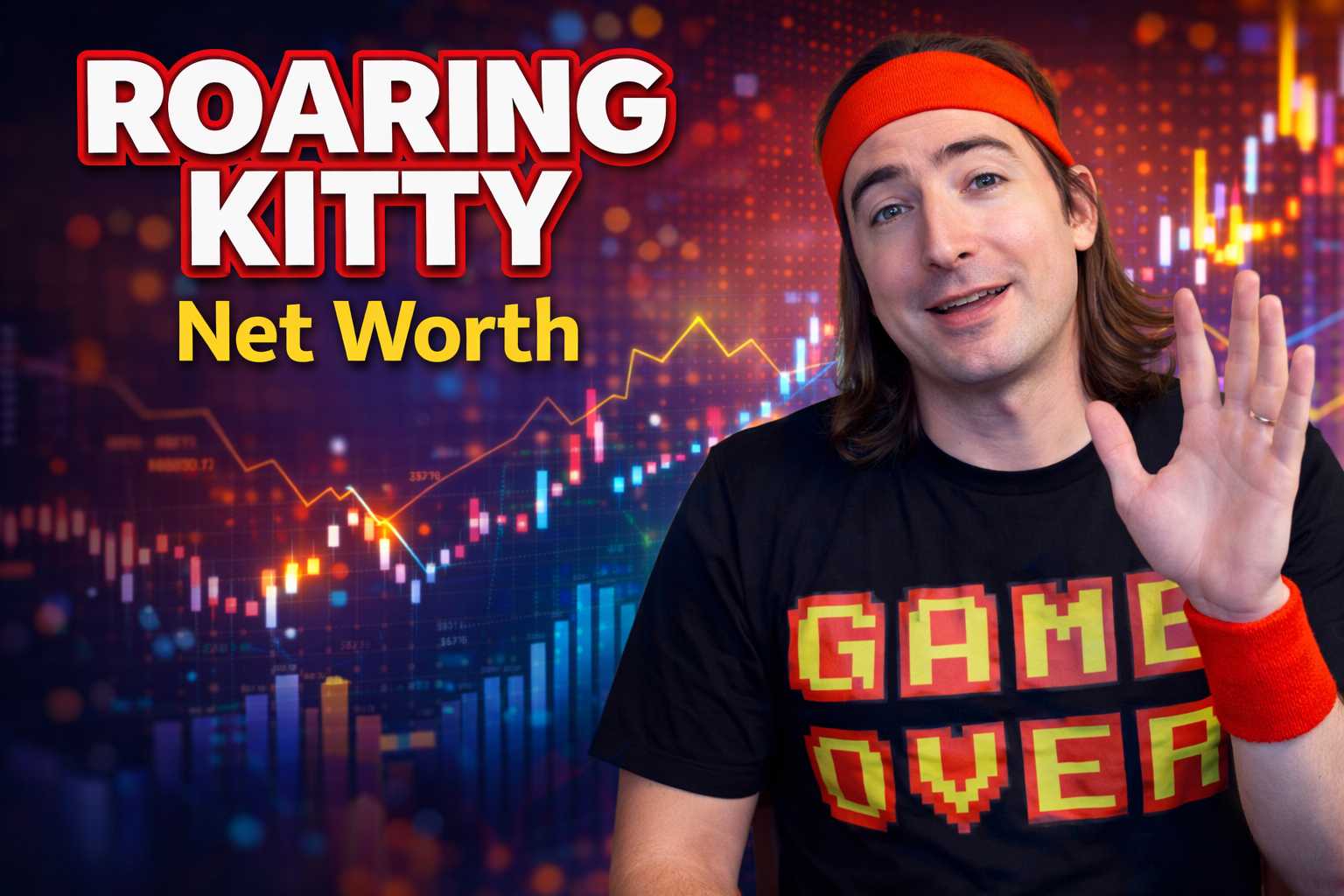
Roaring Kitty's net worth operates as a dynamic market variable rather than a fixed celebrity figure. Following Keith Gill’s 2024 reemergence, which reignited meme-stock volatility, his wealth is best described as a mark-to-market reflection of a single, highly concentrated equity position. Using the last widely reported share count (9,001,000 shares), each $1 move in GameStop’s share price changes paper wealth by about $9.0 million, depending on exposure and hedging strategies.
A clear reference point is mid-June 2024, when reports indicated that Gill’s holdings exceeded 9 million GameStop shares and included approximately $6.3 million in cash, resulting in a portfolio value near $268 million.
Subsequently, Gill was disclosed as a 6.6% shareholder in Chewy via a Schedule 13G filing, and a later Schedule 13G/A showed that stake was sold. These developments demonstrate that his net worth is affected not only by price fluctuations but also by portfolio rotation decisions, many of which are not publicly disclosed.
The last broadly reported “hard” snapshot showed 9,001,000 GameStop shares and about $6.3 million in cash, putting the portfolio's value near $268 million at June 2024 prices.
At today’s GameStop price of $24.82, that same 9,001,000-share stake would be worth $223.4 million before cash, taxes, or any unreported changes in exposure.
The sensitivity is significant: each $1 movement in GameStop’s share price results in approximately $9.0 million of equity value change on 9,001,000 shares, making daily volatility a primary driver of net worth.
Keith Gill has consistently presented himself as an individual investor rather than a fund manager, emphasizing that his investment and social media activities are personal. This distinction is important for net worth analysis because it implies the absence of outside client assets, performance-fee business economics, or any obligation to publish audited statements.

Consequently, the public relies on a patchwork of regulatory filings when ownership thresholds require them and on sporadic portfolio screenshots when he chooses to share them.
This is why Keith Gill's net worth estimates spread so widely across the internet. Many numbers are narrative-driven and unmoored from verifiable exposure. The more disciplined approach treats wealth as a balance-sheet exercise: identify the most reliable position snapshot, mark it to current prices, then haircut for uncertainty around trading activity, taxes, and liquidity.
Gill’s public origin story is unusually well-documented for a retail trader. He built an audience arguing that GameStop was mispriced and committed personal capital early, a position that later swelled to tens of millions during the 2021 short squeeze era. That arc established the template: a deep-value narrative paired with the willingness to hold through violent drawdowns, while using options as a leverage and timing tool.
The crucial point for net worth math is scale. The mid-2024 disclosures implied that an investor was operating with capital bases that resembled those of small institutions. Once exposure reaches millions of shares, net worth no longer behaves like a traditional portfolio. It behaves like a single-stock book, where liquidity pockets, volatility regimes, and options positioning can dominate fundamentals for long intervals.
Early June 2024 disclosures associated with Gill revealed a two-layer exposure: 5 million GameStop shares and 120,000 call options with a $20 strike price and a June 21 expiry, along with a significant cash buffer.
This structure created an asymmetric payoff but also introduced a funding challenge if exercised in full, as converting short-dated calls into shares requires substantial cash outlay unless options are sold to finance the exercise.

By June 13, market reporting converged on a different configuration: Gill appeared to have exited the options leg and increased share ownership to 9,001,000 shares, with cash dropping to roughly $6.3 million.
Structurally, that is a rotation from convex optionality into outright equity concentration. It reduces time-decay risk but increases pure mark-to-market exposure and liquidity risk if the position ever needs to be reduced quickly.
| Date (publicly reported) | GameStop shares | Options exposure | Cash (approx.) | Implied portfolio value (at the time) |
|---|---|---|---|---|
| June 2–3, 2024 | 5,000,000 | 120,000 calls, $20 strike, June expiry | ~$29.4M | Equity + options reported near ~$180M+ (depending on intraday pricing) |
| June 13, 2024 | 9,001,000 | None shown | ~$6.3M | ~$268M total (shares ~$262M + cash) |
As of February 11, 2026, GameStop traded at $24.82. If the 9,001,000-share position observed in June 2024 were still intact, the shareholding alone would be worth $223.4 million.
Adding the previously reported ~$6.3 million cash yields an implied portfolio value around $229.7 million, before considering any additional assets, liabilities, taxes, or changes in exposure since that snapshot.
This figure should be regarded as a scenario rather than a definitive statement. The key uncertainty is whether the stake was reduced, hedged, or rebuilt. Since the position size is below typical thresholds for ongoing beneficial ownership reporting, the public may not notice changes unless Gill discloses them or triggers a new filing requirement.
Assuming 9,001,000 shares and $6.3 million cash, the implied value shifts rapidly:
| GameStop price | Value of 9,001,000 shares | + Cash (approx.) | Implied total |
|---|---|---|---|
| $15 | $135.0M | $6.3M | $141.3M |
| $25 | $225.0M | $6.3M | $231.3M |
| $35 | $315.0M | $6.3M | $321.3M |
The June 2024 setup highlights a structural feature of meme-stock episodes: options can create fast, headline-sized gains without the same liquidity and monetization certainty as shares. Deep-in-the-money calls can behave like stock, but exercising them at scale requires capital. If that capital comes from selling other exposure, the act of monetization can pressure the underlying price and compress the very wealth the market is trying to measure.
Markets price these dynamics through volatility. When implied volatility spikes, call premia expand, and portfolio screenshots can balloon, even if the exit path is narrow. In institutional terms, the relevant questions are order flow, liquidity conditions, and volatility pricing, not just “How high did it go?”
GameStop explains the public fascination. Chewy explains why simplistic net worth numbers can be misleading. A filing showed Gill owned 9,001,000 shares of Chewy, representing a 6.6% stake, a size that forces disclosure and signals institutional-scale positioning.
More recently, a regulatory filing showed he sold all of those Chewy shares, ending that stake. Whatever the profit or loss, that round trip establishes that his wealth is not a static relic of 2021. It is a live portfolio that can rotate across names and catalysts.
It also reinforces a practical constraint. Large stakes in liquid mid-caps are still hard to unwind quietly. Position changes can become events, not because of a press tour, but because size itself alters the market microstructure around the trade.

Disclosure asymmetry: Gill is not obligated to publish a balance sheet, and much of what the public “knows” comes from episodic snapshots.
Concentration risk: When the majority of wealth is concentrated in a single volatile stock, the timing of measurement becomes more significant than biographical details.
Realized vs unrealized value: A $250 million screenshot is not $250 million of spendable cash. Taxes, slippage, and execution feasibility can materially reduce realizable proceeds.
The most defensible approach is therefore conditional: estimate Gill’s net worth under the assumption that the last widely reported GameStop stake remains intact, and then describe the uncertainty range arising from unknown trading and hedging activity.
The most defensible estimate treats Roaring Kitty's net worth as a mark-to-market exercise. Using the last broadly reported snapshot of 9,001,000 GameStop shares and approximately $6.3 million cash, and using a GameStop price of $24.82 (as of February 11, 2026), implies roughly $230 million in portfolio value, assuming holdings are unchanged.
Verified anchors include reported June 2024 holdings of more than 9 million GameStop shares plus ~$6.3 million cash, implying about $268 million at that time. Chewy ownership was confirmed via a 6.6% stake filing, and a later filing showed that stake was sold.
Achieving billionaire status would require either a significantly higher sustained GameStop price on a multi-million-share position or substantial additional assets beyond those publicly documented. The most widely reported snapshots place the portfolio value in the hundreds of millions, not at or above $1 billion.
There is no continuous public reporting that definitively answers this question. The June 2024 update widely reported a move into 9,001,000 shares, but holdings below key reporting thresholds can change without a new filing. In the absence of new disclosures, any claim about the current share count is speculative.
Because net worth depends on both what is owned and when it is measured. Gill’s largest driver is a single volatile stock, and public information arrives in bursts rather than through audited statements. Filings appear only when ownership thresholds require them, as seen with Chewy.
Roaring Kitty’s net worth is best understood as a concentrated-risk balance sheet rather than a static celebrity figure. The last widely reported benchmark placed Keith Gill's net worth at $268 million in June 2024, combining 9,001,000 GameStop shares and approximately $6.3 million in cash. Marked to $24.82 (as of 2026), that share position alone implies about $223 million, resulting in a reasonable conditional estimate near $230 million if exposure remains unchanged.
The key caveat is structural: in the absence of ongoing disclosure, the primary determinant of Keith Gill’s net worth is not market arithmetic, but whether the position still exists in the same form.
Disclaimer: This material is for general information purposes only and is not intended as (and should not be considered to be) financial, investment or other advice on which reliance should be placed. No opinion given in the material constitutes a recommendation by EBC or the author that any particular investment, security, transaction or investment strategy is suitable for any specific person.