Published on: 2026-02-11
Updated on: 2026-02-11
In forex, the spread represents the market’s inherent transaction cost, embedded in every quote and incurred whenever a position is opened and subsequently closed. The spread, defined as the difference between the bid and ask prices, is significant because even minor fluctuations can determine whether short-horizon trades, scalping, and algorithmic strategies remain profitable after costs.
For such strategies, execution quality is a critical differentiator, and the spread constitutes a fundamental cost of accessing liquidity.
In April 2025, average daily foreign exchange trading volume reached $9.6 trillion, highlighting the market’s depth during periods of abundant liquidity and the rapid shifts that can occur when liquidity diminishes. Spreads are generally narrow for the most liquid currency pairs during peak trading hours, but they tend to widen when dealers and liquidity providers adjust for risk during low-liquidity periods or significant market events.
In forex trading, every currency pair is quoted with two prices:
Bid: the price at which the market will buy the base currency from a trader (the trader sells).
Ask: the price at which the market will sell the base currency to a trader (the trader buys).
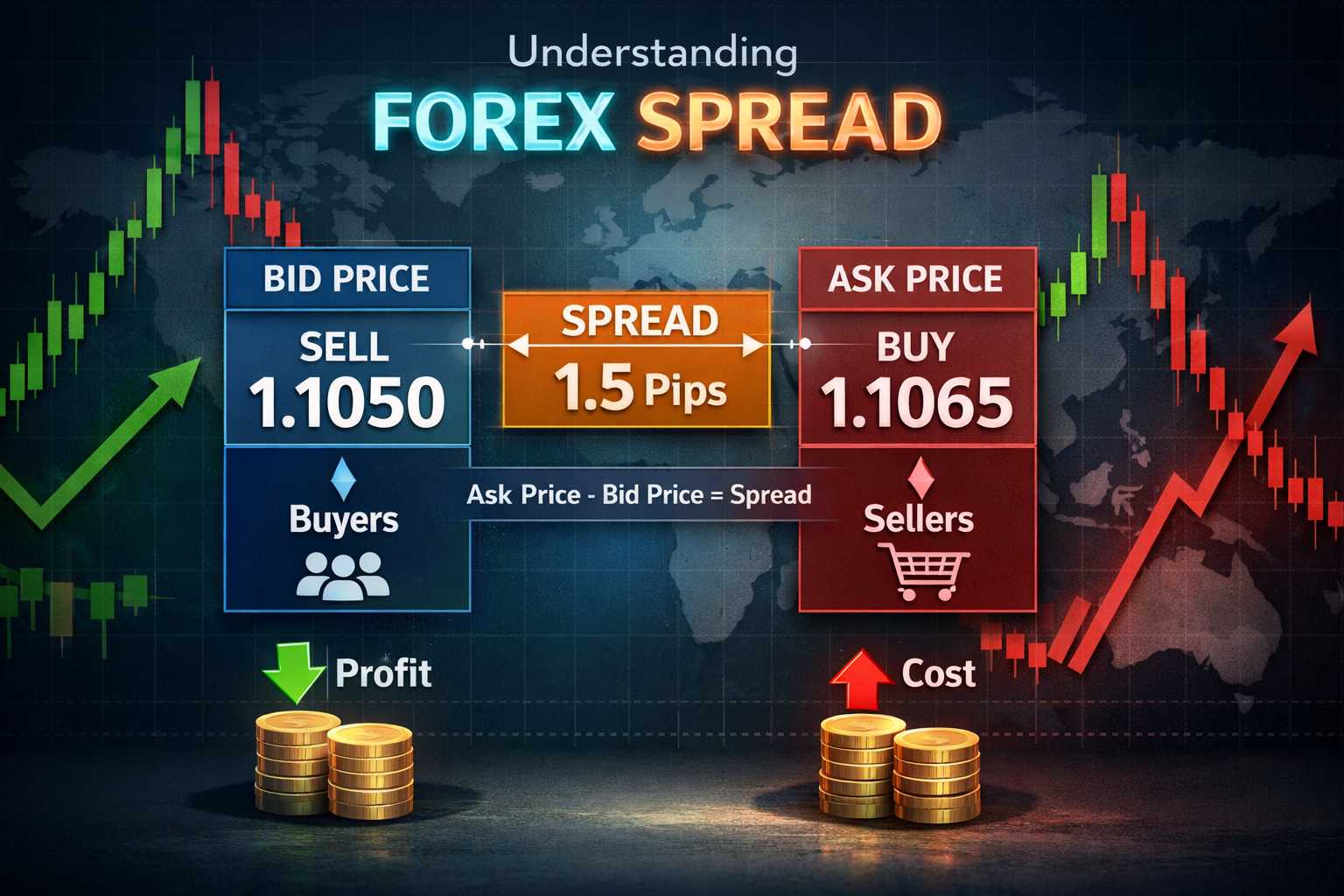
The spread is the difference between the bid and ask prices. It serves as compensation for liquidity providers and brokers who facilitate execution and assume risk. In practical terms, the spread represents a persistent transaction cost in foreign exchange trading, as it is incurred regardless of trade outcome. For example, in the EUR/USD pair, EUR is the base currency and USD is the quote currency.
Two-sided pricing illustrates the mechanism by which liquidity is provided. Dealers, brokers, or liquidity providers are prepared to transact on both sides of the market, but maintain a buffer known as the spread. When liquidity is ample, competition narrows the spread. Conversely, during periods of uncertainty or reduced liquidity, spreads widen to account for increased execution risk.
Generally, this is the basic formula to calculate spread in forex.
Spread (price terms) = Ask − Bid
However, to express the spread in pips, you use this formula:
Spread (pips) = (Ask − Bid) ÷ Pip size
Important Note:
For most pairs, 1 pip = 0.0001.
For JPY pairs, 1 pip = 0.01.
Many platforms also display fractional pips (“pipettes”) for more precise quoting.
| Pair | Bid | Ask | Pip size | Spread (price) | Spread (pips) |
|---|---|---|---|---|---|
| EUR/USD | 1.08500 | 1.08508 | 0.0001 | 0.00008 | 0.8 |
| GBP/USD | 1.26840 | 1.26855 | 0.0001 | 0.00015 | 1.5 |
| USD/JPY | 150.120 | 150.132 | 0.01 | 0.012 | 1.2 |
| USD/MXN | 17.0500 | 17.0650 | 0.0001 | 0.0150 | 150.0 |
The mechanics never change. What changes is the pip convention and the amount of liquidity behind the quote.
The spread is easiest to understand through mark-to-market logic:
If a trader buys, the fill is at the ask, but the position is valued at the bid immediately.
If a trader sells, the fill is at the bid, but the position is valued at the ask immediately.
That gap is the spread, and it is why a newly opened position typically shows an instant, small unrealized loss. The market must move by at least the spread for the trade to reach breakeven, before slippage and commission.
Spreads are quoted in pips, but accounts are funded in currency. Converting pips into cash requires pip value, which depends on:
position size (lot size),
exchange rate,
pair structure (whether the account currency matches the quote currency).
A standard FX convention is 1 lot = 100,000 units of the base currency.
A practical way to think about pip value is to start with the quote currency, then convert into the account currency if needed.
If the account currency is the quote currency (for example, a USD account trading EUR/USD):
Pip value (account currency) = Pip size × Lot size
If the account currency is the base currency (for example, a USD account trading USD/JPY):
Pip value (account currency) = (Pip size ÷ Exchange rate) × Lot size
If the account currency is neither the base nor the quote currency, convert the result using the relevant exchange rate.
Assume a USD-denominated account and a 1 standard lot position.
| Pair | Assumed price | Spread (pips) | Approx. pip value | Spread cost per round turn (open + close) |
|---|---|---|---|---|
| EUR/USD | 1.0850 | 0.8 | $10.00 per pip | $8.00 |
| GBP/USD | 1.2685 | 1.5 | $10.00 per pip | $15.00 |
| USD/JPY | 150.12 | 1.2 | ~$6.66 per pip | ~$7.99 |
For EUR/USD and GBP/USD, when USD is the quote currency, the pip value is approximately $10 per pip per standard lot, which simplifies the spread-to-dollar conversion. For USD/JPY, the pip value fluctuates with the exchange rate because USD is the base currency, requiring the use of the conversion rate.
Forex liquidity is not constant across the 24-hour cycle. The tightest spreads typically coincide with the most active windows, especially major session overlaps (when two major trading sessions are open at the same time).
When volatility rises, liquidity providers reprice faster and protect against adverse selection, which makes them more likely to widen spreads or reduce quote sizes. This is common around macro releases, central bank events, and sudden geopolitical headlines.
Majors (EUR/USD, USD/JPY, GBP/USD) tend to have the tightest structural spreads because liquidity is deepest.
Minors/crosses can be wider because liquidity is fragmented across venues and hedging is more complex.
Exotics often carry materially wider spreads due to higher volatility, lower market depth, and higher balance-sheet costs.
Therefore, cost-effective execution is often determined by the choice of trading instrument rather than broker marketing strategies.
Market orders prioritize immediacy and can suffer from slippage, especially when spreads are widening. Limit orders can reduce spread impact by controlling the entry price, but may not fill in fast markets. In practice, the true cost is often spread + slippage, not spread alone.
Most retail FX pricing falls into two buckets:
Spread-only pricing: the broker’s compensation is embedded in a wider spread.
Raw spread + commission: the spread is closer to interbank pricing, and the broker charges a transparent commission per notional traded.
A concrete example of commission-based pricing in the concrete industry is a model charging $2.50 per side per $100,000 notional on selected offerings, alongside very low minimum spreads.
For pairs where pip value is about $10 per pip per standard lot, a $5 round-turn commission (for example, $2.50 to open and $2.50 to close) is roughly:
Commission (pips) = $5 ÷ $10 = 0.5 pips
So the all-in cost becomes:
All-in (pips) = Raw spread (pips) + Commission (pips)
This conversion makes pricing models comparable on a like-for-like basis.
Trade when liquidity is thick: High-participation windows tend to compress spreads and reduce the probability of unstable fills.
Treat spread expansion as a regime shift: A sudden widening is often a signal that liquidity providers are repricing risk, not simply “noise.”
Model realistic costs in backtests: Strategy performance can collapse when tested on mid-prices but executed on bid-ask prices.
Use the right order type for the job: Limits can cap entry cost; markets can guarantee entry but not price.
Separate spread from slippage: A tight quoted spread can still produce high realized cost if fills occur during fast moves.
Functionally, yes. Spread is an implicit transaction cost embedded in the quote. Unlike a ticket fee, it is not charged as a separate line item on spread-only accounts. On commission accounts, spread still exists, but it is usually smaller and paired with explicit commission.
Take the ask price minus the bid price, then divide by pip size. For EUR/USD, the pip size is 0.0001. For USD/JPY, pip size is 0.01. The result is the spread expressed in pips, which can then be converted into money using pip value.
Spreads widen when liquidity thins and fewer participants are willing to quote tightly. This often happens outside major session overlaps and during off-hours, when market depth is lower, and the probability of sharp price gaps is higher.
A zero-minimum-spread quote does not mean zero total cost. Commission-based accounts can show minimum spreads near 0.0 in ideal conditions, but the broker earns through commission. The relevant comparison is always all-in cost: raw spread plus commission.
Spread effectively widens the breakeven distance. A tight stop in a wider-spread environment is more likely to be triggered by normal bid-ask fluctuations rather than a true market move. This matters most in scalping, news trading, and low time-frame strategies.
Fixed spreads offer predictability, but they can be set wider to compensate the broker for volatility risk. Variable spreads often tighten when liquidity is strong and widen when it is weak. The “better” choice depends on trading horizon, event exposure, and execution sensitivity.
The spread in forex is a fundamental component of trading costs, functioning as a liquidity toll shaped by market depth, volatility, and timing. It directly influences the price movement required for a trade to become profitable. Spread calculation is straightforward: subtract the bid from the ask, convert the result into pips using the pip size, and then translate it into cash using pip value. The greater challenge lies in managing the spread as a dynamic risk factor, particularly during transitions from stable liquidity to sudden market repricing.
Traders who evaluate total transaction costs, choose optimal execution windows, and interpret spread expansion as actionable information consistently make more informed decisions than those who focus solely on the narrowest quoted spreads.
Disclaimer: This material is for general information purposes only and is not intended as (and should not be considered to be) financial, investment or other advice on which reliance should be placed. No opinion given in the material constitutes a recommendation by EBC or the author that any particular investment, security, transaction or investment strategy is suitable for any specific person.