Published on: 2026-07-17
Updated on: 2026-07-17
Netflix (NFLX) second-quarter EPS edged above consensus, but revenue missed slightly. Shares sold off after Q3 revenue and EPS guidance came in below Wall Street forecasts, pointing to the company’s slowest revenue growth since Q3 2023.

Netflix reported a profitable second quarter on 16 July, but the result was mixed rather than a clean beat. Diluted EPS reached $0.80 against the $0.79 consensus, while revenue of $12.56 billion fell slightly below the roughly $12.58 billion expected. The heavier selling came after Netflix forecast weaker-than-expected third-quarter revenue and earnings.
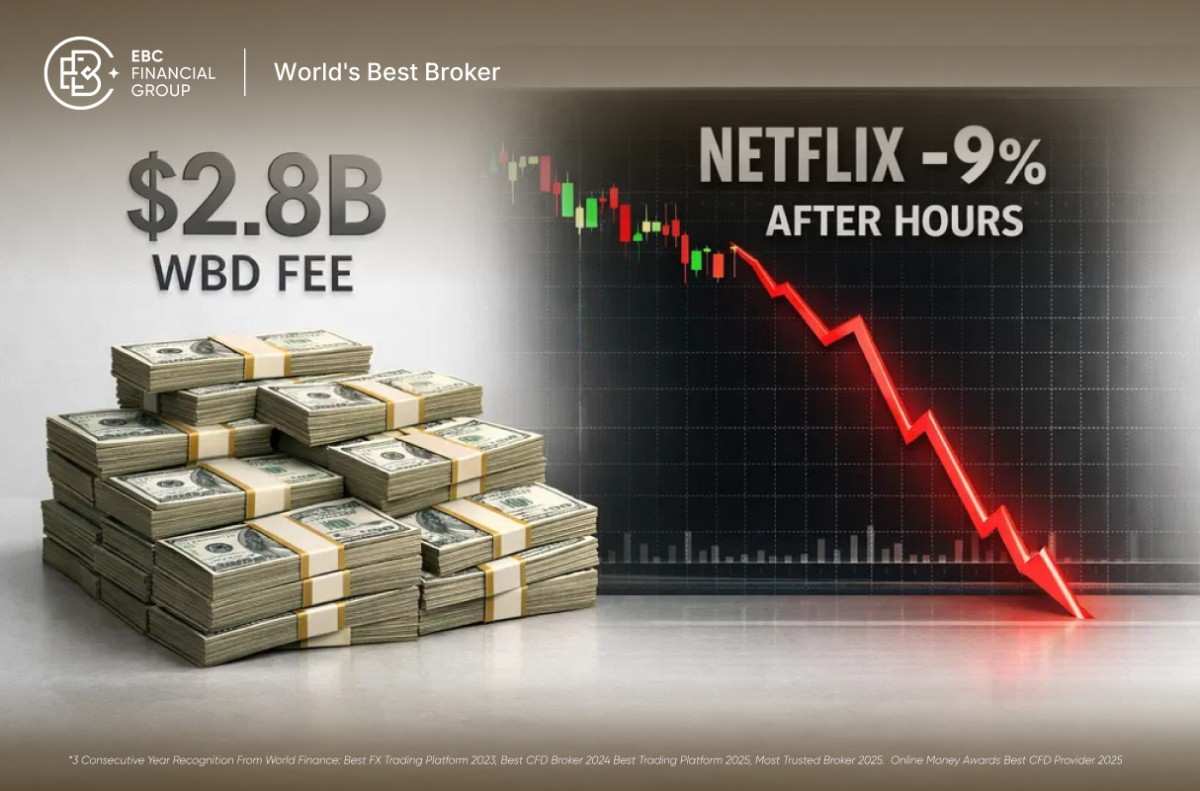
Shares closed at $74.35 before the release and later traded around $67.90 overnight, roughly 8.6% below the close at that point. The quote kept moving during the overnight session, with the decline approaching 9%.
Q2 revenue reached $12.56 billion, up 13.4% year on year, but came in slightly below the roughly $12.58 billion consensus. Diluted EPS of $0.80 beat the $0.79 estimate.
NFLX closed at $74.35 on 16 July and later traded around $67.90 overnight, down roughly 8.6% at that point, with the decline approaching 9% as the session moved. These prices are split-adjusted after the 10-for-1 split in November 2025.
Netflix forecast Q3 revenue of $12.86 billion and EPS of $0.82, below pre-release Wall Street estimates of roughly $13 billion and $0.84.
The projected 11.7% Q3 revenue increase would be Netflix’s slowest growth since Q3 2023.
Netflix narrowed its full-year revenue range around an unchanged $51.2 billion midpoint and held its 31.5% operating-margin forecast.
The quarter was profitable and broadly matched Netflix’s own forecast, even if it did not clear every Wall Street bar. Revenue of $12.56 billion grew 13.4% from a year earlier. Operating income rose to $4.19 billion, an operating margin of 33.4%.
That margin came in a touch ahead of Netflix’s internal plan on expense timing, though it was down from 34.1% a year earlier. Diluted earnings were $0.80 a share.
Free cash flow fell to $1.53 billion from $2.27 billion a year earlier. Netflix said the decline included higher cash tax payments, partly related to the Warner Bros. termination fee, and it held its full-year free-cash-flow forecast of about $12.5 billion.
| Metric | Q2 2026 | Accurate Signal |
|---|---|---|
| Revenue | $12.56bn, up 13.4% | In line with Netflix’s forecast, slightly below consensus |
| Operating margin | 33.4% | Strong, but below 34.1% a year earlier |
| Diluted EPS | $0.80 vs $0.79 | Small beat |
| Free cash flow | $1.53bn | Down from $2.27bn, partly due to higher cash taxes |
| Q3 revenue guide | $12.86bn, up 11.7% | Below roughly $13bn pre-release estimate |
| Q3 EPS guide | $0.82 | Below roughly $0.84 pre-release estimate |
| Q2 buyback | $4.7bn | Largest quarterly repurchase, with $27.1bn of capacity left |
On the top line, the company credited more members, higher prices and a growing advertising business, and it repeated its target of about $3 billion in 2026 advertising revenue, roughly double the prior year. The full-year operating-margin forecast stayed at 31.5%.
This is the first question most ask, and the answer sits in expectations. A share price already reflects what the market believes will happen next.
The Q2 print was not a clean beat to begin with. EPS came in a cent ahead at $0.80, while revenue of $12.56 billion landed just under the roughly $12.58 billion consensus. A mixed result like that gives buyers little to celebrate and sellers a reason to look harder at the outlook.
The outlook is where the damage happened. Netflix guided Q3 revenue to $12.86 billion, or 11.7% growth, against the roughly $13 billion and 13% pre-release Wall Street estimates. It also guided Q3 EPS to $0.82, below the $0.84 pre-release consensus.
Two soft guidance figures in one release, on a stock that had been priced for pace, were enough to send it lower. The 11.7% revenue forecast would mark Netflix’s slowest growth since Q3 2023.
There was a second issue beneath the numbers. Netflix said it would move its detailed What We Watched engagement report to once a year from 2027, published in the first quarter, down from twice a year. Weekly Top 10 data will continue.
The change arrived alongside first-half viewing of just over 97 billion hours, up 2%, against 1.5% growth in 2025.
Netflix argues that variety and quality of viewing count for as much as raw hours, which is a fair point. Some analysts read the reduced frequency as a loss of transparency, particularly while engagement growth stayed modest.
When a widely watched metric gets reported less often, that caution is easy to understand, and it added to the pressure on the stock.
Netflix entered the report already down about 21% for 2026, measured at the regular-session close before the extended-hours drop. Wall Street was not expecting growth to accelerate from Q2. Consensus already pointed to a slight slowdown, from 13.4% to around 13% in Q3. Netflix’s 11.7% forecast suggested a sharper deceleration than expected, which put more pressure on the stock.
It was not all negative. Netflix bought back $4.7 billion of its own shares during the quarter, its largest quarterly repurchase, with another $27.1 billion of capacity authorised.
The buyback shows Netflix continuing to return excess cash to shareholders while holding its full-year free-cash-flow forecast of roughly $12.5 billion. It also narrowed its full-year revenue range around an unchanged $51.2 billion midpoint.
None of this points to a broken business. Netflix delivered a mixed quarter and a softer outlook than the market wanted, and the overnight fall reads more like an expectations reset than a judgement on the company itself.
Management said acquisition and retention stayed healthy and that recent price rises were tracking in line with plan. The open question is whether that holds as growth cools and the advertising business scales towards something large enough to move a $50 billion revenue base.
EPS beat by a cent, but revenue came in slightly below consensus and both Q3 revenue and EPS guidance landed light. Investors sold the softer outlook, not the profit line.
Yes. Netflix ran a 10-for-1 split in November 2025, so the $74.35 close equals about $743.50 under the old structure. The split did not by itself change the company’s value or a shareholder’s proportional ownership.
Yes, at a double-digit rate. Revenue rose 13.4% in Q2. The concern is the pace easing to a guided 11.7% in Q3, its slowest since Q3 2023, not growth stopping.
The first question for now is whether the overnight decline carries into regular trading. Holding in the high-$60s would show the initial gap is stabilising, but it would not prove the selling is finished.
A continued break below the overnight range would show that regular-session investors are applying a larger discount to the slower outlook.
Beyond the first session, the figures that carry weight are Q3 revenue and EPS, advertising growth, and whether Netflix keeps reporting healthy acquisition and retention after its latest price increases. Management said those trends stayed healthy in Q2, so the real test is whether that performance persists as revenue growth cools.