Published on: 2026-07-17
Updated on: 2026-07-17
Technology giants and global financial markets watched in high anticipation as the world’s premier foundry reported its second-quarter earnings. The numbers from Taiwan Semiconductor Manufacturing Company (TSMC) were, by almost any traditional metric, spectacular. Fueled by an insatiable global appetite for artificial intelligence, the chipmaker blew past Wall Street’s expectations, posting a record quarterly net profit.
Yet, in a paradox that has become increasingly common in high-growth tech sectors, TSMC stock slid in immediate reaction. The market’s reaction underscores a growing friction between TSMC's short-term profitability and its eye-watering long-term capital spending commitments. As investors weigh record-breaking revenues against looming margin pressures and complex geopolitical realities, the semiconductor giant finds itself at a critical crossroads.
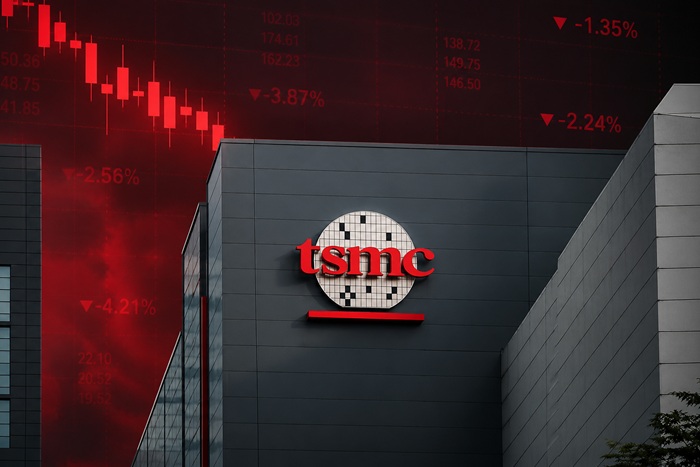
On paper, TSMC’s financial health is robust. The company reported a 77% year-on-year surge in net profit to a record T$706.6 billion ($21.99 billion). Diluted earnings per share (EPS) came in at $4.31. comfortably ahead of the consensus Wall Street estimate of $3.80. Revenue for the quarter rose to $40.2 billion, driven directly by intense AI chip demand from key hyperscale clients like Nvidia, AMD, Broadcom, and Apple.
Further boosting sentiment on the demand front, the company upgraded its full-year revenue growth guidance to "slightly above 40%," up from prior projections of 30%. Management noted that the transition to "agentic AI"—where AI models autonomously execute multi-step tasks—is accelerating, driving a significant wave of processor demand across data centers.
However, TSMC stock still registered a drop of roughly 4% in the hours following the announcement. The immediate slide reveals that Wall Street is no longer simply looking at backward-looking revenue spikes; instead, investors are deeply hyper-focused on the staggering price tag required to maintain this technological monopoly.
To understand why this premium semiconductor stock took a hit despite stellar operating metrics, analysts point to a combination of rising capital expenditures, margin compression from overseas fabs, and escalating regulatory friction.
The biggest source of market anxiety stems from TSMC’s massive capital spending plans. The company officially raised its capital expenditure budget to a range of $60 billion to $64 billion, up significantly from its prior estimate of $52 billion to $56 billion.
The High Cost of Dominance: Building advanced-node fabrication plants (fabs) is an incredibly capital-intensive endeavor. Upgrading to the next-generation 2-nanometer (N2) processes and preparing the groundwork for upcoming A16 Angstrom-class nodes requires massive upfront investments.
Free Cash Flow Concerns: While these investments secure TSMC's position as the uncontested gatekeeper of the AI revolution, such heavy spending raises valid questions about short-term free cash flow and dividend growth potential.
TSMC is aggressively diversifying its geographic footprint, constructing highly advanced factories in Arizona, Japan, and Germany. While this geographic dispersion is highly favored by Western governments seeking to de-risk the global hardware supply chain, it presents a major financial headwind.
Operating a chip factory outside of Taiwan is significantly more expensive due to higher construction costs, labor shortages, and utility price differentials. Management has previously warned that these international expansions could dilute the company's gross margin by several percentage points over the next five years as these operations ramp up. For the third quarter, TSMC guided gross margins down to a range of 65% to 67%, down from 67.7% in the previous quarter, while operating margins are projected to settle between 56% and 58%.
The geopolitical tightrope that TSMC walks grows thinner by the day. Recent moves by the U.S. Commerce Department to tighten licensing on chipmaking tools shipped to Chinese facilities—including revoking TSMC's Validated End-User status for its Nanjing plant—have added regulatory hurdles. Transitioning to a case-by-case licensing model for equipment shipments to China creates bureaucratic friction and timing uncertainties that trigger risk-off sentiment among traders.
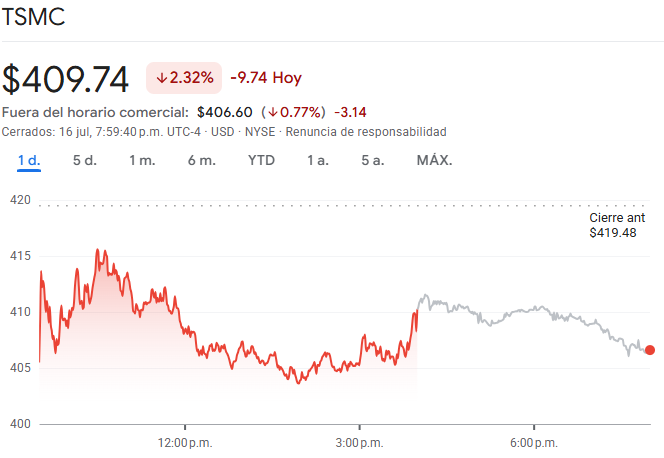
The drop in TSMC stock did not happen in a vacuum. Because the company acts as the foundation for the entire high-performance computing industry, its capital expenditure adjustments and cautious margin outlook triggered a broader market reaction across the semiconductor landscape.
Nvidia and AMD Slide: Shares of Nvidia fell over 2% following the news, while AMD fell nearly 6%, reflecting market concern over rising wafer costs and potential margin pressure on chip designers.
Equipment Manufacturers Under Pressure: While a higher capital budget is technically positive for tool makers like ASML, wider concerns that AI spending may be hitting a near-term plateau have kept the entire tech sector on defense.
Broad Market Volatility: Profit-taking remains elevated. After a massive multi-quarter rally where semiconductor stocks carried global indexes to record highs, even a minor change in forward-looking margin profiles is enough to spark a sell-off.
For long-term investors, the central question is whether the dip in TSMC stock represents a fundamental shift in the AI growth narrative or simply a healthy valuation reset.
The core business fundamentals remain incredibly strong. The Taiwan Semiconductor Manufacturing Company holds roughly 70% to 72% of the global foundry market, and an even higher share of the advanced nodes required for AI accelerators. Competitors like Samsung and Intel continue to struggle with yield rates on their equivalent sub-3nm processes, leaving tech giants with virtually no alternative but to wait in line for TSMC's manufacturing capacity.
Furthermore, TSMC’s valuation metrics remain comparatively reasonable. Even with the recent stock price volatility, the company trades at a forward price-to-earnings (P/E) ratio of around 24 to 31 times depending on regional listings—a figure that is significantly lower than some of its high-flying fabless customers. With a Price/Earnings to Growth (PEG) ratio hovering near 1, the underlying value proposition of the company's equity remains highly compelling to institutional value investors.
However, the market is signaling that it is no longer willing to write a blank check for AI infrastructure. The transition from pure hardware buildouts to proven, revenue-generating enterprise software is taking time. Until hyperscale cloud providers can prove that their massive AI capital outlays are yielding sustained software profits, the hardware supply chain will remain highly sensitive to any signs of rising costs.
The recent pullback in TSMC stock reflects a classic market tension: the clash between incredible current demand and the massive capital costs required to secure future growth. While the company's Q2 earnings confirm that the physical demand for advanced silicon shows no signs of slowing down, the reality of building a highly diversified, geopolitically secure global manufacturing footprint is beginning to bite into margins.
Ultimately, TSMC remains the irreplaceable tollbooth on the highway to the AI future. The current stock price decline appears to be a necessary consolidation phase, shaking out short-term speculative capital while the company digests its heavy capital investments. For those tracking the semiconductor sector, TSMC's massive $64 billion expansion plan is a high-stakes gamble—but in a world increasingly run on silicon, it is a bet the company is uniquely positioned to win.