Published on: 2026-01-21
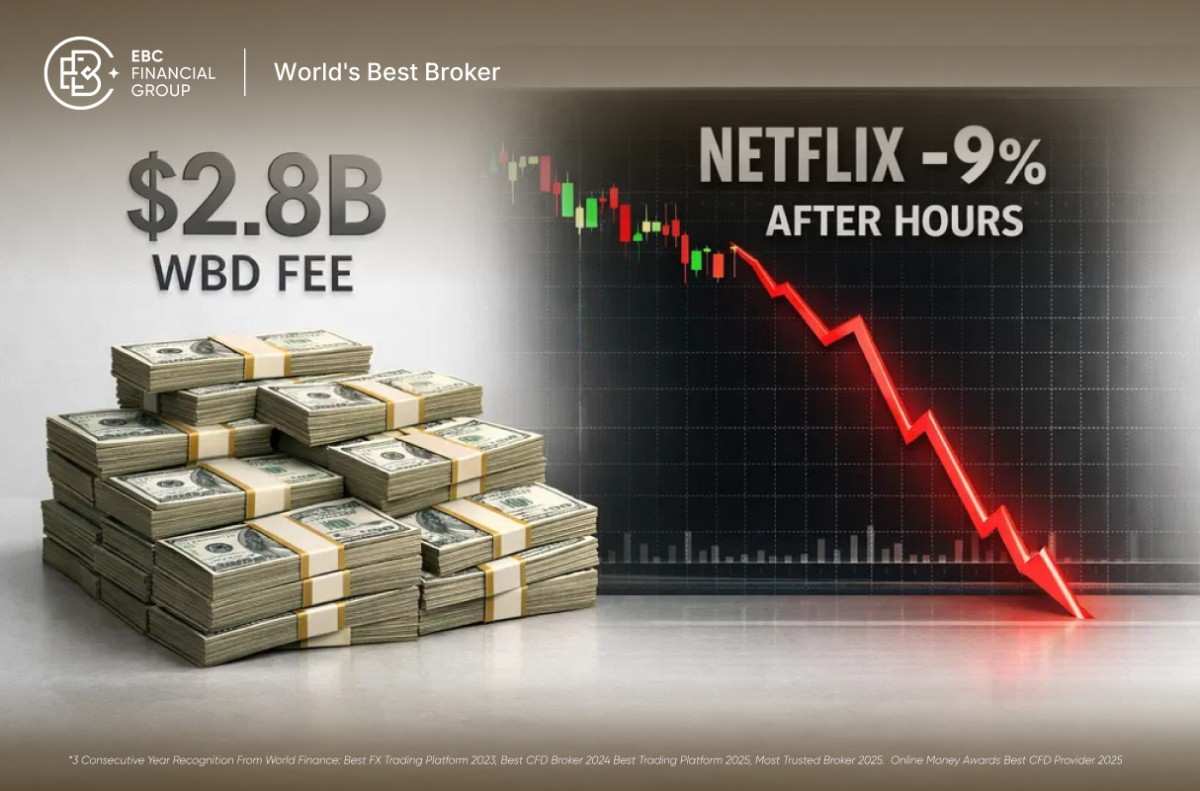
NFLX stock fell about 5% to around $83 in after-hours trading on January 20, even though Netflix topped fourth-quarter expectations, because the market treated guidance as the real earnings report. Q1 profit and revenue targets landed below consensus, and that single-quarter reset was enough to compress sentiment.
 The selloff also reflects increased uncertainty regarding capital allocation. Netflix amended its Warner Bros. Discovery agreement to an all-cash structure valued at $27.75 per WBD share, introducing new considerations about share buybacks and balance-sheet management into the valuation discussion.
Q4 beat, small but clean: $12.05 billion revenue and $0.56 EPS on a split-adjusted basis.
Guidance drove the drop: Q1 revenue was guided to about $12.16 billion and EPS to $0.76, below consensus.
Scale is still growing: Paid subscribers ended Q4 above 325 million.
Ads are becoming meaningful: Advertising revenue reached about $1.5 billion in 2025, with management targeting another doubling in 2026.
The split changed optics, not value: Split-adjusted trading began on November 17, 2025, after a 10-for-1 stock split.
| Metric | Q4 2025 | Q1 2026 guide | Market reaction driver |
|---|---|---|---|
| Revenue | $12.05B | $12.16B | Q1 came in slightly light |
| EPS | $0.56 | $0.76 | Profit outlook missed consensus |
| Paid subscribers | 325M+ | N/A | Growth is slowing, but still positive |
| After-hours move | About -5% to ~$83 | N/A | Expectations and risk premium |
*Figures reflect split-adjusted per-share numbers.
 Guidance reset the short-term earnings path.
Netflix’s Q1 outlook was the immediate catalyst: revenue of roughly $12.16 billion and EPS of $0.76, both above consensus estimates. For a stock priced on predictability, even a modest miss can trigger a sharper move because it forces the market to reprice the next few quarters, not just the one ahead.
Netflix finished Q4 with more than 325 million paid subscribers, but 2025 net additions slowed versus 2024, reviving concerns about penetration limits in mature markets. That shifts the story from “more users” to “more dollars per user,” which raises the importance of pricing cadence and ad yield.
Netflix is leaning further into premium content and live programming, including sports. These formats can drive spikes in engagement, but they also bring more fixed commitments and less flexible cost timing. Investors reacted to the combination of higher content intensity and lighter near-term profit guidance.
Netflix and Warner Bros. Discovery amended their agreement to an all-cash transaction at $27.75 per share, with a shareholder vote anticipated by April 2026. The transaction remains subject to regulatory approvals and other conditions, requiring the stock to reflect a probability-weighted risk premium until greater clarity is achieved.
The clearest positive signal inside the earnings narrative is advertising. Netflix’s ad revenue reached about $1.5 billion in 2025, and management expects it to double again in 2026. The ad-supported plan is priced at $7.99 per month and has surpassed 94 million users by May 2025, giving Netflix a larger funnel without forcing an aggressive price cut on the core product.
The strategic payoff is margin resilience. If ad yield per hour watched rises while subscriber growth slows, Netflix can still expand revenue faster than the user base. The near-term challenge is execution quality: ad load, targeting, measurement, and brand-safety tooling all need to improve without degrading viewing time or customer satisfaction.
The WBD transaction is positioned as a content and studio expansion, but the amended all-cash structure makes capital allocation more concrete. Netflix says the deal will be financed through cash on hand, available credit facilities, and committed financing, and it remains subject to customary closing conditions and regulatory approvals.
For NFLX stock, the tradeoff is simple: strategic upside from a larger content portfolio, against near-term uncertainty around leverage, integration costs, and regulatory timing. Until those inputs are known, the equity can behave like a hybrid of a growth stock and a deal-risk proxy.
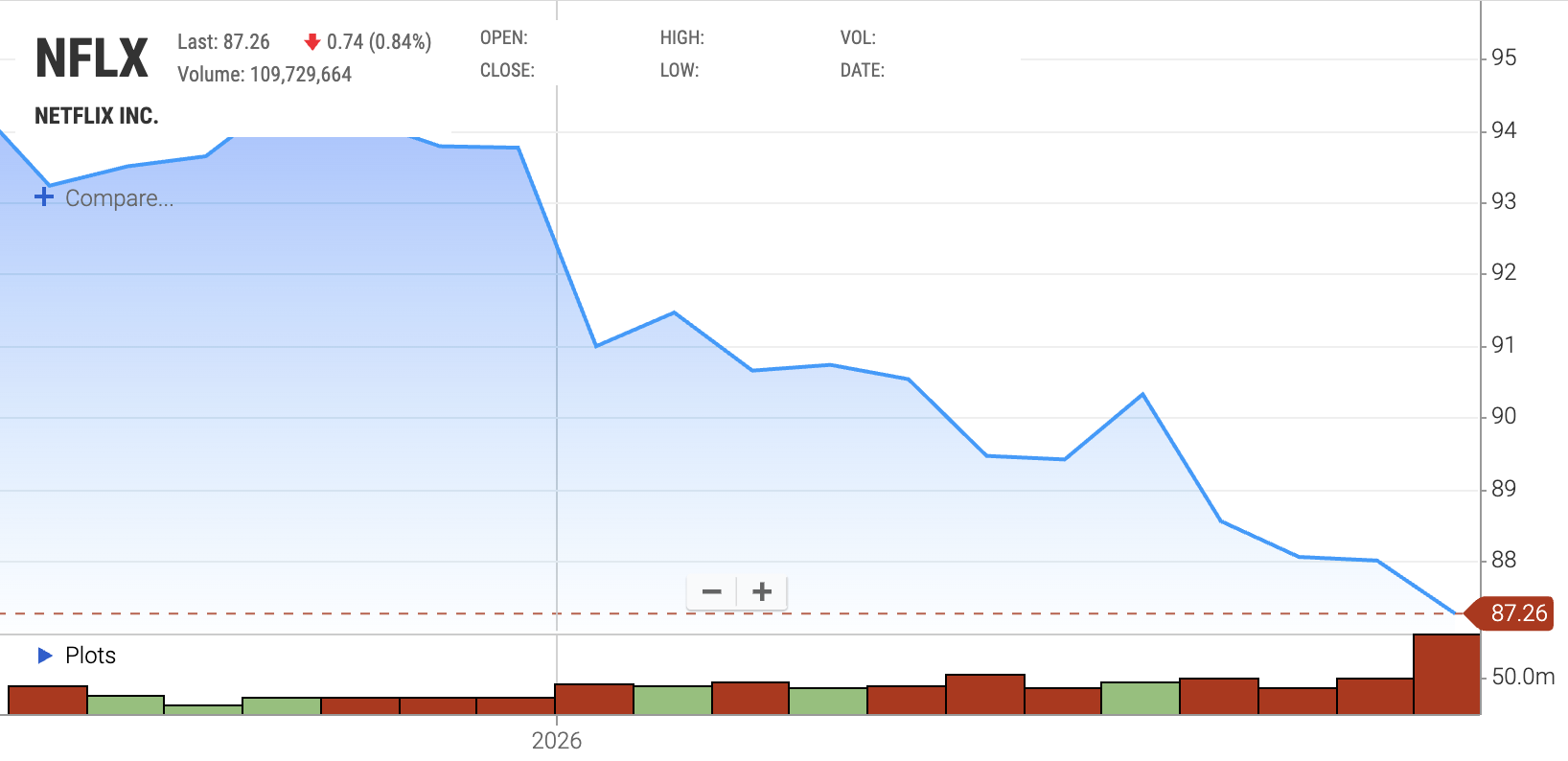
Post-split, NFLX can look “cheap” below $100, but the valuation remains high when scaled to the expanded share count. According to the latest Netflix earnings call transcript, the company posted revenue of more than $12 billion and profit of $2.4 billion for the fourth quarter of 2025, both exceeding analysts' expectations. At a share price of around $87 and approximately 4.34 billion diluted shares, Netflix’s market value is about $379 billion.
This reflects a strong financial position, though at these valuations the potential for upside surprises may be limited.
Support: $80 to $83, near the post-earnings dip and recent lows.
Resistance: around $90, near the recent intraday high.
The next quarter is less about whether Netflix can “beat” and more about whether it can rebuild conviction in the forward trajectory. The market’s checklist is getting tighter:
Advertising Momentum: Signs that ad revenue growth is tracking the 2026 doubling ambition, plus evidence that engagement is stable as ad load and formats evolve.
Pricing and Churn: Whether price increases are sticking without driving elevated cancellations, especially in mature markets where penetration is high.
Cash Deployment: Any clarity on when buybacks could resume, and how much incremental cash must be reserved for the WBD transaction timeline?
Regulatory Cadence: Updates that narrow the probability distribution on the deal’s timing and conditions.
That depends on what you’re buying for: a multi-year compounding story or a near-term “beat-and-raise” setup.
Monetization runway is shifting to ads and ARPU, not just net adds. If ad revenue continues to scale while engagement remains durable, Netflix can grow revenue faster than it adds subscribers.
Pricing power still matters. In mature markets, steady price increases (without churn spikes) can keep margins resilient even if subscriber growth moderates.
Scale advantage is intact. A massive paid base gives Netflix leverage in content amortization, distribution, and global reach.
Guidance is now the main event. When a premium-multiple stock resets the next quarter, the market often demands a couple of clean prints to rebuild trust.
Deal uncertainty can cap the multiple. With an all-cash structure, the conversation shifts to buybacks vs. leverage vs. integration costs, and the stock can carry a “risk premium” until timing and conditions are clearer.
The increasing intensity of content production, including live formats, may elevate fixed commitments and reduce near-term margin flexibility.
NFLX can be a “buy” for long-term investors if you’re comfortable with underwriting: (1) ads scaling without hurting engagement, (2) pricing power holding, and (3) the deal path not straining the balance sheet.
If you need near-term predictability, it may be more of a watchlist/scale-in setup until guidance steadies and deal milestones de-risk.
Because the outlook was missed. Netflix guided Q1 EPS to $0.76 and revenue to about $12.16 billion, both below consensus. For a premium multiple stock, that is enough to reset the market’s near-term earnings curve and widen the risk premium, even if the prior quarter beat.
Netflix reported Q4 revenue of $12.05 billion and net income of about $2.42 billion. Earnings were $0.56 per share on a split-adjusted basis, and paid subscribers ended the quarter above 325 million globally.
No. The 10-for-1 split increased the number of shares and reduced the per-share price, but it did not change the company’s underlying value. Split-adjusted trading began on November 17, 2025, and shareholders received nine additional shares for each share held on the record date.
Advertising reached about $1.5 billion in 2025, and management expects it to double in 2026. The ad-supported plan, priced at $7.99 per month, surpassed 94 million users by May 2025. If ad yield per viewer rises, it can offset slower subscriber growth and support margins.
Netflix and WBD amended their agreement to an all-cash transaction valued at $27.75 per WBD share, with a shareholder vote expected by April 2026. For Netflix investors, the deal could deepen the content moat, but it also raises financing, integration, and regulatory uncertainty that can weigh on the stock.
Netflix’s Q4 beat showed the business is still compounding, but the after-hours drop in NFLX stock highlighted how sensitive the market has become to forward guidance and deal risk. The next phase is less about adding subscribers at speed and more about monetizing a vast user base through pricing, advertising, and disciplined content spending.
If Netflix demonstrates sustainable advertising growth and manages the Warner Bros. Discovery transaction without straining its balance sheet, the premium valuation may be maintained. Conversely, persistent uncertainty in guidance or increased transaction risk is likely to sustain elevated volatility.
Disclaimer: This material is for general information purposes only and is not intended as (and should not be considered to be) financial, investment, or other advice on which reliance should be placed. No opinion given in the material constitutes a recommendation by EBC or the author that any particular investment, security, transaction, or investment strategy is suitable for any specific person.