Published on: 2026-02-24
Updated on: 2026-02-24
Home Depot (HD) will announce its fourth-quarter and full-year fiscal 2025 results on February 24, 2026, with a conference call at 9:00 a.m. (ET).
The current environment looks two-way because the housing cycle is still volatile. The 30-year fixed mortgage rate averaged 6.01% as of February 19, 2026, down from 6.85% a year earlier, but still restrictive for housing turnover. Existing-home sales fell 8.4% in January 2026 (month over month), keeping the housing market subdued and pressuring large, discretionary remodeling activity.
Existing-home sales declined by 8.4% in January 2026, perpetuating the subdued housing market that has negatively impacted large-scale remodeling activity.
Earnings call webcast is scheduled for February 24, 2026 at 9:00 a.m. ET.
Comparable sales (comps) and fiscal 2026 guidance are likely to drive the initial reaction.
Housing turnover remains a key constraint, with mortgage rates and existing-home sales still soft.
Listen for Pro versus DIY mix trends, and margin and shrink commentary.
Options-based estimates suggested a move of up to about 4% in either direction going into the release (estimates change quickly).
According to Home Depot’s investor relations announcement, the Q4 fiscal 2025 earnings release is scheduled for February 24, 2026, and the earnings call webcast begins at 9:00 a.m. ET.
Consensus expectations for this release suggest modest declines in earnings per share (EPS) and sales versus the same quarter in the prior year. The market focus is typically on comparable sales (comps) and forward guidance. Estimates are rounded and can vary by data provider.
| Metric | Common estimate | Plausible range |
|---|---|---|
| EPS (quarter) | ~$2.53 | ~$2.45 to ~$2.65 |
| Revenue (quarter) | ~$38.1B | ~$37.5B to ~$38.8B |
| Comparable sales (YoY) | ~-0.4% | ~-1.5% to ~+0.5% |
It is important to note that the fourth quarter of fiscal 2024 included a 14th week. Home Depot has also stated that the additional week is not included in comparable sales results. This calendar effect can complicate year-over-year comparisons, which is why comps and forward guidance are usually more useful indicators of underlying demand.
Home Depot’s demand is influenced by consumer confidence, housing turnover, home equity extraction, and homeowners’ willingness to undertake larger projects.

Two key data points illustrate the current near-term pressures:
Mortgage rates: the 30-year fixed rate averaged 6.01% as of February 19, 2026, down from 6.85% a year earlier, but still high enough to keep many homeowners locked into older, cheaper mortgages.
Existing-home sales: January 2026 sales fell 8.4%, a sign that transaction activity remains soft heading into the spring selling season.
A sluggish transaction market often redirects customer focus toward smaller, essential projects instead of discretionary remodeling. That mix is usually less supportive for average ticket growth and can lead to uneven demand across categories.
Comparable sales (also called comps) provide the most direct measure of organic demand across the existing store base. Results above the roughly -0.4% year-over-year (YoY) expectation would suggest demand is stabilizing as 2026 approaches, despite continued weakness in housing turnover.
Look at what is driving comps, including customer traffic versus average ticket size, and whether seasonal categories and repair spending are contributing most.
Home Depot continues to emphasize its professional contractor segment “Pro”, and investors will seek evidence that this customer base is performing more robustly than the do-it-yourself (DIY) segment. A strong Pro segment can help stabilize overall sales during periods of weaker DIY demand, though increased competition in this area may exert pressure on profit margins.
Home Depot’s outlook framework gives investors a margin roadmap beyond one quarter. Management has laid out operating margin guideposts and an adjusted margin view that excludes intangible amortization, which helps investors track underlying profitability through the cycle. Inventory shrink (loss from theft, damage, or administrative errors) is another key input to margins.
If the quarter features increased markdowns, an unfavorable product mix, or higher inventory shrinkage, investors may discount a headline EPS outperformance and focus instead on margin risk, which can weigh on the stock even if EPS beats consensus.
Mergers and acquisitions (M&A) are now a key part of Home Depot’s growth narrative. In the third quarter of fiscal 2025, the company reported that the GMS Inc. (GMS) acquisition contributed approximately $900 million in sales over an eight-week period, and management incorporated about $2.0 billion of incremental GMS sales into its fiscal-year outlook.
Guidance tone is often the primary driver of the post-earnings reaction. Home Depot has published a preliminary base-case outlook for fiscal 2026, describing the demand environment as subdued.
Home improvement market around -1% to +1%
Comparable sales are roughly flat to +2%
Operating margin around 12.4% to 12.6%
EPS growth is roughly flat to +4%
Management also sketched an “accelerated recovery case” that assumes a sharper housing rebound, with sales growth around 5% to 6% , comps 4% to 5% , and EPS growth in the mid- to high-single digits.
Consequently, the market is expected to value the stock based on management’s assessment of which scenario most accurately reflects current and future conditions.
Home Depot shares recently traded at approximately $377, with a market capitalization near $378 billion. Options markets indicate an expected move of about 4% around the earnings release, underscoring the importance of clear and precise management guidance.
Three primary scenarios typically influence Home Depot’s stock reaction to earnings:
A 'stabilization' outcome (less negative comps, stable margins, reaffirmed guidance) often supports the stock, because it keeps the recovery narrative intact.
A 'beat but cautious' outcome (headline EPS ahead of estimates, but guarded commentary on spring demand) can still weigh on the stock if guidance does not improve.
A 'demand slip' outcome (weaker comps or average ticket size, plus margin pressure or cautious commentary) often triggers a sharper pullback, because Home Depot is widely treated as a bellwether for repair and remodel demand.
Home Depot (HD) has shown a stronger trading pattern since early January; however, volatility has increased ahead of the earnings release. The stock closed at $376.99 on February 23, 2026, after failing to sustain a mid-February advance toward the high $390s. While the broader trend remains constructive relative to year-end levels, recent weeks indicate a clear loss of momentum.
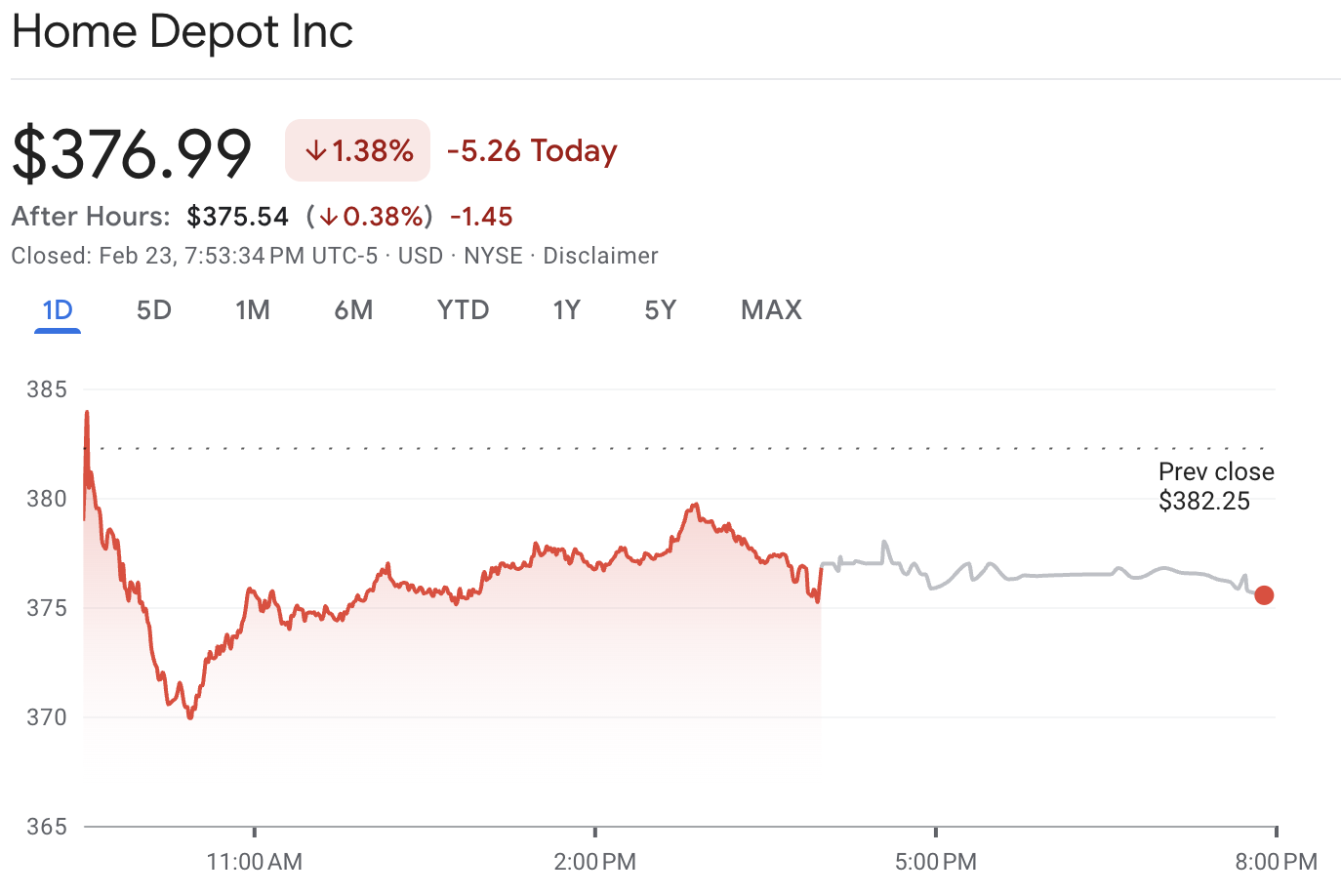
| Period | Return | What it tells you |
|---|---|---|
| 1 week (7D total return) | -1.58% | Short-term softening into earnings after a strong January rebound. |
| 1 month (30D total return) | -2.47% | A mild pullback suggests investors are cautious on guidance risk. |
| 3 months | +11.60% | The longer swing remains positive, reflecting a recovery trend since late 2025. |
| YTD | +9.56% | Despite recent volatility, the market has rewarded HD’s steady operating narrative so far. |
Context: Home Depot’s 52-week trading range is $326.31 to $426.75, indicating that the stock remains significantly below its 52-week high despite the early-year rebound.
HD’s trend has been broadly upward since early January, but the late-February drop has brought the price back toward nearer-term support. After earnings, the key question is whether the stock can hold above its short-term moving average zone or whether sellers push it back into January’s base range. Technical indicators can differ slightly by platform and settings, so treat them as context, not signals on their own.
| Indicator | Latest value | Practical read |
|---|---|---|
| Last price | $382.25 | Back above the low-$380s area, keeping the post-pullback tone steadier. |
| RSI (14) | 52.99 | Neutral momentum. Buyers are present, but it is not overbought. |
| MACD (12,26) | 3.92 | Positive trend signal, consistent with a market still leaning higher. |
| ADX (14) | 16.39 | Trend strength is modest, so earnings can still swing direction quickly. |
| ATR (14) | 8.46 | Typical daily range is about $8–$9, with earnings likely to exceed that. |
| EMA 20 | 381.48 | Price is slightly above short-term trend support. |
| EMA 50 | 374.44 | Medium-term support sits in the mid-$370s. |
| EMA 200 | 370.44 | Long-term trend floor remains in the low-$370s area. |
Using the February session high/low/close (High: $384.14, Low: $369.58, Close: $376.99), the immediate pivot map looks like this:
| Type | S1 | Pivot | R1 |
|---|---|---|---|
| Classic | $369.84 | $376.90 | $384.22 |
| Fibonacci | $371.35 | $376.90 | $382.46 |
If Home Depot remains above the $369–$371 support band following the initial earnings reaction, it typically indicates that buyers are maintaining the uptrend. A decline below this zone increases the risk of a move toward the mid-$360s, where demand was previously observed in January.
Home Depot reports Q4 and full-year fiscal 2025 results on February 24, 2026, with the earnings call and webcast scheduled for 9:00 a.m. ET.
Comparable sales usually carry the most weight because they strip out store growth and provide the cleanest read on demand. Investors also focus on gross margin and operating margin trends, especially when pricing pressure or mix shifts are in play.
Consensus expectations cluster around $2.53 EPS and roughly $38.1 billion in revenue, with comparable sales around -0.4% year over year.
Housing turnover and borrowing costs influence big projects. Mortgage rates around 6% and soft existing-home sales can slow remodel timing, push customers toward smaller repairs, and keep demand choppy across discretionary categories.
Management’s range for the home improvement market, comparable sales, and margin targets is the key signal. Home Depot has framed a base-case 2026 scenario in which the market is roughly -1% to +1% and comps are flat to +2%, with a faster upside case tied to housing activity.
Home Depot (HD) earnings represent a pivotal event, not due to the impact of a single quarter on the company’s long-term prospects, but because investors are seeking evidence that home improvement demand can stabilize prior to a full recovery in the housing market. Macroeconomic indicators remain mixed, as mortgage rates have eased but existing-home sales remain weak.
Disclaimer: This material is for general information purposes only and is not intended as (and should not be considered to be) financial, investment or other advice on which reliance should be placed. No opinion given in the material constitutes a recommendation by EBC or the author that any particular investment, security, transaction or investment strategy is suitable for any specific person.