Published on: 2026-05-26
The DAX Index sits close to record highs, but its strength should not be read as a direct verdict on Germany’s economy. It is better understood as a measure of large-cap corporate Germany, shaped by exports, interest rates, energy prices, global demand, and sector rotation.
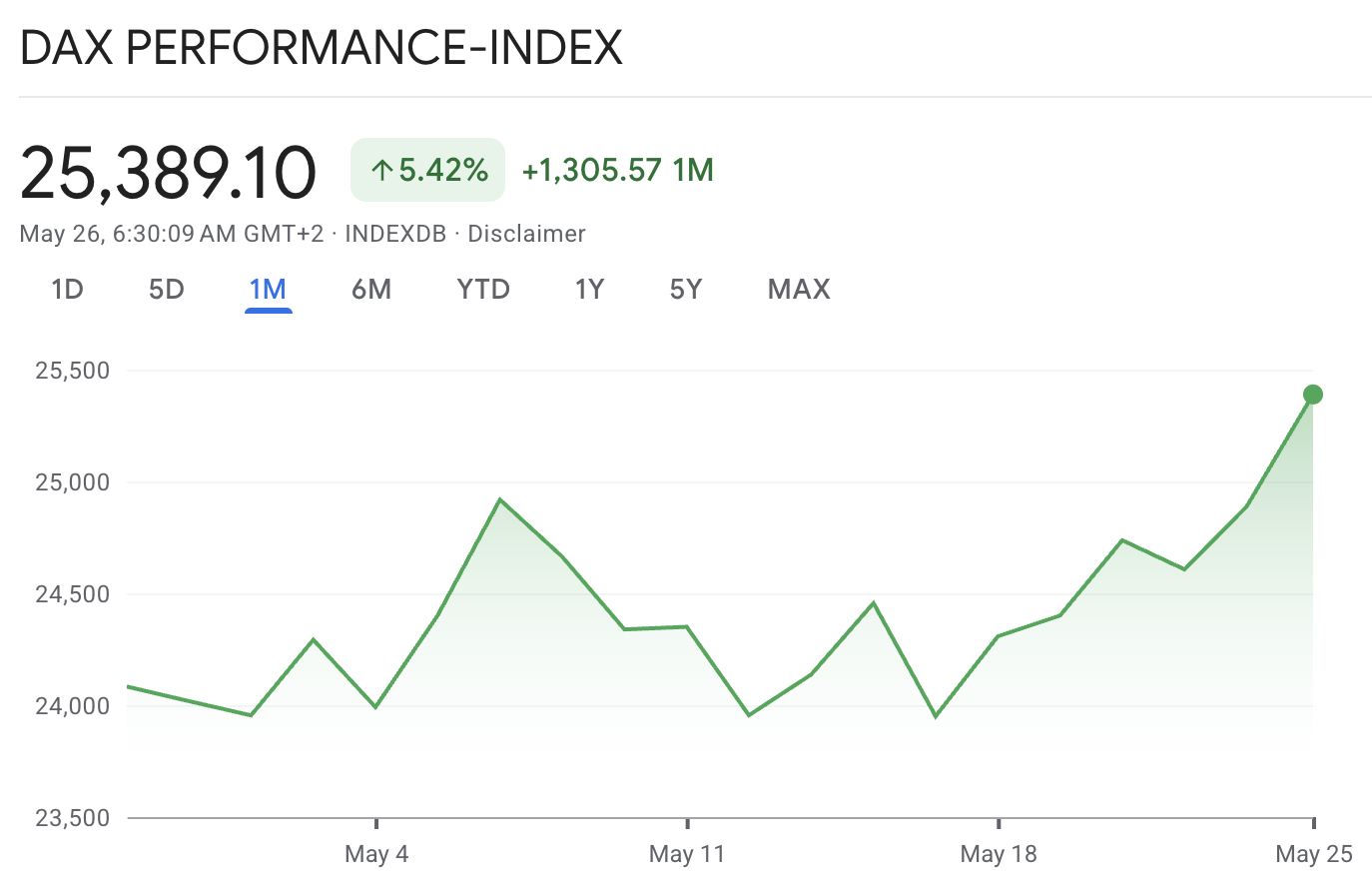
As of the latest available market data, the DAX traded around 25,389, up 2.01% in the previous session, with a 52-week range of 21,863.81 to 25,507.79. That places the index near its January peak, even as Germany’s recovery remains modest and oil prices continue to pressure energy-sensitive industries.
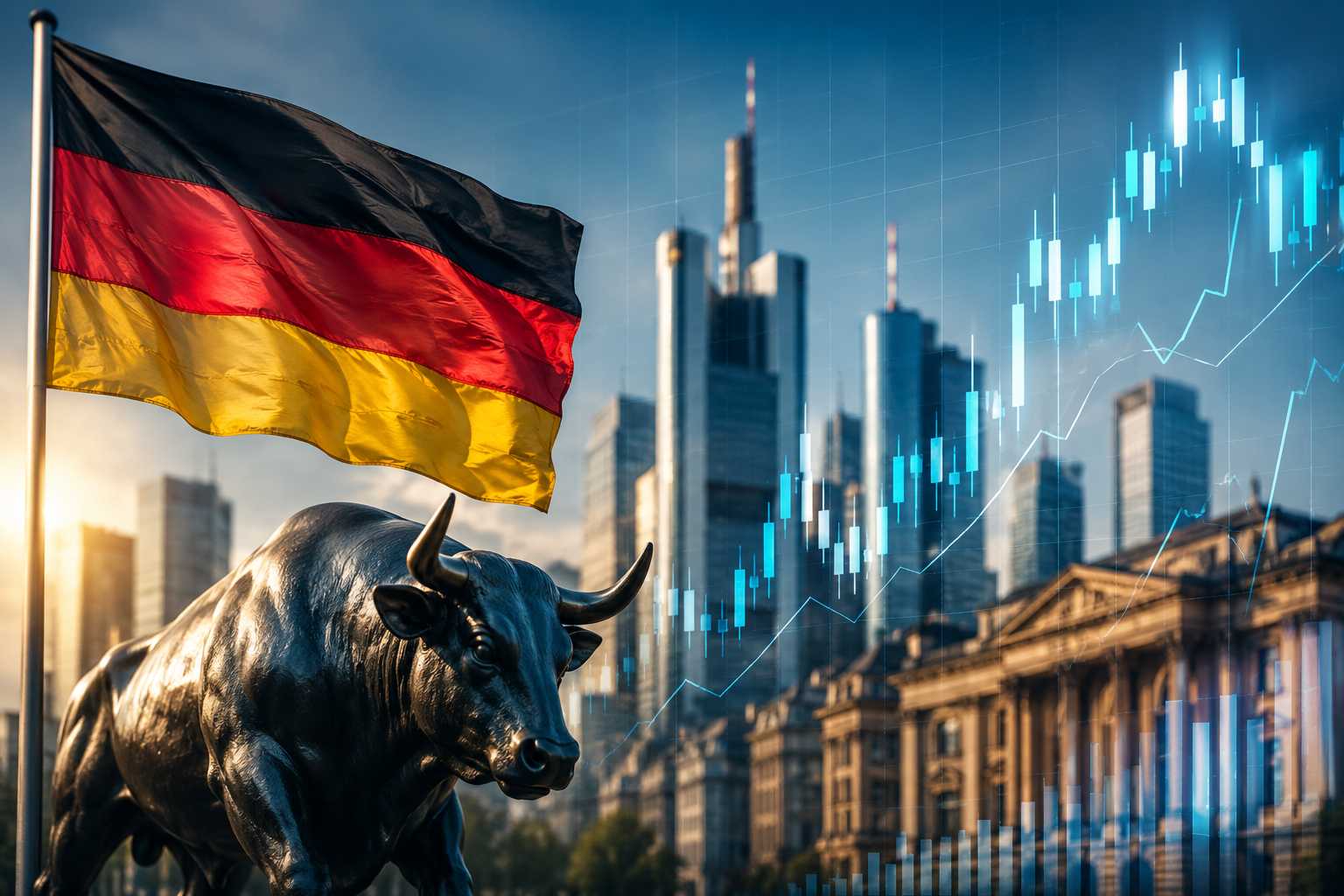
The DAX tracks 40 major German companies listed on the Frankfurt Stock Exchange, selected mainly by free-float market capitalisation and quality standards.
Germany’s GDP rose 0.3% quarter-on-quarter in Q1 2026, helped by stronger household spending, government consumption, and exports.
German HICP inflation rose to 2.9% in April 2026, while core inflation eased to 2.3%, leaving energy as the main swing factor.
The ECB deposit rate is 2.00%, down from its 2023 peak of 4.00%, which eases valuation pressure on equities.
Oil risk remains relevant because Germany’s market is heavily exposed to industrials, autos, chemicals, logistics, and export demand.
Technical signals remain positive, but the DAX is close to the 25,507–25,585 resistance area, where fresh momentum needs broader sector support.
The DAX is Germany’s main stock market index. It tracks the performance of the country’s largest listed companies and is widely used as the benchmark for German equities.
It is also one of Europe’s most closely followed indices because Germany is the eurozone’s largest economy. A move in the DAX often reflects more than local sentiment. It can show how markets are pricing global manufacturing, energy costs, trade flows, interest rates, and the euro.
The index is not a pure domestic demand gauge. Many DAX companies earn a large share of revenue abroad. Siemens, SAP, Airbus, Allianz, Deutsche Telekom, Mercedes-Benz, BMW, BASF, and Deutsche Bank all respond to international forces as much as German household spending.
That gives the DAX a wider role. It is a German benchmark, but also a European cyclical barometer.
The DAX is commonly quoted as a performance index, which means dividends are included in its calculation. This gives the benchmark a different structure from price-only indices, where returns reflect share-price movement alone.
The distinction affects long-term comparisons. A performance index will usually compound faster than a price index because dividend payments are treated as reinvested returns. As a result, comparing the headline DAX with price-only versions of the S&P 500, FTSE 100, or CAC 40 can overstate the relative strength of German equities.
When the DAX reaches a record high, the move reflects two sources of return: capital appreciation and dividend reinvestment. That makes the index a broader measure of shareholder return, not just a snapshot of where German share prices are trading.
Germany’s economy is improving, but not strongly. Official data show GDP rose 0.3% in Q1 2026 after a revised 0.2% gain in Q4 2025. That is growth, but not a broad industrial boom.
The DAX can still rise in this environment because equity markets price future earnings, not only current GDP. Lower rates, stabilising exports, stronger global technology spending, and improved demand for industrial equipment can lift large-cap shares before the domestic economy feels stronger.
ECB policy is a major part of the story. The deposit rate has fallen from 4.00% in September 2023 to 2.00%. Lower rates reduce the discount applied to future earnings and can support equity valuations, especially when recession fears ease.
Oil and shipping risk can weigh heavily on German equities because Germany remains an industrial and export-led economy. When crude prices rise or shipping routes face disruption, markets quickly reassess production costs, transport expenses, inflation pressure, and profit margins across the DAX.
That channel remains relevant. Brent crude traded near $98.40 per barrel on 26 May 2026 after renewed tension around Iran, while other reports placed Brent below $95 earlier in the session. The exact level moved quickly, but the broader point is clear: energy markets are still adding uncertainty to European equities.
Higher oil prices do not hurt every DAX company equally. Insurers and software firms are less directly exposed. Autos, chemicals, airlines, logistics companies, and heavy manufacturers face greater pressure through fuel, power, materials, and transport costs.
The effect becomes more serious when oil also lifts inflation expectations. Germany’s HICP inflation rose to 2.9% in April, while energy inflation accelerated to 8.9%. That keeps the energy-inflation link alive for the DAX.
| Indicator | Latest reading | Interpretation |
|---|---|---|
| DAX level | 25,389.10 | Near the top of its 52-week range |
| 52-week range | 21,863.81–25,507.79 | Market remains close to record territory |
| Germany Q1 GDP | +0.3% QoQ | Recovery is positive but measured |
| Germany HICP inflation | 2.9% YoY | Energy is still lifting headline inflation |
| Germany core HICP | 2.3% YoY | Underlying inflation has eased |
| ECB deposit rate | 2.00% | Lower rate pressure supports valuations |
| Brent crude | Around $95–$98 | Energy risk remains a live input |
The DAX is moved by five broad forces.
First is global growth. Germany sells machinery, cars, chemicals, software, insurance, and industrial equipment into the world economy. Stronger global capital spending often helps DAX earnings.
Second is the euro. A weaker euro can support exporters by making German goods more competitive abroad, although it can also raise import costs.
Third is interest rates. Lower eurozone rates can support equity valuations and reduce financing pressure.
Fourth is energy. Germany’s industrial base is sensitive to fuel, electricity, gas, and shipping costs.
Fifth is sector leadership. A rally led by only a few large names is less durable than one supported by industrials, financials, technology, autos, and insurers together.
| Indicator | Current signal | Reading |
|---|---|---|
| RSI | Firm but elevated | Momentum remains positive, but upside is less clean near highs |
| MACD | Positive | Buyers still hold the short-term advantage |
| EMA 20 | Price above | Short-term trend remains constructive |
| EMA 50 | Price above | Pullbacks have stayed orderly |
| EMA 200 | Price above | Long-term trend remains intact |
| Support | 24,800, then 24,400 | Key areas where buyers may re-enter |
| Resistance | 25,507–25,585 | Record-high zone and first major test |
| Trend | Bullish | Structure still favours buyers |
| Momentum | Positive but mature | A breakout needs broader participation |
Technical conditions still favour buyers, with moving averages giving a stronger signal than oscillators. That fits the current market structure: the trend is firm, but momentum is no longer fresh.
A sustained move above the January high near 25,507.79 would confirm a new breakout attempt. Failure to hold 24,400would suggest the market is entering a deeper consolidation rather than a brief pause.
No. The DAX reflects large listed companies, many of which earn significant revenue outside Germany. It often reacts to global demand, interest rates, energy costs, and export expectations before domestic economic data improves.
Germany has a large industrial base. Higher oil can raise transport, production, and input costs. It can also lift inflation and delay rate relief. The effect is strongest in autos, chemicals, logistics, and heavy industry.
The DAX itself is an index, not a security. Market participants usually gain exposure through index futures, contracts for difference, exchange-traded funds, structured products, or individual DAX components.
Equity markets look ahead. Lower ECB rates, improving exports, and stronger global demand for selected large-cap sectors can lift the index before the domestic economy feels strong.
The main resistance area is 25,507-25,585. Key support sits near 24,800 and 24,400. A break above resistance would strengthen the bullish case. A break below support would weaken short-term structure.
The DAX Index remains a useful guide to Germany’s listed corporate sector, but it should not be read in isolation. Its latest strength reflects lower ECB rates, a modest recovery in German growth, strong large-cap leadership, and global demand for industrial and technology exposure.
The main risk is still energy. Germany’s equity market remains sensitive to oil prices, shipping uncertainty, and any renewed pressure on inflation. If oil stays elevated while inflation remains above target, the DAX may struggle to extend gains without stronger earnings support.
For now, the trend remains constructive. The next test is whether the index can move beyond the record-high zone with broader sector participation, rather than relying on a narrow group of large-cap leaders.