Published on: 2026-01-22
Updated on: 2026-01-22
Gold is still trading close to record territory, even after a sharp two-day swing that reminded traders how fast sentiment can change. Earlier, spot gold hit a fresh record near $4,888 per ounce, and then slipped as markets calmed and the US dollar firmed.
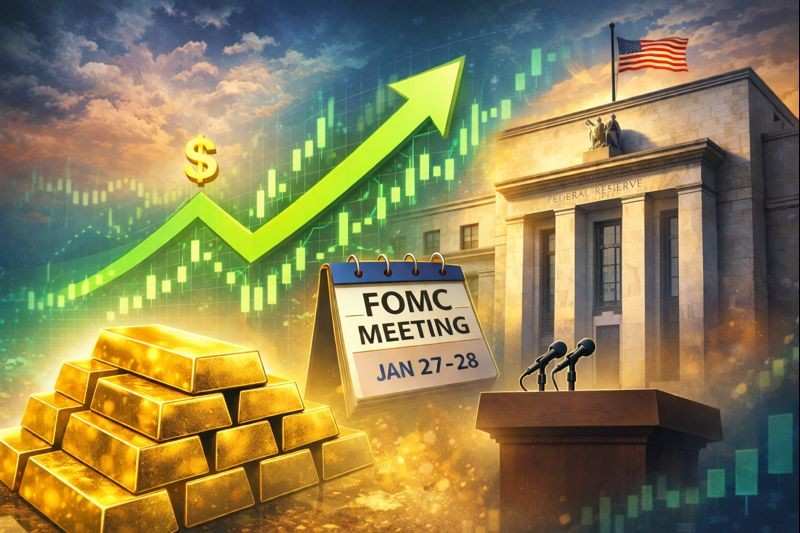
The attention now shifts to the upcoming Federal Reserve meeting scheduled for January 27–28, 2026. The policy decision is due 2:00 p.m. ET on Wednesday, January 28, followed by the Chair's press conference at 2:30 p.m. ET.
The rate decision itself may not be the biggest surprise, but the message around future cuts, inflation progress, and financial conditions can move the US dollar and bond yields quickly. Those two inputs often set the short-term direction for XAU/USD.
Gold's direction next week is likely to depend on whether the Fed sounds more relaxed or more cautious about inflation and future rate cuts.
The market currently expects the Fed to hold rates, so the bigger risk is a surprise in the tone of the statement or the Chair's press conference.
Here are the key drivers to watch:
The Fed's guidance on rate cuts in 2026
Real yields and the US dollar
Positioning and profit-taking
Risk mood in global markets
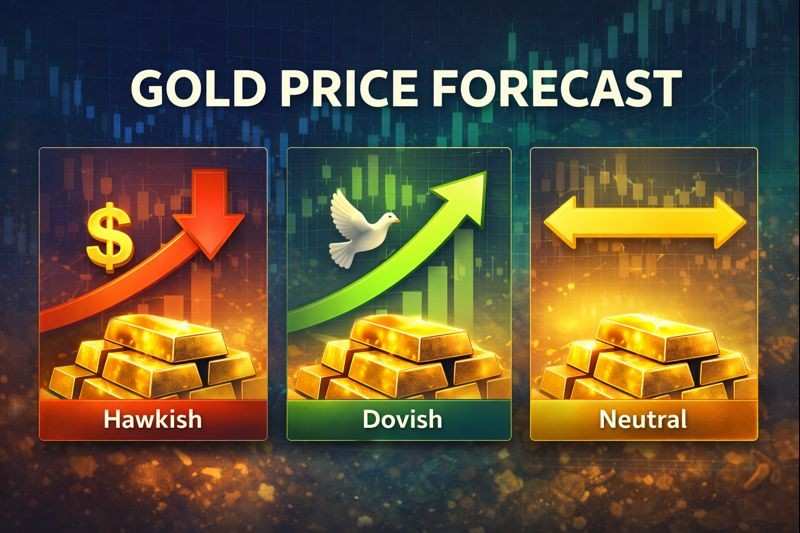
This can happen if the Fed holds rates and sounds more open to cuts later in 2026.
What you might see:
The US dollar softens and yields ease.
Gold pushes back toward 4,830 to 4,858, and then tests the record zone near 4,887 if momentum builds.
This can happen if the Fed holds and avoids strong hints about the timing of cuts.
What you might see:
Price trades between support near 4,803 and resistance near 4,831.
Short swings continue, but the trend stays intact.
This situation may arise if the Fed strongly opposes cutting prices or if the language regarding inflation becomes more cautious.
What you might see:
The US dollar firms and yields rise.
Gold tests 4,803, and a break below that opens room toward lower supports, including areas closer to the 100-day average zone in the low-to-mid 4,700s.
Gold is expected to trade within a range with significant intraday fluctuations until the FOMC statement and press conference have concluded.
The most probable setup is a consolidation below the highs, because inflation is not low enough to force rapid easing, while structural demand remains strong enough to keep dips supported.
Base Case Range (Next Week):
Support focus: $4,803 to $4,794, then $4,713 if the move extends lower.
Resistance focus: $4,830 to $4,858, then the record area near $4,888.
A clean break above the highs is possible, but it likely needs a Fed message that pushes real yields lower, or a renewed surge in risk hedging demand, or both.
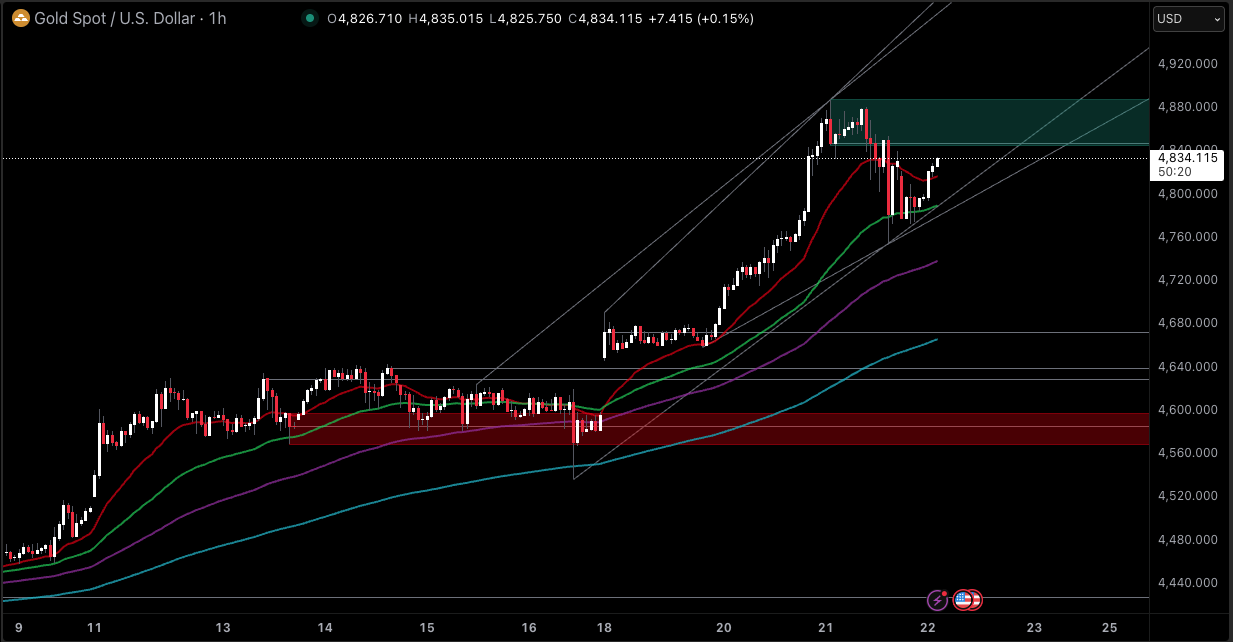
As of today, XAU/USD is trading around the mid-$4,800s, after a pullback from a record high earlier this week.
| Metric | Latest reading |
|---|---|
| Spot gold (XAU/USD) bid | 4,843.11 |
| Day's range | 4,772.26 – 4,832.97 |
| 52-week range | 2,729.80 – 4,888.22 |
| Record high | 4,888 per ounce area |
The proximity to the $4,888 area is the psychological issue for next week. Markets tend to behave differently just below a record because sellers use the level to take profit, while late buyers hesitate because the risk-reward worsens at the top of a range.
At present, gold is not reacting to a single variable. It is responding to the mix of interest rates, inflation credibility, and investors' views on the stability of the policy framework.
A simple way to think about gold is to watch real yields. If real yields rise, the opportunity cost of holding gold rises. When real yields decline, gold typically performs better.
Real yields have risen recently, with the 10-year TIPS real yield around 2.0% (about 1.97% in the latest benchmark reading).
At the same time, the nominal 10-year Treasury yield has been around 4.3% in recent data.
If the Fed signals it is comfortable keeping policy restrictive, real yields can stay firm, and gold can consolidate or correct.
If the Fed opens the door to easier financial conditions, real yields can soften quickly, and gold can attempt a breakout.
The US Dollar Index has been near $98.61 in the latest read shown alongside major market instruments.
A softer dollar tends to support gold because it makes gold cheaper for buyers using other currencies, and a weaker dollar often coincides with looser financial conditions.
The risk next week is that a more hawkish Fed message triggers a dollar bounce, which can pressure gold even if the broader bull trend remains intact.
The Fed's calendar indicates which meetings include a Summary of Economic Projections, where the "dot plot" is presented.
The January meeting is not one of those projection meetings. Thus, the market may lean even more on the wording of the statement and the press conference.
The latest inflation readings are not giving the Fed an obvious green light. The US annual CPI rate was 2.7% in December 2025, while core inflation was cited at around 2.6% in widely followed summaries.
According to recent reports, expectations for the Fed's preferred inflation measure indicate that core PCE inflation is around 2.8% year-over-year.
This combination supports a "hold and watch" posture, which means gold's reaction next week may hinge on forward guidance and tone, not the policy rate alone.
Longer-term demand trends have also supported gold prices. The World Gold Council has noted increased investments by both investors and central banks, indicating that 2026 may be influenced by geoeconomic uncertainty. Prices could remain stable if these conditions continue.
Some banks and research desks have also raised their medium-term gold forecasts as demand broadened beyond traditional safe-haven buyers.
That does not eliminate downside risk next week, but it helps explain why pullbacks have struggled to gain traction.
Most mainstream expectations point to a hold. The current target range is 3.50% to 3.75%, and traders have assigned a very high probability to no change at the January meeting.
At the same time, markets are still pricing meaningful easing later this year. For example, markets had priced around 45 basis points of US rate cuts this year.
That combination matters for gold:
If the Fed sounds comfortable with the idea of cuts later, gold may regain momentum.
If the Fed pushes back against cut expectations, gold may see another wave of profit-taking.
Since the "hold" outcome is widely expected, gold may respond more to the reasons behind it than the outcome itself. These are the sections that tend to move markets:
Traders will closely monitor whether the Fed indicates that inflation is approaching the 2%.
Recent commentary has indicated a cooling trend in inflation, with December core inflation reported at approximately 2.7% in some market analyses.
If the Fed highlights softer hiring or rising slack, the market can interpret that as a reason to cut later.
If the Fed signals it is uneasy about market strength, it can sound more hawkish than expected. If it sounds relaxed, it can ease conditions further and support gold.
Gold can move sharply around the Fed, even when the rate decision is "as expected." These steps can help reduce avoidable mistakes:
Use position sizes that match the day's volatility, because the average daily range can widen fast around key events.
Decide your invalidation level before entering a trade, because fast candles can trigger emotional exits.
Watch liquidity around the statement and press conference, because spreads can widen briefly in thin moments.
At EBC Financial Group, we generally see better outcomes when traders plan levels and risks first, and opinions second.
The next scheduled Fed meeting is January 27–28, 2026, with the policy statement released at 2:00 p.m. ET on January 28 and the Chair's press conference at 2:30 p.m. ET.
Gold is priced in US dollars and does not pay interest. When rate expectations shift, the US dollar and bond yields can move quickly, and gold often follows.
Yes. Most daily moving averages signal a "buy" or "strong buy," although short-term pullbacks may happen near record highs.
In conclusion, Gold heads into next week's FOMC meeting trading close to record highs, suggesting the market is already pricing in uncertainty.
The Federal Reserve may not need to change rates to move XAUUSD sharply, because the real driver will be how the statement and press conference reshape expectations for real yields and the dollar.
For traders, the priority is not guessing the headline; it is staying disciplined around key levels, sizing positions for higher event risk, and respecting that FOMC weeks often bring sharp swings in both directions.
Disclaimer: This material is for general information purposes only and is not intended as (and should not be considered to be) financial, investment or other advice on which reliance should be placed. No opinion given in the material constitutes a recommendation by EBC or the author that any particular investment, security, transaction or investment strategy is suitable for any specific person.