Published on: 2026-03-09
BlackRock (BLK) shares dropped after the HPS Corporate Lending Fund (HLEND) announced it would adhere to its standard 5% quarterly repurchase limit, despite investor requests to redeem approximately 9.3% of shares outstanding.
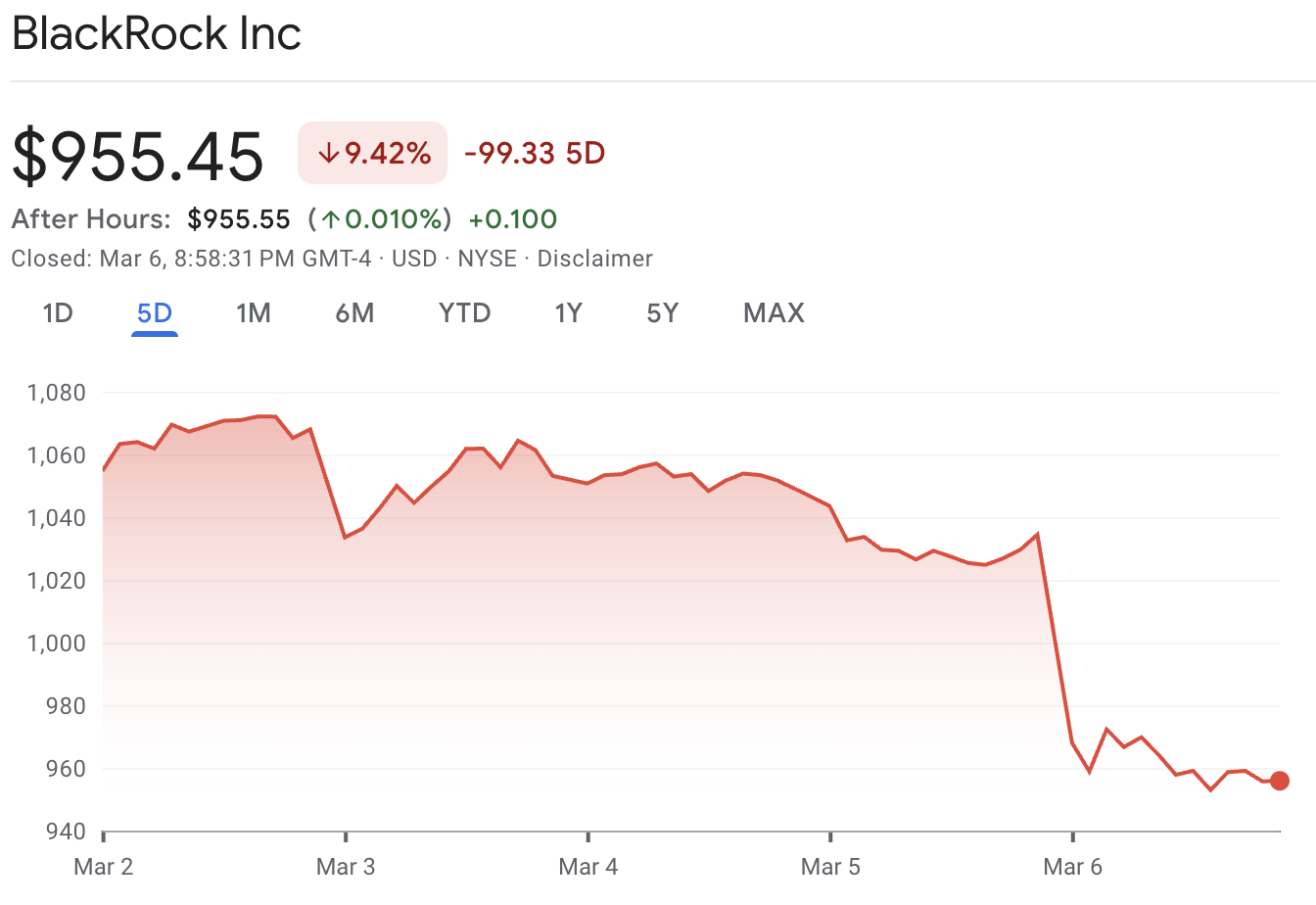
At the latest close, BlackRock (BLK) ended at $955.45, down 7.7% on March 6. The selloff was driven by renewed concern over liquidity in semi-liquid private credit funds, not by a sudden breakdown in BlackRock’s core business.
BlackRock stock fell after its HLEND private credit fund limited withdrawals under its existing liquidity rules, which raised fresh concerns about investor access to cash in semi-liquid products.
The market reaction was driven more by worries over private credit liquidity than by weakness in BlackRock’s core business.
Investors viewed the HLEND move as part of a broader industry issue, as similar pressure has appeared across other major private credit platforms.
HLEND continued operating within its stated structure, which was designed to manage the mismatch between investor liquidity demands and longer-term private credit assets.
The decline was triggered by HLEND’s March 6 filing and accompanying shareholder letter.
The fund said first-quarter 2026 repurchase requests reached about 9.3% of shares outstanding as of December 31, 2025. That was the first time requests had exceeded its 5% quarterly limit since inception.
HLEND said it would fulfill repurchases for 5% of shares outstanding, or about $620 million.
Notably, BlackRock did not close the fund or remove it from the market. HLEND implemented a pre-existing liquidity limit that was integral to the product’s structure.
The fund said that without this cap, there would be a structural mismatch between investor liquidity expectations and the longer duration of the private credit loans it owns.
Analysts framed the move as a warning sign for the broader private credit industry, where investors have grown increasingly cautious regarding credit quality, valuations, and redemptions in semi-liquid funds.
The market responded rapidly for three primary reasons:
Liquidity concerns escalated fast. A 9.3% redemption request against a 5% quarterly limit signaled that investor demand for cash had moved beyond the fund’s normal design.
This was not seen as an isolated case. Similar pressure has been reported at other private credit firms, including Blackstone and Blue Owl, which reinforced the view that this is an industry issue rather than a single-fund problem.
Private credit now matters more to BlackRock’s equity story. Since BlackRock completed its HPS acquisition in July 2025, private credit has become a more important growth engine, making stress in a flagship strategy more relevant to BLK investors.
The bearish perspective is clear: private credit funds offer attractive income streams from inherently illiquid assets.
HLEND’s letter makes clear that the fund chose to preserve capital and stick to its existing rules rather than stretch beyond them.
While this represents prudent fund management, such events often prompt public shareholders to reduce valuations of alternative asset managers.
Investors are concerned that redemption pressure may hinder fundraising, slow fee growth, necessitate stricter valuation scrutiny, and highlight the liquidity mismatch inherent in wealth-oriented private credit products.
Conversely, BlackRock’s core business continues to demonstrate robust performance.
In its January 15, 2026 earnings release, BlackRock reported $14 trillion in assets under management, record full-year net inflows of $698 billion, 19% revenue growth, 18% growth in adjusted operating income, and 10% growth in adjusted diluted earnings per share.
Analysts suggest the market is responding to a confidence shock rather than to any demonstrated deterioration in BlackRock’s overall earnings capacity.

BlackRock stock is under pressure amid investor focus on liquidity risks in private credit, even though the company’s latest reported operating performance remains strong.
| Metric | Latest Reported Performance |
|---|---|
| Current Market Pricing | $955.45 |
| Assets Under Management | $14 trillion |
| 2025 Net Inflows | $698 billion |
| Revenue Growth | 19% |
| Adjusted Operating Income Growth | 18% |
| Adjusted Diluted EPS Growth | 10% |
| Quarterly Dividend | $5.73 per share |
| Dividend Increase | 10% |
That means the recent weakness in BLK is not being driven by a broad breakdown in BlackRock’s business model. It is being driven by concern that stress in private credit could hurt sentiment, fundraising, and future growth in one of the firm’s most important expansion areas.
That is why the BlackRock stock is falling even though BlackRock’s latest reported fundamentals still look strong.
The key question is whether the HLEND episode remains a one-off confidence event or becomes part of a broader pattern across private credit.
If more semi-liquid funds face similar redemption pressure, investors may continue to view private credit managers as more exposed to liquidity risk than previously assumed.
For BlackRock specifically, the market will closely monitor three factors:
whether redemption pressure at HLEND stabilizes
whether private markets inflows remain healthy
whether the HPS platform continues to contribute growth without adding reputational or liquidity concerns
Currently, BlackRock’s fundamentals remain intact. The decline in stock price reflects investor concerns that the private credit issue could escalate further.
Clear evidence that redemption pressure at HLEND is easing and future requests move back within the fund’s normal quarterly limit
Continued strength in BlackRock’s core business, especially steady inflows, resilient fee growth, and solid earnings across ETFs, wealth, and institutional asset management
Improved confidence in BlackRock’s private credit platform if management shows that liquidity remains strong, fundraising is stable, and the HPS acquisition continues to support long-term growth
Redemption pressure spreads further across HLEND and other semi-liquid private credit products
Private credit stress starts to weigh on fundraising, fee-related earnings, or asset valuations
Broader market volatility and weaker sentiment toward alternative asset managers push investors to assign a lower valuation multiple to BlackRock stock
BlackRock stock fell after HLEND capped withdrawals at its usual 5% quarterly limit, even as redemption requests rose to about 9.3% of shares outstanding. Investors took that as a sign of growing stress in private credit.
No. HLEND did not shut down. It continued operating under its existing structure and used a built-in repurchase cap designed for a semi-liquid private credit fund.
Yes. Based on its latest results, BlackRock reported $14 trillion in AUM, record 2025 net inflows of $698 billion, 19% revenue growth, and 10% growth in adjusted diluted EPS.
No. Similar redemption pressure has appeared at other private credit firms, including Blackstone and Blue Owl, which is why investors see this as a broader industry issue.
BlackRock may appeal to long-term investors because its core business remains strong, but the stock now carries added private credit risk. It suits investors who can tolerate near-term volatility.
BlackRock stock is falling because investors were unsettled after HLEND said redemption requests had risen above the fund’s quarterly withdrawal limit.
The fund received requests equal to about 9.3% of shares outstanding, but it fulfilled only its standard 5% quarterly repurchase limit. That raised concerns that private credit funds may be harder to exit quickly than many investors expected.
Even so, BlackRock’s broader business remains strong, with about $14 trillion in assets under management and solid recent operating growth. The current selloff is best understood as a private credit liquidity concern weighing on a company whose core fundamentals still look healthy.
Disclaimer: This material is for general information purposes only and is not intended as (and should not be considered to be) financial, investment or other advice on which reliance should be placed. No opinion given in the material constitutes a recommendation by EBC or the author that any particular investment, security, transaction or investment strategy is suitable for any specific person.