Published on: 2026-07-02
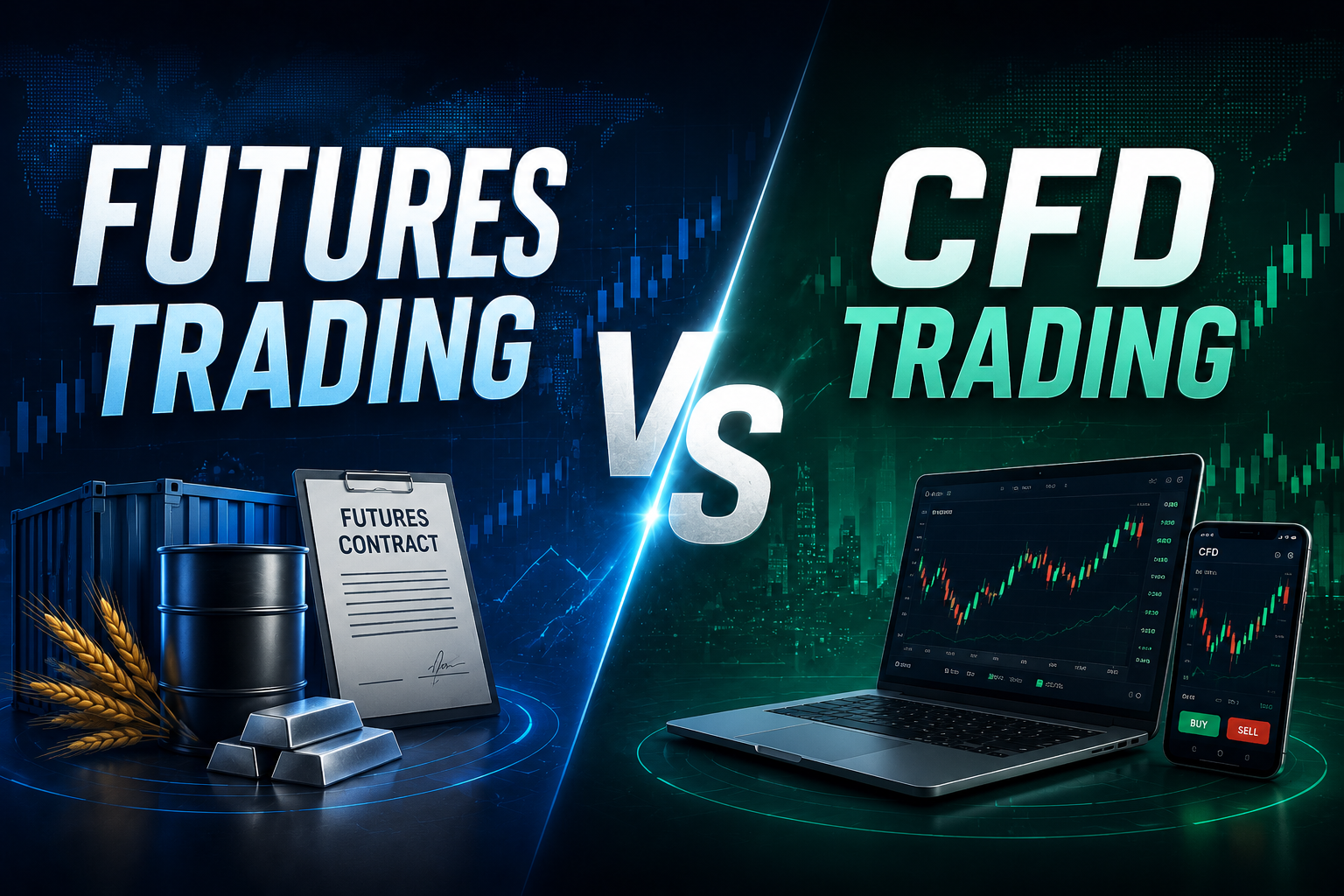
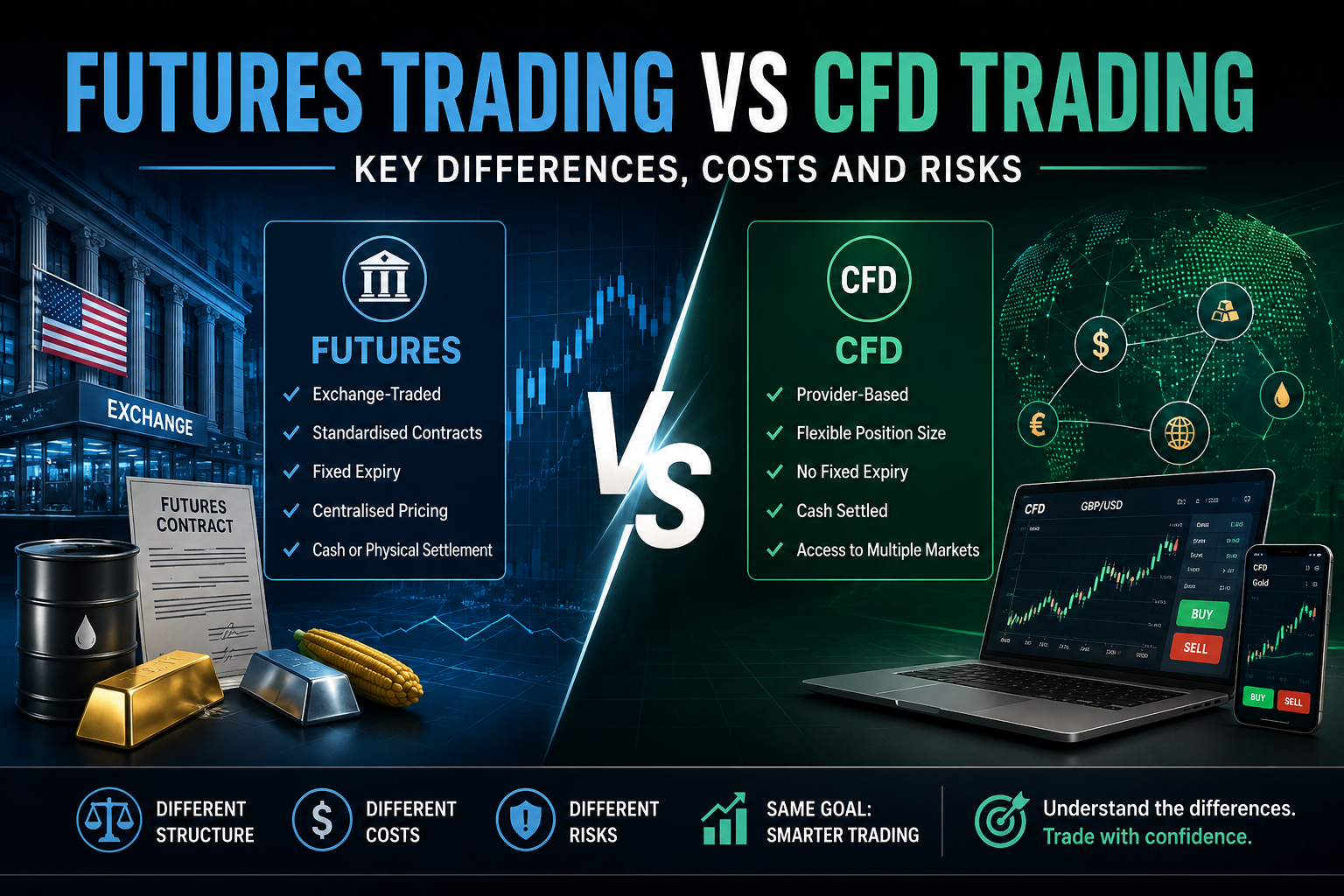
Futures trading uses standardised exchange-traded contracts with fixed contract sizes and expiry dates. CFD trading uses contracts that track the price movement of an underlying market, usually with more flexible position sizing and no direct ownership.
Traders use futures to speculate, hedge portfolio exposure, manage commodity price risk or trade exchange-listed derivatives with centralised pricing. Traders use CFDs to go long or short on markets such as indices, forex, commodities and shares through a provider-based contract. The practical differences appear in contract structure, costs, margin treatment, expiry and execution.
Futures are exchange-traded contracts with standardised contract sizes, expiry dates, margin rules and settlement terms.
CFDs are usually provider-issued derivatives that mirror price movement without giving ownership of the underlying asset.
Futures require expiry management, whereas most spot CFDs have no fixed expiry and may incur overnight financing charges.
Both use leverage, so traders must assess total market exposure, not only the margin deposit.
Futures may suit traders seeking exchange transparency, while CFDs may suit traders seeking flexible sizing and simpler access to multi-asset instruments.
Futures trading is the buying or selling of a standardised contract that tracks an underlying market at a future settlement date. Traders use futures to speculate on price direction, hedge exposure or manage risk in markets such as indices, commodities, currencies, bonds and interest rates.
Contract size: Each futures contract controls a fixed amount of market exposure.
Exchange trading: Futures trade on organised exchanges using standardised contract terms.
Settlement: Contracts can settle in cash or through physical delivery, depending on the market.
Margin: Traders post margin to open exposure without paying the full contract value upfront.
Expiry: Every futures contract has an expiry date and must be closed, settled or rolled.
Use cases: Futures are used for speculation, hedging and portfolio risk management.
Suppose an equity index is trading at 6,000, and one futures contract has a multiplier of $5 per index point.
Contract exposure = 6,000 × $5 = $30,000
If the index rises 50 points, profit = 50 × $5 = $250
If the index falls 50 points, loss = 50 × $5 = $250
The trader may not need to deposit the full $30,000, but profit and loss still follow the full contract exposure.
Contract Size and Multiplier
Contract size defines the market exposure controlled by one futures contract.
The multiplier converts price movement into cash value, such as $5 per index point.
Tick Size and Tick Value
Tick size is the smallest permitted price movement.
Tick value shows the cash gain or loss from one tick movement.
Margin and Mark-to-Market
Futures positions are marked to market as prices move.
If equity falls below the required margin level, the trader may need to add funds or reduce exposure.
Expiry and Rollover
Futures contracts expire, so the same contract cannot be held indefinitely.
Rollover means closing the expiring contract and opening a later one.
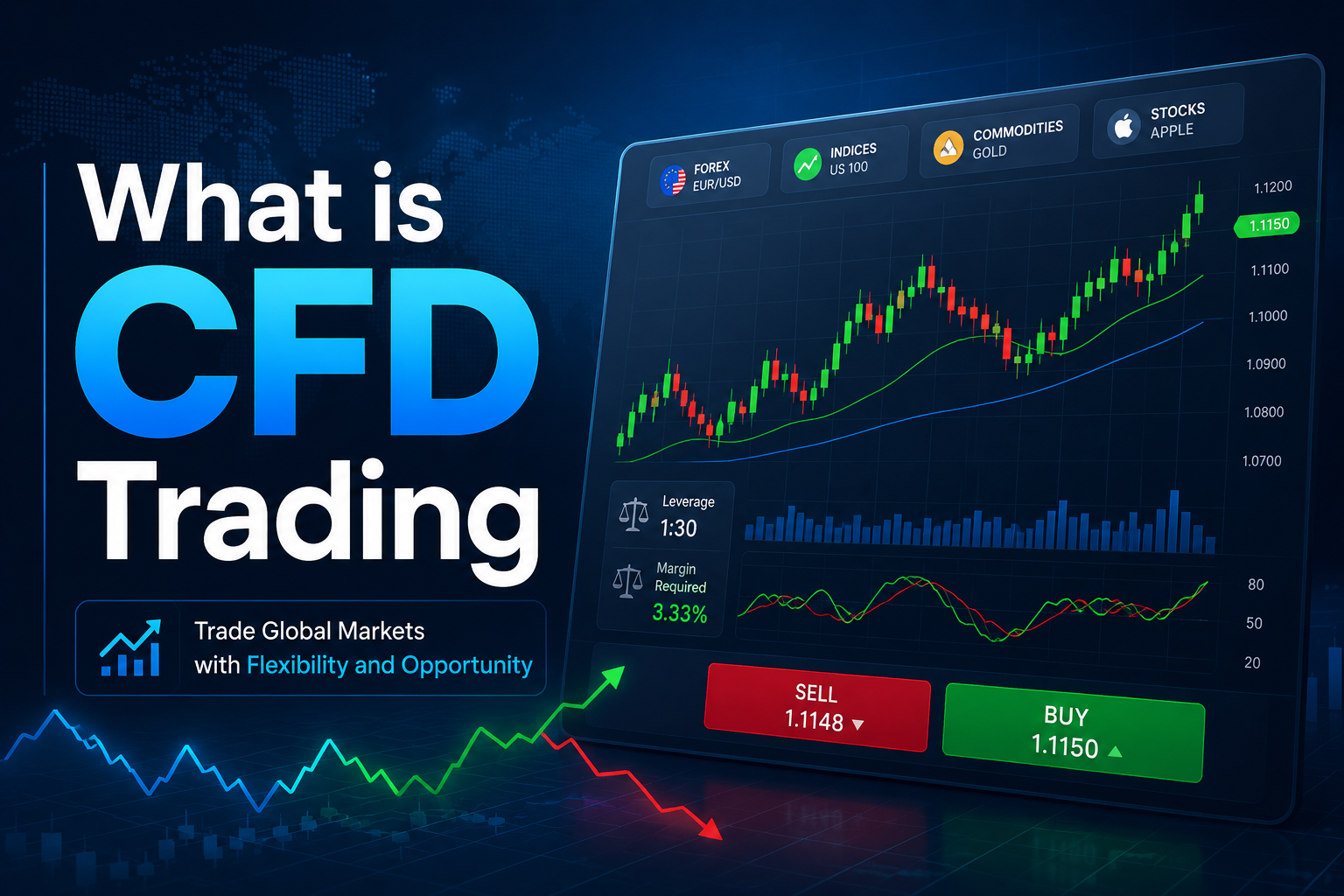
CFD trading uses a contract for difference to track the price movement of an underlying market without ownership of the asset. Traders use CFDs to go long or short on markets such as indices, forex, commodities and shares through a broker or CFD provider.
Position size: CFD trade size is usually more flexible than standard futures contract size.
Provider trading: CFDs are usually traded through a broker or CFD provider such as EBC Financial Group.
Settlement: CFDs are cash-settled, with no ownership transfer or physical delivery.
Margin: Traders post margin to control a larger CFD position.
Expiry: Most spot CFDs have no fixed expiry date.
Use cases: CFDs are used for short-term speculation, flexible exposure and multi-asset access.
Suppose the S&P 500 is trading at 6,000.
A trader buys 1 lot of an index CFD equivalent to $10 per index point.
If the index rises 50 points, profit = 50 × $10 = $500
If the index falls 50 points, loss = 50 × $10 = $500
The trader may post only a fraction of the position value as margin, but the profit or loss is calculated on the full CFD position size.
Position Size and Point Value
Position size defines how much each price movement is worth.
If a CFD is worth $10 per point, a 50-point move creates a $500 profit or loss.
Price Movement and Spread
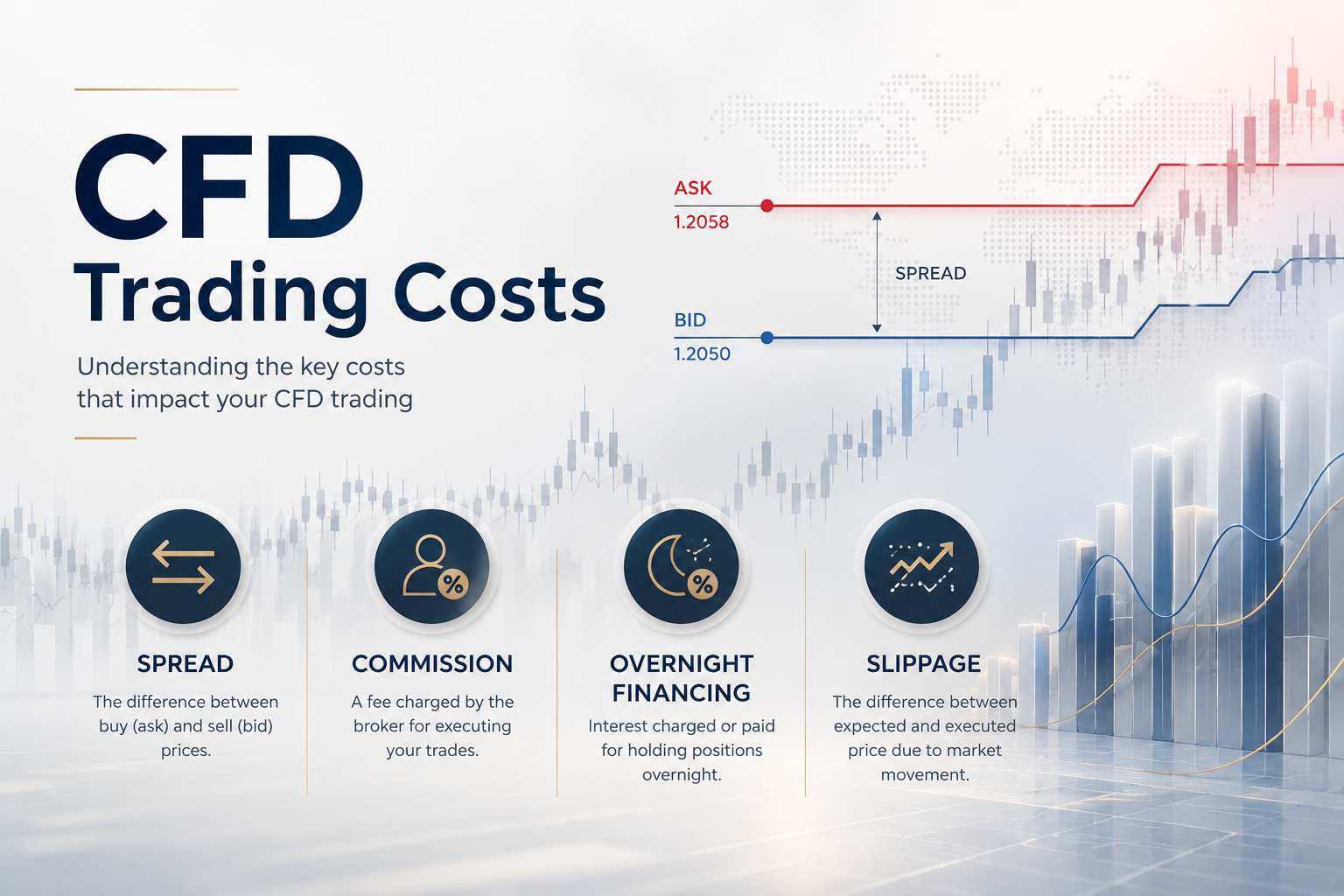
CFD prices track the underlying market via the provider’s bid and ask quotes.
The spread is part of the trading cost and matters most for short-term positions.
Margin and Floating Profit or Loss
CFD positions require margin to open and maintain exposure.
Profit and loss update as the underlying market moves.
Expiry and Overnight Financing
Most spot CFDs do not expire.
Positions held overnight may incur financing charges.
| Feature | Futures Trading | CFD Trading |
|---|---|---|
| Market Structure | Exchange-traded | Usually OTC through a provider |
| Contract Terms | Standardised by exchange | Flexible and provider-defined |
| Position Size | Fixed contract size, though micro contracts may exist | Usually more flexible |
| Expiry | Fixed expiry or contract month | Most spot CFDs have no fixed expiry |
| Settlement | Cash or physical settlement, depending on contract | Cash-settled between trader and provider |
| Pricing | Centralised exchange price discovery | Based on underlying market and provider pricing |
| Margin | Exchange or clearing-based framework | Broker and regulatory margin framework |
| Costs | Spread, commission, exchange fees, clearing fees, rollover | Spread, possible commission, overnight financing |
| Transparency | Exchange order book and volume | Provider-based execution |
| Counterparty | Clearinghouse structure | Broker or CFD provider |
| Best Suited For | Hedging, structured exposure, exchange transparency | Flexible access, smaller sizing, short-term speculation |
| Main Risk | Contract size, expiry, margin calls | Leverage, financing cost, provider execution, gap risk |
Futures provide a more standardised route to market exposure, with contract terms, expiry and settlement defined by the exchange. CFDs provide a more flexible structure, especially for traders who want smaller position sizes or do not want to manage futures expiry directly. The practical trade-off is between exchange transparency and operational flexibility.
The S&P 500 can be traded through an index futures contract or an index CFD. The market view may be the same, but the position size, cost structure and execution route differ.
The CME Micro E-mini S&P 500 futures contract uses a multiplier of $5 × the S&P 500 Index and has a minimum tick of 0.25 index points, making each tick worth $1.25 per contract.
| Item | Micro E-mini S&P 500 Futures | S&P 500 Index CFD |
|---|---|---|
| Market Price Example | S&P 500 at 6,000 | S&P 500 at 6,000 |
| Position Size | $5 per index point | Example: $10 per index point |
| Notional Exposure | 6,000 × $5 = $30,000 | 6,000 × $10 = $60,000 |
| 50-Point Rise | Profit = 50 × $5 = $250 | Profit = 50 × $10 = $500 |
| 50-Point Fall | Loss = 50 × $5 = $250 | Loss = 50 × $10 = $500 |
| Expiry | Contract expiry applies | Most spot CFDs have no fixed expiry |
| Cost Focus | Spread, commission, exchange fees, rollover | Spread, possible commission, overnight financing |
| Main Difference | Exposure follows exchange contract specifications | Exposure follows selected CFD size |
The futures position is defined by the exchange contract multiplier. The CFD position is defined by the trade size selected through the provider, which makes sizing more flexible but shifts attention to spread, financing and execution terms.
Gold can also be traded through futures or CFDs. Gold futures give exchange-traded exposure to a standardised metal contract, while a gold CFD tracks the price movement of gold without ownership or direct delivery exposure.
COMEX Gold futures represent 100 troy ounces of gold, while CME’s gold product material also states that each COMEX Gold futures contract has a minimum tick price of $10.00.
| Item | Gold Futures | Gold CFD |
|---|---|---|
| Market Price Example | Gold at $2,400 per ounce | Gold at $2,400 per ounce |
| Position Size | 100 troy ounces | Example: 10 ounces |
| Notional Exposure | 100 × $2,400 = $240,000 | 10 × $2,400 = $24,000 |
| $10 Price Rise | Profit = 100 × $10 = $1,000 | Profit = 10 × $10 = $100 |
| $10 Price Fall | Loss = 100 × $10 = $1,000 | Loss = 10 × $10 = $100 |
| Settlement | Futures settlement rules apply | Cash-settled with provider |
| Cost Focus | Spread, commission, exchange fees, rollover | Spread, possible commission, overnight financing |
| Main Difference | Large standardised contract exposure | More flexible exposure sizing |
The gold example shows why contract size matters. A standard gold futures contract can create large notional exposure quickly, while a CFD may allow a trader to choose a smaller trade size. The trade-off is that CFD costs and execution depend on the provider’s terms.
| Cost Area | Futures Trading | CFD Trading | When It Matters Most |
|---|---|---|---|
| Spread | Exchange bid-ask spread | Provider or platform spread | Intraday and high-frequency trading |
| Commission | Usually charged per contract | Sometimes charged, often asset-dependent | Frequent trading or larger position size |
| Exchange Fees | Usually apply | Usually not charged separately | Futures execution cost calculation |
| Clearing Fees | Usually apply | Usually not charged separately | Futures trading through exchange infrastructure |
| Overnight Financing | Usually reflected in futures pricing | Common for leveraged spot CFDs | Multi-day CFD positions |
| Rollover | Needed when holding beyond contract expiry | Usually not needed for spot CFDs | Multi-week futures exposure |
| Slippage | Possible in fast or thin markets | Possible in fast or thin markets | News events, low liquidity and large orders |
Cost depends on holding period.
Intraday traders focus mainly on spread, commission and slippage.
Multi-day CFD traders must account for overnight financing.
Multi-week futures traders need to consider rollover costs and contract liquidity.
Larger positions depend more on execution quality and margin efficiency.
The better instrument depends on the trader’s capital size, holding period, market access needs and tolerance for contract complexity.
| Trader Type | Better Fit | Why |
|---|---|---|
| Trader Who Wants Transparent Exchange Pricing | Futures | Futures trade through a centralised order book with visible exchange volume |
| Trader With Smaller Position-Size Requirements | CFDs | CFDs usually allow more flexible exposure sizing |
| Beginner Learning Directional Trading | CFDs or Micro Futures | Smaller position size matters more than the product label |
| Trader Avoiding Expiry Management | CFDs | Most spot CFDs do not require direct contract rollover |
| Trader Hedging Portfolio or Commodity Exposure | Futures | Standardised contracts make hedging cleaner and more structured |
| Intraday Trader | Either | The better fit depends on spread, commission, liquidity and execution speed |
| Multi-Day CFD Trader | CFDs, with Cost Control | Overnight financing must be included before holding beyond one session |
| Multi-Week or Larger-Size Trader | Often Futures | Futures may become more efficient if rollover and contract size are managed properly |
| Trader Focused on Provider Simplicity | CFDs | Market access and platform execution are usually more straightforward |
| Trader Focused on Contract Precision | Futures | Contract terms, expiry and settlement are clearly defined by the exchange |
CFDs may suit traders who want flexible sizing, simpler access and no direct futures expiry management. Futures may suit traders who need exchange transparency, visible liquidity and standardised contract exposure.
Comparing margin only: Margin is the deposit, not the full exposure. Traders should calculate the total position value before entering.
Ignoring futures expiry: Futures contracts expire. Positions need to be closed, settled or rolled before expiry risk becomes relevant.
Treating futures CFDs as direct futures: A CFD can track a futures price, but the trader still holds a CFD with the provider. Check whether the product is an exchange-traded futures contract, a spot CFD, or a futures-based CFD.
Underestimating CFD financing: Spot CFDs may look efficient intraday, but overnight financing can build over longer holding periods. Review overnight charges before holding a CFD for more than one session.
Oversizing positions: Position size determines whether a losing trade stays manageable or becomes an account-level problem. Set the trade size based on stop distance and acceptable account risk, not on maximum available leverage.
Ignoring liquidity and slippage: Thin liquidity, market gaps and news events can affect both futures and CFDs.Avoid oversized orders around major news and check spread conditions before execution.
Skipping product terms: Traders should check contract size, margin rules, expiry, financing and execution terms before opening either product.
Futures are standardised contracts traded on an exchange. CFDs are usually provider-issued contracts that track the price movement of an underlying market. Futures have expiry dates, contract specifications and exchange clearing. CFDs usually offer more flexible sizing and no ownership of the underlying asset.
No. A CFD may track the price of a futures contract, but it remains a CFD. The trader does not hold the exchange-traded futures contract directly. The position is between the trader and the CFD provider.
Safety depends on product structure, leverage, position size and execution discipline. Futures offer exchange transparency and central clearing. CFDs may allow smaller position sizing but carry provider and financing considerations. Neither product is low-risk when leverage is excessive.
Short-term CFD trades may be efficient when spreads are tight and position size is small. Futures may be more efficient for larger or longer-held exposure if the trader manages rollover properly. The real comparison should include spread, commission, financing, exchange fees, slippage and holding period.
CFDs may be easier for beginners because position sizes are often more flexible and the platform process is simpler. Micro futures can also reduce contract size. In both cases, beginners need to understand margin, stop placement, trading costs and full exposure before trading live.
Futures generally do not charge overnight financing in the same way that spot CFDs do. Funding expectations are usually reflected in futures pricing. Traders still face spreads, commissions, exchange fees and rollover costs when maintaining exposure beyond expiry.
Most spot CFDs do not have fixed expiry dates. Some futures-based CFDs may follow an expiry schedule or adjustment process. Traders should review the product terms before trading index-, commodity-, or futures-linked CFDs.
Futures and CFDs can express the same market view, but they are built differently. Futures are exchange-traded contracts with standardised terms, expiry dates and clearing arrangements. CFDs are flexible derivative contracts that track price movement without transferring ownership of the underlying asset. Cost comparison depends on spread, commission, financing, rollover and holding period.
The better choice depends on the trade being executed. Futures may fit traders who need exchange transparency, structured exposure and hedging precision. CFDs may fit traders who need smaller position sizes, direct long or short access and operational flexibility. In both markets, leverage turns position sizing into the main risk control.