Published on: 2026-07-09
Updated on: 2026-07-09
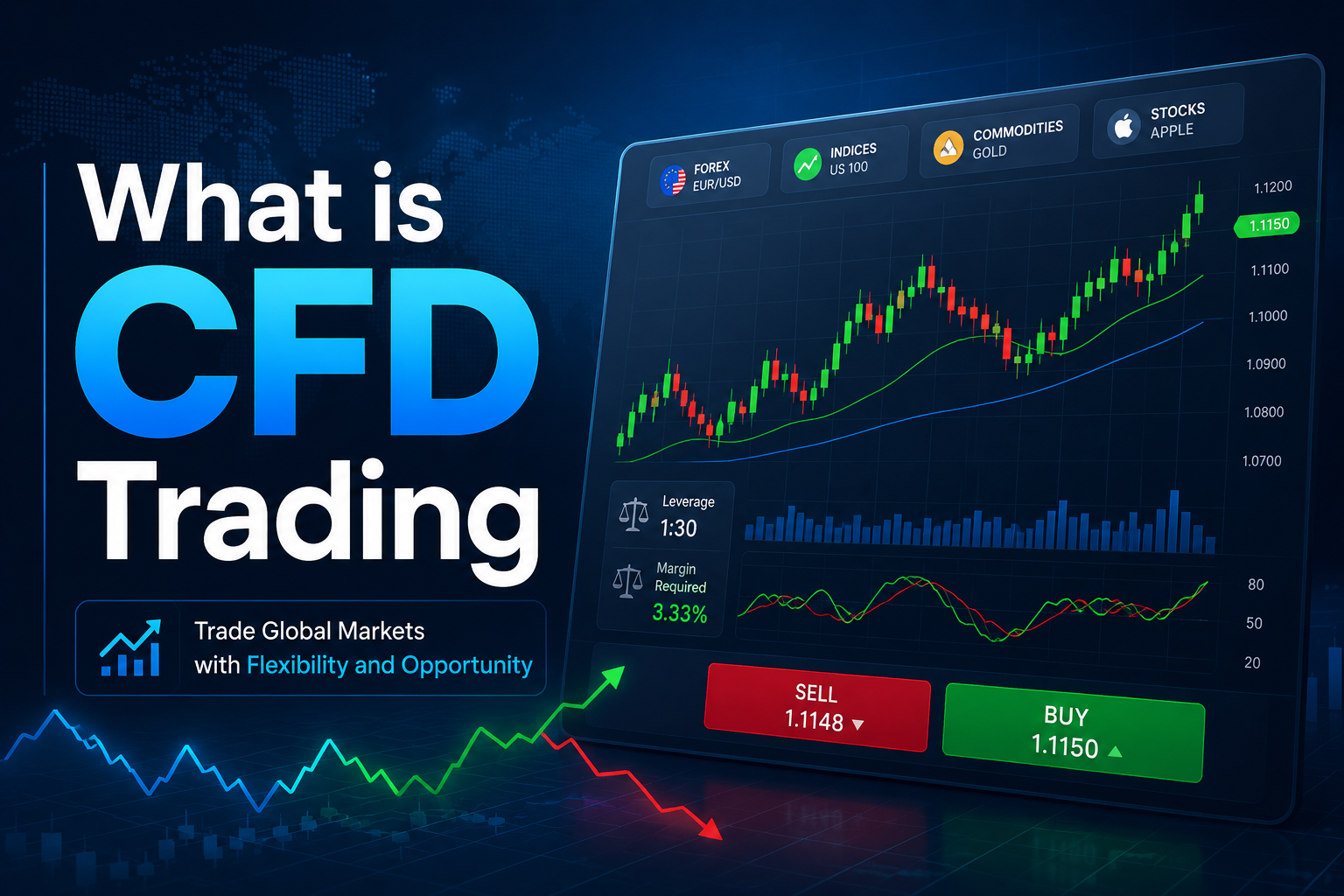
CFD trading gives traders exposure to global markets without owning the underlying asset. CFDs combine price speculation, leverage, margin, and short selling into a single, flexible instrument. That flexibility allows traders to access larger market exposure with less upfront capital, but it also means relatively small price movements can produce much larger gains or losses.
A contract for difference, or CFD, is a derivative agreement between a trader and a broker to exchange the price difference of an asset from the moment a position opens to the moment it closes. CFDs are widely used across forex, indices, commodities, shares, ETFs and other markets, although availability and rules differ by jurisdiction.
CFDs allow traders to speculate on price movements without owning the underlying asset.
Traders can go long if they expect prices to rise or go short if they expect prices to fall.
Leverage lowers the upfront margin requirement, but profit and loss are based on total market exposure.
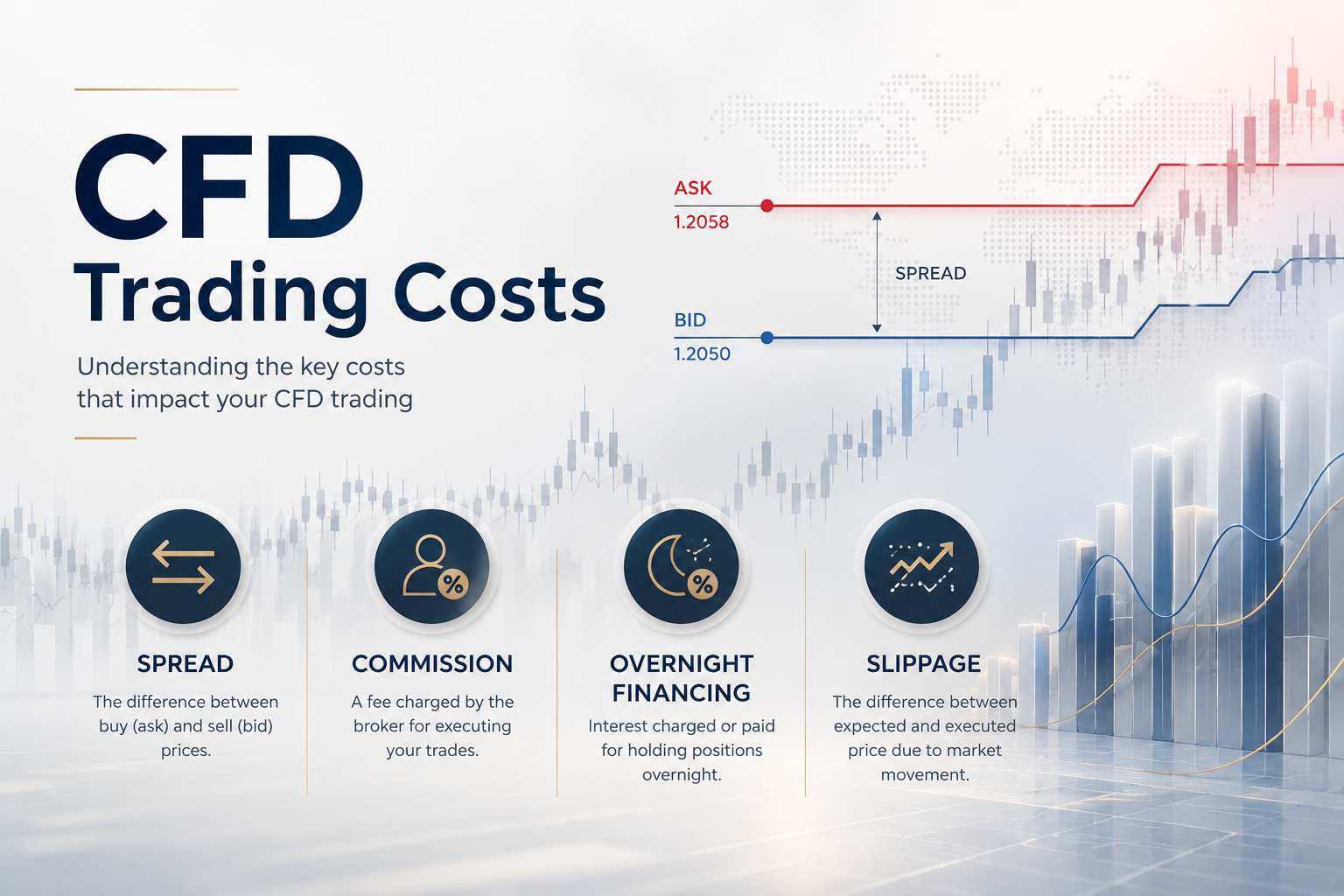
Spreads, commissions, overnight funding, slippage and conversion fees can affect the break-even price.
Margin calls can lead to forced position closures when account equity falls below required levels.
CFDs are generally better suited to tactical trading and hedging than passive long-term investing.
CFD trading is the buying or selling of a contract that tracks the price movement of an underlying market. The trader does not receive shares, barrels of oil, gold bars, currency notes or ETF units. The CFD reflects the market’s price movements, and the final settlement is in cash.
A simple CFD flow looks like this:
Underlying marketCFD tracks price
Trader goes long or short.
Price moves
Difference settled in cash.
For example, if a trader buys a gold CFD at $2,300 and closes it at $2,330, the gross gain is based on the $30 price movement multiplied by the contract size. If the price falls instead, the trader loses based on the same price difference.
CFDs differ from traditional investing. A stock investor owns shares in a company and may receive voting rights or dividends. A CFD trader has only price exposure. The product is designed for market access and tactical positioning, not ownership.
A CFD trade usually follows eight steps:
Choose a market.
Traders first select the underlying market they want exposure to, such as forex, gold, oil, an index, a share CFD or an ETF CFD. The market chosen affects volatility, trading hours, spreads and overnight funding.
Decide whether to go long or short.
A long position is used when the trader expects the price to rise. A short position is used when the trader expects the price to fall.
Select position size.
Position size determines the total market exposure. This is one of the most important decisions because profit, loss and margin requirement all depend on trade size.
Check the bid, ask and spread.
The bid is the selling price, the ask is the buying price, and the spread is the difference between them. The spread is a trading cost because the position usually starts slightly negative.
Deposit the required margin.
Margin is the capital needed to open the leveraged position. It is not the full value of the trade, but collateral reserved by the broker.
Monitor the position.
As the underlying market moves, unrealised profit or loss changes account equity. If the trade moves against the trader, available margin declines.
Close the trade.
The trader exits by placing the opposite order. A long CFD is closed by selling. A short CFD is closed by buying back.
Calculate the final result after costs.
The net profit or loss reflects the price difference, position size and trading costs such as spread, commission, overnight funding or slippage.
The process is simple in form, but the outcome depends on execution. A correct market view can still produce a weak result if position size is too large, spreads widen, or funding costs build over time.
Assume a trader buys a gold CFD at $2,300 with a position size of 10 ounces. The total market exposure is $23,000. If the margin requirement is 5%, the trader needs $1,150 in margin to open the position.
If gold rises to $2,330, the market has moved $30 in the trader’s favour. With a 10-ounce position, the gross profit is $300. If spread, funding and other costs total $25, the net profit is $275.
If gold falls to $2,270, the gross loss is $300 before costs. The underlying market has moved about 1.3%, but the loss equals about 26.1% of the $1,150 margin used for the trade.
EBC supports a range of trading platforms designed for different trading styles, from chart-focused analysis to multi-asset execution. Traders can access markets through MT4, MT5, TradingView tools and the EBC mobile app across desktop, web and mobile devices.
MT4 is widely used for forex and CFD trading, offering real-time charts, technical indicators, order tools, and automated trading via Expert Advisors. EBC provides MT4 access for forex, stocks, indices and commodities.
MT5 is the upgraded multi-asset platform, offering faster performance, broader market capability, more order types and enhanced charting tools. EBC supports MT5 for traders who want a more advanced trading environment.
TradingView is useful for traders who prioritise advanced charting, indicators, alerts, custom scripts and strategy testing. EBC’s TradingView resources help traders use the platform for market analysis and chart-based decision-making.
The EBC app allows traders to track markets, manage accounts and open or manage trades from one place. It is designed for mobile-first access, making it useful for traders who need flexibility beyond desktop.
CFDs are usually quoted with a bid and ask price. The bid is the price at which a trader can sell. The ask is the price at which a trader can buy. The spread is the difference between the two.
If gold is quoted at $2,300.00/$2,300.40, the spread is $0.40. A long position opens at the ask price and would close at the bid price. That means the trade starts slightly negative before the market moves.
Contract size also matters. A one-point move in an index CFD, a one-dollar move in gold, or a one-pip move in forex can have different cash values depending on the product specification.
CFDs allow traders to act on both rising and falling markets.
Going long
Buy first.
Profit if the price rises.
Lose if the price falls.
Going short
Sell first.
Profit if the price falls.
Lose if the price rises.
A long CFD mirrors a bullish trade. A short CFD allows the trader to speculate on falling prices without borrowing the underlying asset. Both directions carry risk because losses occur whenever the market moves against the position.
Leverage allows a trader to control a larger position with a smaller margin deposit. It improves capital efficiency but also increases account sensitivity to price movements.
| Margin Deposited | Leverage | Market Exposure | 1% Market Move | P/L as % of Margin |
|---|---|---|---|---|
| $1,000 | 5:1 | $5,000 | $50 | 5% |
| $1,000 | 10:1 | $10,000 | $100 | 10% |
| $1,000 | 20:1 | $20,000 | $200 | 20% |
| $1,000 | 30:1 | $30,000 | $300 | 30% |
At 30:1 leverage, a $1,000 margin deposit controls $30,000 of market exposure. If that market moves by 1%, the position changes by $300. That $300 move equals 30% of the original $1,000 margin.
This is why leverage changes the relationship between the market and the account. The underlying price may move only slightly, but the trader’s account can move much more sharply because the position is larger than the cash committed upfront.
Margin is the capital required to open and maintain a CFD position. It acts as collateral rather than a fee.
Margin required = Notional exposure × Margin rate
For example, a $20,000 position with a 5% margin requirement requires $1,000 in margin.
| Margin Situation | What It Means |
|---|---|
| Equity Falls | Unrealised losses reduce available margin |
| Margin Call Risk | The broker may request more funds or restrict new positions |
| Forced Close-Out | Positions may be closed automatically if equity falls below the required level |
There are three margin concepts worth knowing:
Initial margin is the amount needed to open the trade.
The maintenance margin is the equity required to keep the position open.
Free margin is the remaining account equity available after margin is reserved.
As losses grow, account equity falls, and free margin shrinks. If equity approaches the broker’s maintenance requirement, the trader may receive a margin call or be prevented from opening new positions. If losses continue, the broker may automatically close positions to reduce risk.
In the UK, retail CFD providers must close out a customer’s position when funds fall to 50% of the margin needed to maintain open CFD positions. UK rules also require negative balance protection for retail CFD accounts.
CFD costs affect the real breakeven price. A trader can have the right market view and still produce a weak result if trading costs are high.
| Cost | When It Applies | Commonly Seen In | Impact on Trader |
|---|---|---|---|
| Spread | At entry and exit | Forex, indices, commodities, crypto | Creates an immediate breakeven hurdle |
| Commission | Often on share CFDs | Stock and ETF CFDs | Reduces net profit on both sides |
| Overnight Funding | Positions held past the daily cut-off | Leveraged spot CFDs | Erodes returns on multi-day trades |
| Slippage | Fast or illiquid markets | News events, market opens and closes | Execution may differ from the expected price |
| Currency Conversion | Instrument currency differs from account currency | Global CFDs | Adds hidden international cost |
| Market Data Fees | Broker- or platform-dependent | Share CFDs and professional market data feeds | Raises trading overhead |
Short-term traders usually feel spreads and slippage most. Swing traders and hedgers need to watch overnight funding costs because they can compound over time.
CFDs can track many markets, but each market behaves differently.
| CFD Market | Main Driver | Common Use | Key Risk |
|---|---|---|---|
| Forex CFDs | Interest rates, central bank policy and macroeconomic data | Currency speculation and hedging | High leverage and event-driven volatility |
| Index CFDs | Corporate earnings, interest rates and market risk appetite | Broad market exposure | Gap risk and macroeconomic shocks |
| Share CFDs | Earnings, valuation and company-specific news | Single-stock long and short trading | Earnings gaps and corporate actions |
| Commodity CFDs | Supply, demand and geopolitical events | Gold, oil and metals exposure | Volatility and overnight funding costs |
| ETF CFDs | Sector or thematic exposure | Tactical basket exposure | Liquidity and tracking risk |
| Crypto CFDs | Liquidity, market sentiment and regulation | High-volatility speculation | Extreme price swings and regulatory restrictions |
Forex CFDs are driven mainly by macroeconomic data and central bank policy. Commodity CFDs respond more to supply, demand and geopolitical events. Understanding what moves the underlying market is just as important as understanding the CFD itself.
CFDs are not automatically better or worse than other instruments. Their usefulness depends on the objective, time horizon and risk profile.
| Feature | CFDs | Stocks | Futures | Options | ETFs |
|---|---|---|---|---|---|
| Ownership | No ownership of the underlying asset | Own shares directly | Contract exposure | Right, but not the obligation, to buy or sell | Own fund units |
| Leverage | Built into the product | Limited unless using margin | Built into the contract | Embedded through the option premium | Usually unleveraged unless using a leveraged ETF |
| Expiry | Usually no fixed expiry | None | Fixed expiry | Fixed expiry | None |
| Short Exposure | Direct short positions | Requires short-selling access | Possible | Possible through put options | Requires an inverse ETF or short-selling |
| Costs | Spread, commission, overnight funding and slippage | Spread, commission, custody fees and taxes | Exchange fees, margin and rollover costs | Premium, spread and time decay | Expense ratio and spread |
| Common Use | Tactical trading and hedging | Long-term investing | Standardised leveraged exposure | Defined-risk trading strategies | Diversified investing |
| Key Risk | Leverage and margin calls | Market risk | Leverage and expiry | Time decay and complexity | Market and tracking risk |
Stocks provide ownership. Investors may receive voting rights, dividends, and long-term participation in the company's growth. CFDs do not provide ownership; they only track price movement.
That makes stocks more suitable for long-term investing, while CFDs are more commonly used for short-term speculation, hedging or short exposure. CFDs require less upfront capital, but losses can compound faster due to leverage.
Futures are standardised exchange-traded contracts with fixed expiry dates and set contract sizes. CFDs are broker-issued contracts that track the underlying market and are often more flexible in position size.
Futures may offer more transparency through exchange trading and central clearing. CFDs may be simpler for traders who want flexible exposure without having to manage futures expiry or contract rollovers.
Options give the buyer the right, but not the obligation, to buy or sell an asset at a set price before or on expiry. A buyer’s maximum loss is usually limited to the premium paid.
CFDs are more direct. The trader goes long or short and gains or loses based on price movement. Options offer more strategy flexibility, while CFDs are easier to understand but carry leverage and margin-call risk.
ETFs are exchange-traded funds that usually hold a basket of assets. They are commonly used for diversified, longer-term exposure to markets, sectors, commodities or themes.
CFDs are more tactical. Traders may use them to go long or short, apply leverage or take shorter-term views on an index, sector or theme. ETFs suit portfolio building. CFDs suit active positioning.
CFDs offer several practical advantages:
access to multiple markets from one account,
ability to trade long or short,
leverage,
no physical ownership or delivery,
flexible position sizing,
potential use in hedging.
A trader with equity exposure may use an index CFD to reduce short-term market risk. A currency-sensitive investor may use forex CFDs to manage exchange-rate exposure.
These advantages depend on discipline. Leverage must be sized carefully, costs monitored, and trade decisions reflect liquidity and volatility.
CFD risk arises from the interaction among price movement, leverage, margin, costs and execution.
Leverage can accelerate losses because the trade is measured against total market exposure, not only the margin deposited.
Margin calls can force positions to close before a market has time to recover.
Spreads may widen during volatile periods, especially around major economic data, earnings releases or market opens.
Slippage can also turn a planned exit into a worse realised price.
Funding costs are another risk. A short-term CFD trade may be affected mainly by spread and execution. A multi-day or multi-week position can be affected more by overnight funding, especially when interest rates are elevated or the position is highly leveraged.
Counterparty risk also matters. Most CFDs are over-the-counter contracts with a broker rather than exchange-traded instruments. That makes broker regulation, pricing transparency, execution quality and client-money protections important parts of the risk assessment.
Regulated CFD trading can help reduce some product and conduct risks, although it does not remove market risk. Major regulatory bodies include:
FCA, the UK Financial Conduct Authority, applies retail CFD restrictions, including leverage limits, 50% margin close-out protection, and negative balance protection.
ESMA, the European Securities and Markets Authority, requires measures such as leverage limits, margin close-out, negative balance protection, mandatory risk warnings, and restrictions on incentives for CFD-like products that fall within its remit.
ASIC, the Australian Securities and Investments Commission, maintains CFD product intervention rules covering leverage restrictions, margin close-out and negative balance protection for retail clients.
These protections are designed to reduce excessive leverage, improve risk disclosure and limit account-level losses for eligible retail clients. They do not guarantee profits or prevent losses from normal market movement.
Good CFD traders think about risk before returns. A basic CFD risk plan should include:
Maximum loss per trade
Define how much of the account can be lost on one position before entering. Many traders use a fixed percentage so that a single trade cannot severely damage the account.
Position size
Calculate the trade size based on risk tolerance, stop-loss distance, and market volatility. Larger positions need smaller tolerance for error.
Stop-loss level
Decide where the trade idea is invalid. A stop should reflect market structure, not just an arbitrary cash amount.
Leverage limit
Use lower leverage during periods of high volatility or when trading around major news. More leverage leaves less room for normal market noise.
Check events such as inflation data, central bank decisions, employment reports and earnings announcements. These can widen spreads, increase slippage and trigger sharp price gaps.
Cost check
Review spread, commission and overnight funding before entering. A trade that looks attractive on price direction may be weaker after costs.
Exit plan
Define when to take profit, reduce exposure or close the position if market conditions change.
Risk control does not make CFD trading safe. It makes the exposure measurable. The goal is to prevent a single poor trade, a volatile session, or a margin call from controlling the account.
Inflation data, central bank decisions, earnings releases and geopolitical shocks can widen spreads and create gaps. During those periods, even a correct view can suffer poor execution.
CFDs can be studied by beginners, but live leveraged trading requires more than basic market knowledge. A beginner should understand margin, leverage, spread, slippage, funding, forced close-outs and position sizing before risking capital. A demo account can help new traders understand how positions move without financial exposure.
Open an EBC trading account
Start by opening an EBC trading account and completing the required registration process. EBC’s account page outlines a simple flow: provide personal information, complete account setup, deposit funds and start trading through MT4 or MT5.
Choose your CFD market
EBC offers access to CFD markets across commodities, indices, shares, and ETFs, giving traders exposure to multiple asset classes from a single platform.
Select your trading platform
Trade through EBC-supported platforms including MT4 and MT5. MT4 is widely used for charting, indicators and automated trading tools, while MT5 supports a broader multi-asset trading environment.
Open your position
Choose your contract size, decide whether to buy or sell, and review key trade details such as spread, margin and potential costs before placing the order.
Monitor and close your trade
Track open CFD positions in real time through the platform. Traders can manage risk with stop-loss or take-profit orders and close positions whenever market conditions or trading plans change.
Review EBC’s available trading products and open an account to get started.
CFD trading means speculating on whether a market will rise or fall without owning the underlying asset. If the market moves in the trader’s chosen direction, the CFD's value increases. If it moves against the position, the CFD loses value.
No. CFD traders do not own the underlying asset. They hold a cash-settled contract that tracks price movement.
A CFD makes money when the market moves in the trader’s chosen direction after costs. It loses money when the market moves against the position or when trading costs outweigh the price movement.
CFDs are not better than stocks. They serve a different purpose. Stocks provide ownership and suit long-term investing. CFDs provide leveraged price exposure and are well-suited to tactical trading or hedging.
Losses can exceed the margin used for a single position because profit and loss are calculated on full market exposure. In some regulated jurisdictions, negative balance protection may prevent retail clients from losing more than the total funds in their CFD account.
CFD trading is a flexible way to access financial markets, but it is not the same as owning an asset. A CFD is a cash-settled contract based on price movement, with leverage, margin and costs shaping the final result.
Used carefully, CFDs can support tactical market views and hedging across asset classes. Used carelessly, they can turn small market movements into rapid drawdowns. Successful CFD trading depends less on predicting market direction than on controlling exposure, understanding costs and managing leverage.