Published on: 2026-03-17
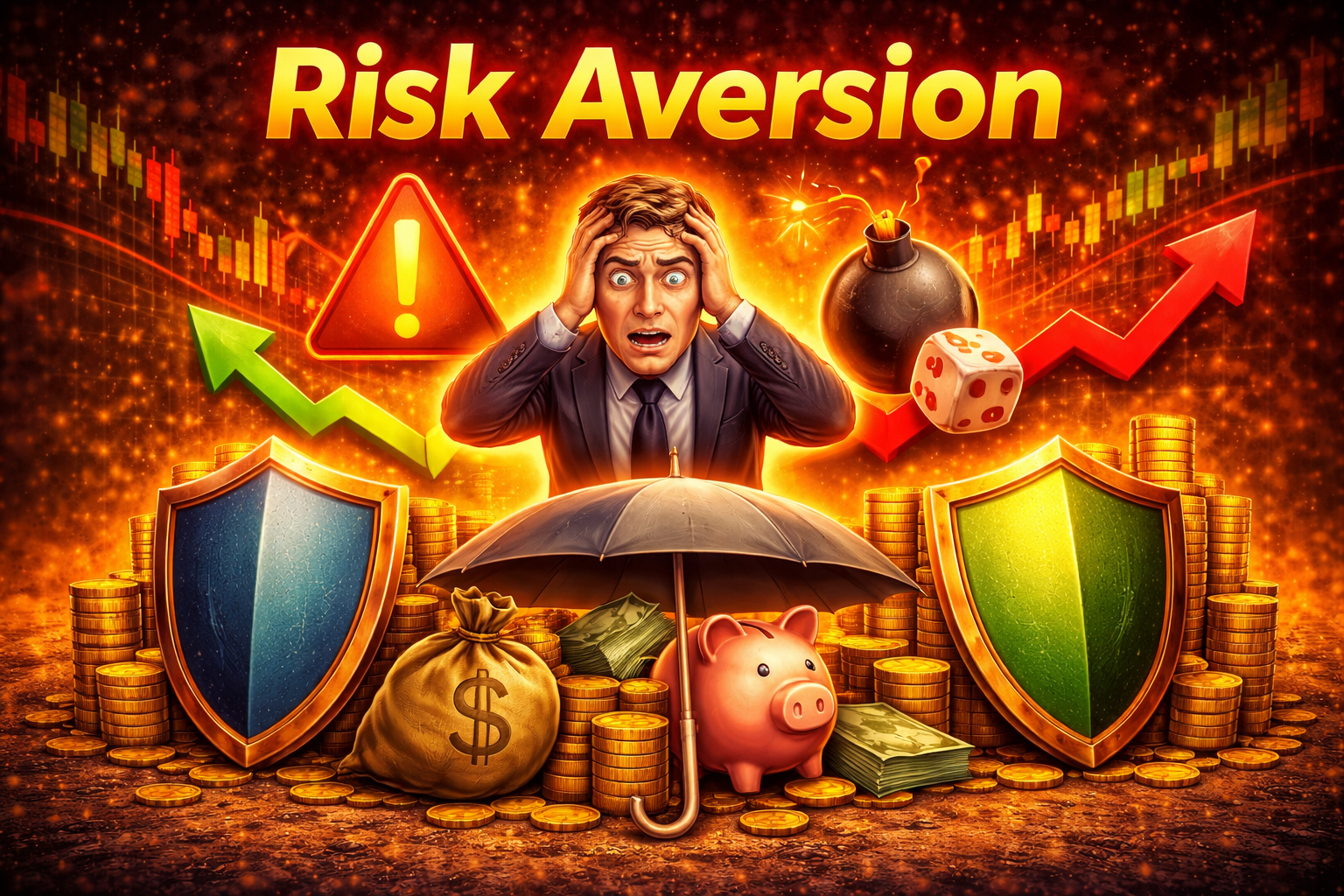
Risk aversion is a behavioural and economic concept that describes the preference for lower risk versus higher risk when faced with two otherwise equal opportunities. In trading, risk aversion influences decision‑making, position sizing, asset allocation, and responses to changing market conditions. Traders who exhibit high risk aversion tend to prefer safer assets and are often willing to sacrifice potential upside in order to reduce the likelihood of loss.
In financial markets, investors and traders continuously assess the potential return of an investment alongside the likelihood of losing money. This fundamental balancing act is often described as the risk‑return trade‑off, reflecting the amount of risk a market participant is willing to take in exchange for potential returns. At the heart of this balancing act is the concept of risk aversion.
Risk aversion describes the preference for lower risk when choosing between different investment opportunities with similar expected returns.
Risk‑averse behaviour influences trading decisions, asset allocation, and portfolio risk management.
During periods of uncertainty, markets often see a flight to safety, with capital flowing into lower‑risk assets such as government bonds or defensive stocks.
Understanding risk aversion helps traders interpret market behaviour, manage positions, and build resilient portfolios.
In economics and finance, risk aversion refers to the tendency of investors to prefer more certain outcomes to less certain ones, even if the expected value of the less certain outcome is higher.
In formal terms, a risk‑averse trader is more concerned with reducing losses than with maximising gains. This trader would rather accept a lower but more predictable return than chase higher returns with greater uncertainty.
Imagine two investment choices:
Choice A: A guaranteed return of $100.
Choice B: A 50 per cent chance to earn $200 and a 50 per cent chance to earn nothing.
Although the expected value of Choice B is also $100, a risk‑averse investor may choose Choice A because the outcome is certain, whereas Choice B carries uncertainty.
This preference highlights the emotional and psychological component of risk aversion, which can influence real‑world trading behaviour.
Risk aversion affects various aspects of trading:
Risk‑averse traders often take smaller positions relative to their overall portfolio to limit potential losses.
Such traders tend to prefer lower‑volatility assets such as government bonds, cash equivalents, or defensive stocks, which historically exhibit more stable earnings and steady dividends.
Examples of defensive stocks that appeal to risk‑averse investors include:
Johnson & Johnson: healthcare with consistent demand
Procter & Gamble: consumer staples with resilient cash flows
Duke Energy: a utility with regulated revenue
PepsiCo: diversified beverages and snacks
These companies often demonstrate lower beta relative to broad market benchmarks, meaning their prices tend to move less sharply in response to market swings.
Market environments frequently shift between “risk‑on” and “risk‑off” states:
Risk‑on: Traders are willing to take more risk in pursuit of higher returns. This often corresponds with rising equity markets and robust economic data.
Risk‑off: Traders become more cautious, seeking preservation of capital. This shift is often associated with economic uncertainty, geopolitical tensions, or financial market stress.
During risk‑off phases, assets perceived as safer attract capital. This is known as a flight to safety or flight to quality.
For example, during periods of market stress such as the 2020 coronavirus sell‑off, investors flocked to high‑grade government bonds and gold, while riskier assets experienced sharp outflows as risk aversion spiked.
Risk aversion is intimately connected to behavioural finance, which studies psychological factors in financial decision‑making. Traditional financial theory assumes that investors act rationally, but real markets often reflect emotions such as fear and greed.
Key behavioural phenomena related to risk aversion include:
Loss aversion: Traders tend to dislike losses more than they enjoy equivalent gains. This is a foundational concept explaining why many investors sell winners too early and hold losers too long.
Regret aversion: Fear of making a bad decision can lead to overly cautious behaviour.
Herd behaviour: In times of uncertainty, risk‑averse traders may follow the crowd into perceived safe assets, amplifying price movements.
These psychological drivers explain why markets sometimes overreact both on the downside (panic selling) and on the upside (exuberant buying followed by regret).
Every investment decision involves weighing expected returns against potential risk. The risk‑return trade‑off suggests that higher expected returns usually come with higher risk.
Risk‑averse investors inherently prefer investments with:
Lower volatility
Predictable cash flows
Higher historical stability
They are often willing to sacrifice potential high returns in exchange for a more secure investment.
A clear illustration of risk aversion in action occurred during the 2008 Global Financial Crisis.
Between 2007 and 2009:
Equity markets fell sharply as investor confidence plunged.
Capital flowed out of riskier assets such as high‑yield bonds and cyclical equities.
Demand for U.S. Treasury securities surged, pushing yields to historic lows.
Gold prices rose as investors sought tangible stores of value.
Another relevant example emerged during the 2020 pandemic‑related market sell‑off. In March 2020:
The S&P 500 experienced rapid declines.
Investors increased allocations to government bonds, gold, and short‑duration assets.
Defensive sectors such as consumer staples, healthcare, and utilities underperformed less severely than cyclicals and financials.
These episodes demonstrate how investor psychology and risk aversion can influence broad asset flows and valuations.
Risk aversion is not directly observable, but it can be inferred through:
Investor sentiment surveys (e.g., AAII
Put/Call ratios
Fear & Greed Index
Volatility spikes (e.g., VIX rising)
Sharp movement into safe‑haven assets
Widening spreads between high‑grade and high‑yield bonds
Increased demand for defensive ETFs
Reduced appetite for small‑cap or emerging market equities
Growing inflows into fixed‑income funds
Traders and investors can adjust strategies in response to rising risk aversion:
Increase exposure to high‑quality bonds.
Allocate to defensive equities with stable cash flows.
Use volatility hedges such as options or gold.
Trim high‑beta positions.
Increase cash or short‑term instruments.
Diversify across uncorrelated asset classes.
While related, risk aversion and risk tolerance are not identical:
A trader may understand the theoretical risk in an investment (risk tolerance) but act more conservatively due to emotional factors (risk aversion).
Investors often misapply risk aversion in ways that can harm long‑term returns:
Overreacting to short‑term volatility: selling quality assets at low prices.
Too much emphasis on safety: which can lead to underperformance over long horizons.
Ignoring diversification: concentrating too much on perceived safe assets rather than balancing risk.
Smart investors mitigate these mistakes by combining rational risk management with an understanding of their own psychological biases.
Risk aversion in trading is the preference for investments with more predictable outcomes, in which traders choose lower‑risk assets even if they offer lower returns to avoid potential losses.
Risk aversion affects markets by driving flows into safer assets, increasing volatility in risky assets, and influencing sentiment indicators such as volatility indexes and credit spreads.
Defensive stocks, such as consumer staples or utilities, tend to have more stable earnings and dividends, which can make them more attractive when risk aversion is high, but they are not risk‑free.
Yes, risk aversion can change with market conditions, personal financial circumstances, and investor sentiment, often rising during periods of uncertainty and falling in more confident markets.
Traders measure risk aversion indirectly by tracking market indicators such as volatility indexes, sentiment surveys, and shifts in asset allocation toward defensive instruments.
Risk aversion is a foundational concept in trading and investing that reflects the level of uncertainty a market participant is willing to accept. Because financial markets are driven as much by psychology as by fundamentals, risk‑averse behaviour often manifests during periods of stress, driving capital into safer assets and raising volatility in riskier sectors.
Understanding risk aversion allows traders to better anticipate market dynamics, asset flows, and sentiment‑driven price movements. By incorporating risk aversion into portfolio design and trade execution, investors can build strategies that balance return objectives with emotional and economic realities.
Whether markets are calm or turbulent, recognising how risk aversion influences decision‑making can help both new and experienced traders navigate market cycles more skillfully.
Disclaimer: This material is for general information purposes only and is not intended as (and should not be considered to be) financial, investment or other advice on which reliance should be placed. No opinion given in the material constitutes a recommendation by EBC or the author that any particular investment, security, transaction or investment strategy is suitable for any specific person.