Published on: 2026-03-17
Updated on: 2026-03-17
Multi-asset brokers are becoming more popular among Indian traders as market perspectives evolve. Traders now view equities, commodities, mutual funds, bonds, and hedging strategies as interconnected rather than separate.
Traders increasingly seek a single platform to monitor opportunities, assess risks, and respond quickly to market changes.

India’s demat accounts increased from 40 million to over 120 million by August 2025, with tier-2 and tier-3 cities accounting for 45% of new accounts in 2024. This marks a significant shift in the trading landscape.
India is now one of the fastest-growing retail investment markets globally, with millions of new traders entering each year.
Multi-asset brokers provide diversification, hedging options, and cost efficiency that single-asset platforms cannot match.
Selecting a regulated, multi-asset broker is now a critical decision for active Indian traders.
Retail investors now represent over 45% of daily turnover in the NSE cash market, and their share of the NSE F&O segment reached 62% by April 2025.
This level of retail dominance in derivatives reflects not only increased participation but also evolving risk management, which prompted strong regulatory intervention.
Demat accounts grew from 3.6 crore in 2019 to 19.4 crore by 2025, while domestic institutional ownership in listed companies climbed from 13% to 20% over the same period.
In 2026, the focus is expected to shift from account growth to more sophisticated investor participation, as household savings move from physical assets to financial instruments.
A maturing investor base requires advanced tools. This is a structural necessity, not a marketing claim.
A multi-asset broker is a platform that gives traders access to multiple financial markets under a single account, single login, and single set of funds.
Typical asset classes available through a multi-asset broker include:
Forex: Currency pairs including majors, minors, and exotics
Equities and stock CFDs: Shares in global companies like Apple, Tesla, and Microsoft
Commodities: Gold, silver, crude oil, and agricultural products
Indices: Global benchmarks such as the S&P 500, FTSE 100, and Nifty 50
ETFs: Diversified exposure to sectors, bonds, and thematic baskets
Cryptocurrencies: Digital assets as part of a broader diversified portfolio
Instead of managing separate accounts for equities, forex, and commodities, traders can consolidate all assets in one place.
Indian equity markets are influenced by factors such as the strength of the dollar, Federal Reserve decisions, commodity supply shocks, and global risk sentiment. A purely domestic equity portfolio cannot hedge against these risks on its own.
A trader with a Nifty-weighted equity portfolio during periods of dollar strength and risk-off sentiment faces multiple challenges. Holding a long gold position or a USD/INR hedge could offset these risks.
That kind of integrated, cross-asset risk management has historically been the preserve of institutional trading desks. Multi-asset brokers have made it available to every serious retail trader.
Derivatives market reforms in 2024 and 2025 reduced the range of strategies available to retail traders on domestic platforms.
Weekly expiry structures were limited, contract sizes increased, and margin requirements for short positions became stricter.
These changes were necessary. The data behind them was stark: the vast majority of retail derivative traders were losing money, and the losses were accelerating year on year.
The practical consequence is that experienced traders who relied on multi-leg derivative strategies and short-dated expiry plays found their domestic playbook significantly narrowed.
India's allocation of household investable assets to equities currently stands at 15-20%, compared with 50-60% in developed markets such as the United States and Canada.
This gap indicates both a trend toward catching up with global markets and a growing interest in international diversification.
By 2026, Indian traders will follow the same international financial news as their counterparts in London or Singapore, tracking Federal Reserve decisions, OPEC production, and US earnings with fluency.
Multi-asset brokers enable traders to act on this knowledge efficiently, eliminating the need to manage multiple offshore accounts.
Running separate accounts across multiple platforms multiplies fee exposure at every level, from spreads and commissions to withdrawal charges and overnight financing costs.
| Broker type | Account required | Fees structure | Cross-asset hedging |
|---|---|---|---|
| Single-asset equity broker | Multiple required | Per-platform fees | Not available |
| Single-asset forex broker | Multiple required | Per-platform fees | Not available |
| Multi-asset broker | One account | Consolidated | Full cross-ass |
For active traders using multiple asset classes, these annual cost differences can significantly affect net performance over time.
By 2026, technology will be the primary differentiator in the brokerage industry.
Leading multi-asset platforms have invested in AI-driven tools, algorithmic trading infrastructure, and mobile-first execution environments, while domestic single-asset platforms have been slow to adopt them.
Platforms built on MetaTrader 4 and MetaTrader 5, the global standard for professional retail trading, give Indian traders access to expert advisors, advanced charting suites, copy trading, and sub-20-millisecond order routing.
The execution quality and tools available on these platforms surpass those offered by most domestic single-asset providers.
Not all multi-asset brokers are equal, and Indian traders should apply a clear checklist before committing funds.
Top-tier regulation: Regulatory standing is your primary protection, not a secondary consideration.
Asset breadth: Ensure the broker truly offers the asset classes you plan to trade, rather than only listing them for marketing purposes.
Execution speed: For active traders, execution speed matters. Look for platforms with sub-20-millisecond execution averages.
Fund safety: Segregated client accounts and insurance coverage on funds are baseline requirements, not premium features.
Platform compatibility: MT4 and MT5 remain the global standard. A broker offering both gives traders maximum flexibility.
Customer support: For Indian traders across time zones, 24/7 support is essential.
Indian traders seeking a regulated, multi-asset broker with global reach should consider EBC Financial Group.
EBC Financial Group was established in London and is regulated by the FCA in the UK, ASIC in Australia, FSCA in South Africa, and CIMA in the Cayman Islands.
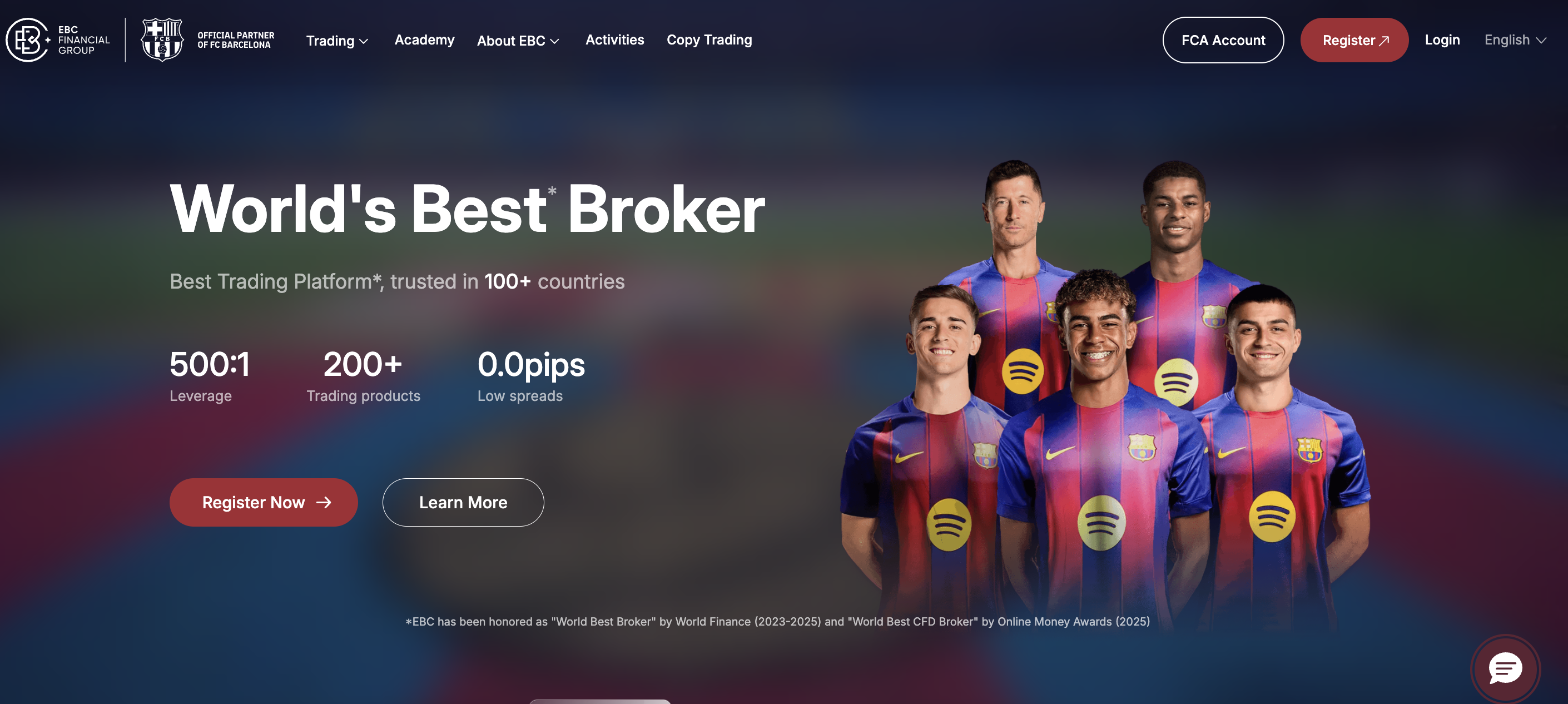
EBC offers access to over 200 CFDs across multiple asset classes on MetaTrader 4 and MetaTrader 5, with leverage up to 1:500 and spreads as low as 0 pips on Professional accounts.
Here is what EBC Financial Group offers on a single platform:
| Asset Class | What You Can Trade |
|---|---|
| Forex | 36+ currency pairs including majors, minors, and exotics |
| Commodities | Gold, silver, WTI crude oil, Brent crude |
| Indices | S&P 500, FTSE 100, DAX, Nikkei, and more |
| Stocks (CFDs) | Apple, Tesla, Amazon, Microsoft, and other blue-chip equities |
| ETFs | Over 90 ETFs covering sectors, bonds, and global themes |
| Cryptocurrencies | Major digital assets as part of a diversified portfolio |
EBC also provides copy trading, a 90-day demo account, 24/7 technical support, an AI-powered economic calendar, and institutional-grade order flow tools.
Risk Warning: CFDs are complex instruments and come with a high risk of losing money rapidly due to leverage. Please ensure you understand the risks involved before trading.
Yes. Indian traders use multi-asset brokers, but regulations vary by product and jurisdiction. It is important to understand regulatory requirements before trading.
Traders seek broader market access, easier diversification, and a more efficient trading experience. A single platform allows them to manage forex, commodities, indices, and equities without multiple accounts.
Most multi-asset brokers offer forex pairs, stocks, commodities, indices, and ETFs. Some also provide access to bonds or other instruments, depending on the broker and jurisdiction.
EBC Financial Group is a strong choice for Indian traders looking for a multi-asset broker. It offers access to forex, stocks, commodities, indices, and ETFs through a single trading ecosystem.
More Indian traders are choosing multi-asset brokers as the market evolves. Participation is deeper, digital habits are stronger, and traders now focus on cross-asset strategies rather than isolated products.
The right multi-asset broker does not just give you more assets to trade. It gives you a smarter, more cost-efficient, and better-protected way to engage with global financial markets, no matter where you are in India.
Disclaimer: This material is for general information purposes only and is not intended as (and should not be considered to be) financial, investment, or other advice on which reliance should be placed. No opinion given in the material constitutes a recommendation by EBC or the author that any particular investment, security, transaction, or investment strategy is suitable for any specific person.



World's Best Broker